
Why Organizations Use Matching Shirts to Build Stronger Teams
July 24, 2026
Why Organizations Use Matching Shirts to Build Stronger Teams
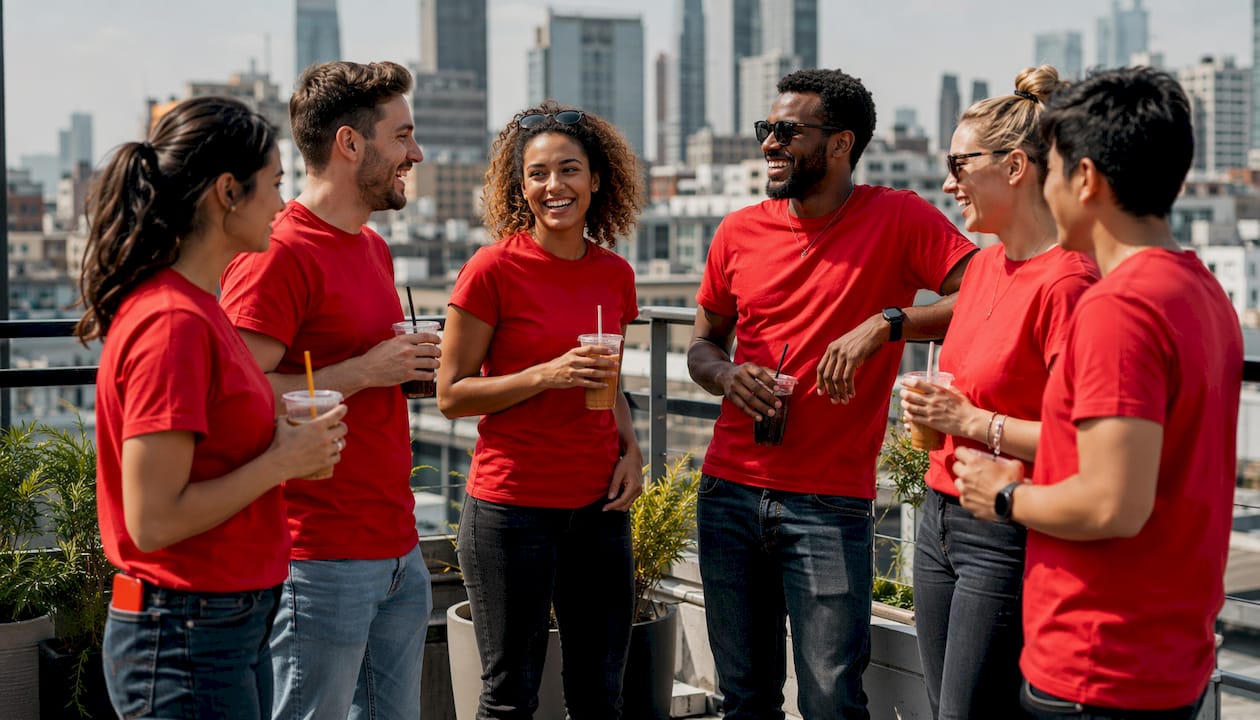
Organizations use matching shirts for one core reason: shared clothing creates shared identity, and shared identity drives better performance. The effect shows up in youth sports programs, corporate sales teams, nonprofit volunteer crews, and everything in between. When people wear the same shirt, individual differences in status and social confidence fade to the background, and the group moves to the front.
Here is what the research and real organizational experience point to:
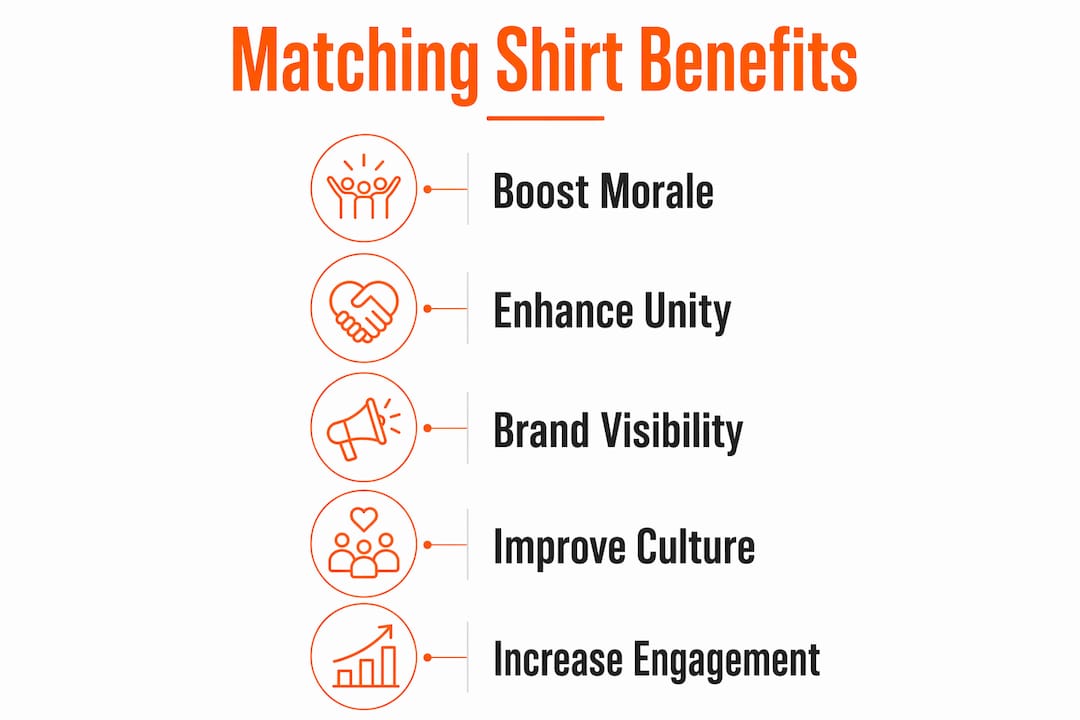
- Matching shirts reduce visible status differences, making it easier for people to collaborate across levels
- Coordinated apparel boosts morale by giving employees a tangible symbol of belonging
- Branded shirts function as mobile advertising, reinforcing company identity at every event and client interaction
- Visual uniformity activates group-oriented thinking, a pattern documented in social identity theory
- Involving employees in the design process creates ownership, which increases daily wear and long-term engagement
These are not soft benefits. They translate into measurable outcomes: higher attendance, stronger retention, and a brand presence that travels wherever your team goes.
Why matching shirts improve employee morale and team unity
The most immediate effect of matching shirts is psychological, not aesthetic. When everyone on a team wears the same shirt, individual markers of status, like a more expensive watch or a designer jacket, become invisible. What remains visible is the group. That shift changes how people interact.

Uniform attire reduces social barriers and promotes accountability in workplace settings. Employees who feel visually connected to their team communicate more freely and coordinate more naturally, especially during high-pressure events or client-facing situations. The shirt becomes a quiet signal: we are in this together.
The effect on participation is concrete. Research on group settings shows that matching apparel reduces dropout rates and improves sustained involvement by creating a shared footing among members. When someone feels like part of a unit, showing up consistently feels less optional. That dynamic applies equally to a sales team preparing for a trade show and a volunteer crew running a community event.
- Morale rises when employees receive something tangible that says the organization invested in them
- Shared attire creates accountability: people represent the group, not just themselves
- New hires integrate faster when they receive matching apparel as part of onboarding
- Remote or seasonal workers feel included when they share a visual identity with the core team
Pro Tip: Roll out matching shirts at the start of a new quarter or project, not just at annual events. Timing the distribution around a fresh goal gives the shirt meaning beyond the fabric.
How matching shirts function as branding and free advertising
Every time an employee wears a branded shirt outside the office, the organization gets exposure it did not pay for in that moment. At a conference, a community event, or even a coffee shop, a consistent logo and color scheme builds recognition. That recognition compounds over time.
Consistent logo and color use builds trust among customers, clients, and partners. A team that arrives at a trade show in matching shirts signals organization and reliability before anyone says a word. Clients read visual cohesion as a proxy for operational competence. It is a fast, nonverbal credibility signal.
Long-term design consistency matters too. Persistent visual identity accumulates prestige and brand recognition over time, which is why organizations that maintain the same color palette and logo placement across multiple seasons or years build stronger recall than those that change their look constantly. The shirt becomes part of the brand story, not just a uniform.
Understanding color psychology in branding is worth the time before you finalize your palette. Color choices carry emotional associations that affect how customers perceive your organization at a glance.
Pro Tip: Place your logo on the left chest for everyday wear and add a larger back print for event shirts. That combination covers both close-up professional interactions and visibility in crowds.
What social identity theory tells us about coordinated apparel
Social identity theory, developed by psychologist Henri Tajfel, explains that people define themselves partly through the groups they belong to. Shared symbols, including clothing, activate that group identity and make cooperative behavior more likely. This is not abstract theory. It plays out every time a team puts on matching shirts for the first time.
Shared symbols like branded colors or slogans activate group identity and cooperation. When visual uniformity makes the group observable to both its own members and outsiders, it triggers the psychological patterns that support collective effort. People stop thinking primarily as individuals and start thinking as part of a unit.
Personalization within that uniformity adds another layer. Personalized apparel evokes an endowment effect, increasing participants’ commitment. A shirt with an employee’s name on it becomes theirs in a way that a generic shirt never does. That sense of ownership translates into higher engagement and more consistent wear.
- Visual uniformity reduces individual status salience, encouraging equality across the team
- Group-oriented thinking increases cooperation and collective accountability
- Personal elements like names or role identifiers deepen individual investment within the group
- Teams with consistent visual identity show stronger cohesion than those without shared markers
The psychology of visual storytelling applies directly here: the symbols and colors you choose for your shirts communicate your organization’s values before anyone reads a word of your mission statement.
How to design matching shirts employees actually want to wear
The biggest mistake organizations make with matching shirts is treating them like a logistical checkbox. A poorly designed shirt gets worn once and lives in a drawer. A well-designed shirt becomes something employees reach for on their own.
Bold, modern designs increase employee willingness to wear matching shirts by making apparel a desirable self-expression tool rather than a mandatory uniform. The goal is a shirt that employees would genuinely choose to wear, not one they tolerate. That distinction drives daily wear compliance, which is where the morale and branding benefits actually accumulate.
Design elements that consistently work:
- Distinct colors: Teams with clearly differentiated colors from others in their industry or league develop stronger in-group identification. Color is the fastest identity signal.
- Meaningful symbols: A logo or graphic that connects to something the team actually values, whether a local reference, a shared mission, or a cultural touchstone, carries more weight than a generic design.
- Player or employee names: Adding names creates individual investment within the group identity. People feel recognized as individuals and as part of the team simultaneously.
- Consistent design across seasons: Organizations that maintain design continuity build visual identity that accumulates recognition over time, rather than starting from zero each year.
Modern printing methods, including Direct-to-Film (DTF) transfers, remove the old barrier of high minimum orders. Small teams can now order personalized, professional-quality shirts with names and numbers at a per-unit cost that fits realistic budgets. You do not need to order 200 shirts to get a great result.
Pro Tip: Give employees two or three color or style options within the same design system. Letting someone choose their preferred cut or colorway increases buy-in without sacrificing visual cohesion.
The practical impact on workplace culture and daily engagement
Matching shirts do something that most culture initiatives cannot: they make the culture visible. A values statement on a wall is easy to ignore. A shirt that represents the team is worn, seen, and felt every time someone puts it on.
Employees wearing matching apparel feel more connected, which improves communication and coordination in day-to-day work. The effect is especially pronounced during onboarding. New employees who receive branded apparel on their first week report feeling part of the team faster than those who do not. The shirt signals inclusion before relationships have had time to develop naturally.
A fintech startup that grew from 30 to 120 employees in under a year used branded hoodies to address a silo problem. After distributing matching hoodies to all employees, including remote workers, the company saw improved morale, organic social sharing with the company hashtag, and HR-reported increases in team cohesion. The shared apparel gave a dispersed team a common visual anchor.
Matching shirts also support role clarity in larger organizations. Management teams in embroidered business shirts and customer-facing staff in bright polos communicate structure without an org chart. Clients and partners read those visual cues instantly, which smooths interactions and sets expectations before a conversation begins.
The custom apparel and brand identity connection runs deeper than most leaders realize. When employees wear clothing that represents shared values, they connect with the organization’s story in a personal, daily way. That connection shows up in retention, in referrals, and in how confidently people represent the brand in public.
Key Takeaways
Matching shirts work because they make group identity visible, and visible identity drives cooperation, morale, and brand recognition simultaneously.
| Point | Details |
|---|---|
| Group identity drives behavior | Shared apparel activates group-oriented thinking, reducing status differences and increasing cooperation. |
| Participation and retention improve | Matching shirts reduce dropout rates and boost sustained involvement in team settings. |
| Branding travels with your team | Consistent logos and colors build public trust and recognition at every event and client interaction. |
| Design determines daily wear | Bold, modern designs with personalization increase willingness to wear shirts beyond mandatory occasions. |
| Jam4apparel delivers the full solution | Jam4apparel produces custom screen-printed and embroidered team shirts with no high minimums, serving organizations across Chicagoland. |
Jam4apparel brings your team’s identity to life
Your team already has an identity. The question is whether it is visible. Jam4apparel specializes in exactly this: turning an organization’s values, colors, and culture into apparel that employees actually want to wear and clients immediately recognize.
Based in Lake in the Hills, Illinois, Jam4apparel handles screen printing, embroidery, and DTF transfers in-house, which means faster turnaround and tighter quality control than outsourced alternatives. Whether you need 12 shirts for a department team-building day or 500 for a company-wide rollout, the production process scales without the per-unit cost penalties that come with traditional minimums.
The corporate apparel options cover everything from embroidered polos for client-facing staff to bold screen-printed event tees that double as walking advertisements. Every order includes design support, so you are not starting from a blank page. Jam4apparel works with small businesses, nonprofits, schools, and growing brands throughout the Chicagoland area, and the same attention to detail applies whether the order is 15 pieces or 1,500.
Ready to put your team’s identity on a shirt worth wearing? Browse custom apparel by industry or reach out to Jam4apparel directly to get a quote for your next order.
Recommended
Ready to print your design?
Screen print, embroidery, and DTF — no minimums on many styles.