Why Organizations Pre-Order Apparel: Benefits and Strategy
July 15, 2026

Why Organizations Pre-Order Apparel: Benefits and Strategy
Pre-ordering apparel is defined as the practice of collecting orders and payments from members or customers before production begins. Organizations and teams that understand why organizations pre-order apparel gain a clear edge in managing budgets, reducing waste, and delivering branded gear that actually fits demand. Independent brands using pre-order models grow 40–60% faster than inventory-led peers in their first two years. That growth gap reflects a structural advantage, not luck. Pre-ordering shifts the entire procurement model from guesswork to confirmed data, and the benefits reach far beyond simple inventory control.
Why organizations pre-order apparel: the core advantages
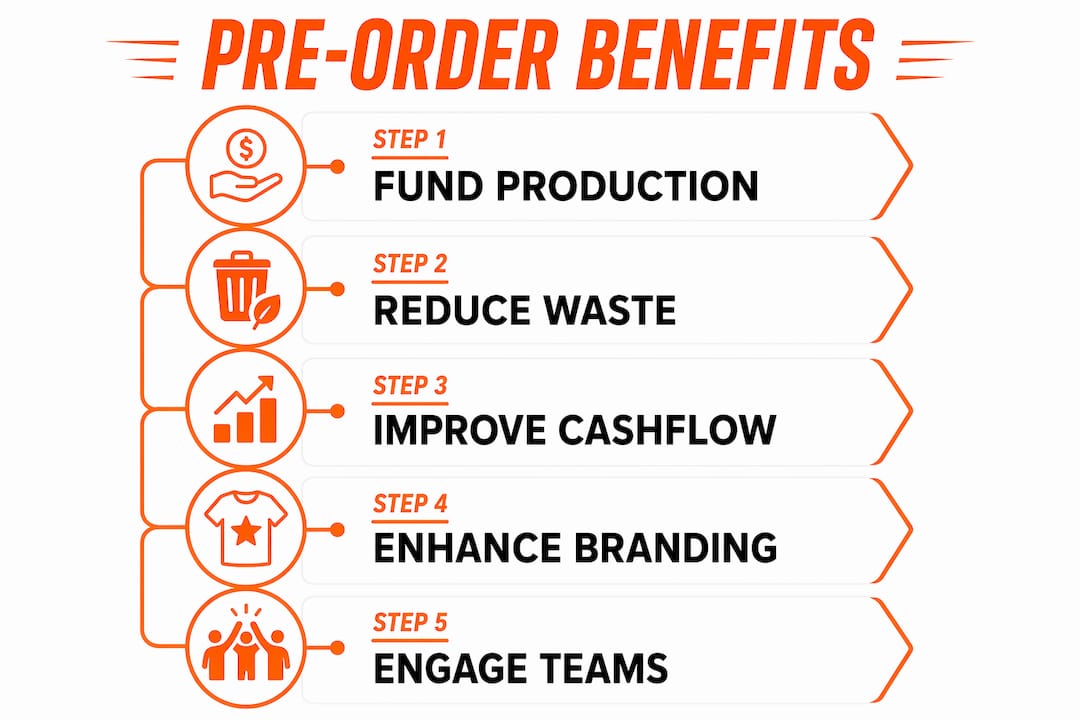
Pre-ordering apparel delivers six distinct advantages that directly affect how organizations plan, spend, and brand themselves.
Demand forecasting becomes exact. When teams submit orders before production starts, the organization knows precisely how many units to produce in each size and color. There is no estimating, no padding the order “just in case,” and no leftover stock sitting in a storage room after the season ends.
Inventory risk drops to near zero. Pre-orders reduce overstock risk by producing only what is already sold. That means no markdowns, no write-offs, and no wasted budget on apparel nobody wanted.
- Cash flow improves immediately. Customer payments arrive before the production invoice is due, which means the organization funds manufacturing with collected revenue rather than working capital.
- Exclusivity drives commitment. Limited-time pre-order windows create urgency and a sense of belonging. Teams feel more invested in apparel they actively chose and committed to early.
- Sustainability improves. Producing only confirmed orders eliminates deadstock. For nonprofits, schools, and sports teams, that reduction in waste also strengthens the organization’s public image.
- Product decisions get smarter. Early order data tells you which styles, colors, and fits your team actually wants. That live market feedback guides future apparel decisions far better than internal guessing.
Pro Tip: Run a short pre-order window of two to three weeks before finalizing your design. The response rate tells you whether a design has real buy-in or just polite interest.
Pre-ordering also shifts apparel buying from impulsive purchasing to intentional selection, which deepens team engagement with the final product. Members who chose their gear feel ownership over it. That psychological shift matters for team cohesion and brand pride.

How does pre-ordering apparel affect cash flow and financial planning?
The biggest financial benefit of pre-ordering is that it inverts the traditional cash flow cycle. In a standard buy-to-stock model, an organization pays for apparel upfront, holds inventory, and recoups costs later. Pre-ordering reverses that sequence entirely.
Customer payments arrive first. Production costs are paid second. The result is that net working capital requirements shrink, and in well-run campaigns, the organization operates with a negative cash conversion cycle. That means the organization collects money before it spends money.
| Model | Cash timing | Inventory exposure | Financial risk |
|---|---|---|---|
| Buy-to-stock | Pay before selling | High, unsold units possible | High, capital tied up in stock |
| Pre-order | Collect before producing | Near zero, produce to order | Low, production funded by sales |
The table above shows why finance-conscious organizations favor pre-ordering for large apparel runs. The reduction in working capital requirements frees budget for other priorities, whether that is event costs, equipment, or program expansion.
One real tradeoff exists. If production delays occur, the organization holds customer funds without delivering product. That creates a “cash trap” where fulfillment delays damage customer trust and trigger refund requests. Managing this risk requires strict operational controls, which the next section covers in detail.
Pro Tip: Build a 10–15 day buffer into your stated delivery window. Communicating a slightly longer timeline and delivering early builds far more trust than promising fast and missing the date.
Understanding turnaround time for custom apparel before launching a pre-order campaign prevents the most common cash flow problems. Production schedules, decoration methods, and shipping logistics all affect when orders actually ship.
What operational strategies ensure a successful apparel pre-order?
Running a pre-order campaign without a clear process leads to delays, confusion, and refund requests. The following steps give organizations a repeatable framework.
- Set a firm pre-order window. Fulfillment windows of 30–90 days are standard in apparel. Communicate the exact open and close dates before accepting a single order.
- Confirm samples before launch. Never open a pre-order on a design that has not been physically reviewed. A sample review catches sizing issues, color mismatches, and decoration quality problems before they affect hundreds of units.
- Cap the order window. A defined close date creates urgency and gives your production partner a confirmed quantity. Open-ended pre-orders create scheduling chaos for both the organization and the decorator.
- Send weekly updates to buyers. Transparent communication about ship dates reduces cancellations and builds trust. A brief weekly status message costs almost nothing and prevents most refund requests.
- Coordinate payment processing and manufacturing together. Confirm that payment collection, production scheduling, and shipping logistics are aligned before the campaign opens. Gaps between these three functions cause the majority of pre-order failures.
- Use marketing to build excitement before the window opens. A preview of the design, a countdown, or a member-only early access period all increase conversion rates when the pre-order goes live.
Operational discipline with capped ordering windows and regular buyer updates is the single most effective way to prevent trust crises. Organizations that skip this step often face a flood of cancellation requests right before their production deadline.
Pro Tip: Pair your pre-order campaign with a free art proof review so members can see exactly what they are ordering. Jam4apparel provides a free art proof on every order, which removes the guesswork for buyers and reduces post-order complaints.
One underused tactic is blending pre-order with a small stock buy for core items. Combining buy-to-stock and pre-order strategies lets organizations keep a handful of popular sizes on hand for immediate needs while testing new designs through pre-order. That hybrid approach protects conversion rates without sacrificing the financial benefits of ordering to demand.
How do pre-orders support organizational branding and team engagement?
Pre-ordering does more than manage inventory. It actively strengthens brand identity and team culture when run well.
Pre-order campaigns create exclusivity and community around an apparel release. When members know a design is only available for a limited window, they treat it as something worth having rather than a generic uniform. That perception shift directly affects how they wear and represent the brand.
Organizations also benefit from demand validation that reflects real member preferences. When a design receives strong pre-order numbers, the organization knows it resonates. When numbers are low, the organization can adjust the design or colorway before committing to full production. That feedback loop is one of the most underrated advantages of ordering apparel early.
- Team involvement increases satisfaction. Members who participate in selecting styles and colors feel heard. That sense of input translates into higher wear rates and stronger brand visibility in the field.
- Sustainability becomes a brand asset. Producing only what is ordered means zero deadstock. For schools, nonprofits, and community organizations, that commitment to reducing waste is worth communicating publicly.
- Branding consistency improves. Pre-orders give decoration teams a single confirmed order to work from, which reduces the variation that comes from multiple small reorders over time.
Understanding why custom apparel builds brand identity helps organizations connect pre-order decisions to long-term brand strategy. Apparel is not just clothing. It is a visible, wearable signal of organizational values and team unity.
Key Takeaways
Pre-ordering apparel works because it aligns production with confirmed demand, funds manufacturing through collected payments, and reduces both inventory risk and wasted budget for organizations of any size.
| Point | Details |
|---|---|
| Demand drives production | Pre-orders eliminate guesswork by producing only confirmed quantities in exact sizes and colors. |
| Cash flow improves structurally | Customer payments arrive before production costs, reducing working capital requirements significantly. |
| Operational discipline is non-negotiable | Capped windows, sample reviews, and weekly updates prevent delays and protect member trust. |
| Exclusivity builds engagement | Limited-time pre-order windows increase team commitment and improve wear rates after delivery. |
| Hybrid models reduce risk | Blending pre-order with small stock buys protects conversion while testing new designs safely. |
What I’ve learned from watching organizations run apparel pre-orders
Most organizations treat a pre-order campaign as an inventory tool. The ones that get the most out of it treat it as a demand validation engine first and an inventory tool second.
The financial leverage is real. Collecting payment before production starts is a genuine structural advantage, especially for nonprofits and school programs operating on tight budgets. But that advantage evaporates the moment a production delay hits and the organization has no communication plan. I have seen well-designed campaigns collapse into refund requests simply because nobody sent a status update for three weeks.
The organizations that run pre-orders well share one habit: they over-communicate. They send updates before members ask for them. They set delivery windows with a buffer built in. They treat the pre-order period as a relationship-building exercise, not just a transaction.
My honest recommendation is to blend pre-order and stock for your first campaign. Keep a small quantity of your most popular core item in stock for immediate needs, and run the pre-order on your new or seasonal design. That approach lets you test the process without putting your entire apparel program at risk. Once your team is comfortable with the workflow, you can shift more volume to pre-order and capture the full financial benefit.
Pre-ordering is not a shortcut. It is a discipline. Organizations that treat it that way consistently get better apparel, stronger team buy-in, and healthier budgets.
— Adam
Jam4apparel supports your organization’s apparel pre-order needs
Organizations running pre-order campaigns need a production partner that can meet confirmed timelines and deliver consistent quality across large runs.
Jam4apparel specializes in custom screen printing and embroidery for corporate teams, schools, sports programs, nonprofits, and events throughout the Chicagoland area. In-house production means faster turnaround times and direct quality control on every order. Whether your organization needs 24 pieces or 2,400, Jam4apparel handles the decoration, sizing, and fulfillment coordination that makes pre-order campaigns run smoothly. Visit the custom apparel by industry page to find solutions built for your specific organizational needs and request a quote.
FAQ
What does pre-ordering apparel mean for an organization?
Pre-ordering apparel means collecting member orders and payments before production begins. The organization then produces only the confirmed quantity, eliminating overstock and reducing financial risk.
How long does a typical apparel pre-order take to fulfill?
Standard apparel pre-order fulfillment windows run 30–90 days from order close to shipment. Building a buffer into your stated timeline reduces the risk of missing delivery expectations.
How does pre-ordering improve an organization’s cash flow?
Pre-orders collect customer payments before production costs are due, which means manufacturing is funded by sales revenue rather than working capital. This inverts the traditional cash conversion cycle and reduces financial exposure.
What is the biggest risk in running an apparel pre-order?
The main risk is a production delay that leaves the organization holding customer funds without a delivery date. Strict operational controls, capped order windows, and weekly status updates prevent most trust-related problems.
Can organizations use pre-ordering for employee uniforms and team apparel?
Pre-ordering works well for employee uniform programs and team apparel because it aligns production with confirmed headcounts and eliminates the cost of ordering excess sizes that go unused.
Recommended
Ready to print your design?
Screen print, embroidery, and DTF — no minimums on many styles.