Minimum Order Quantity (MOQ): Definition, Formula & Tips
July 30, 2026

Minimum Order Quantity (MOQ): Definition, Formula & Tips
Minimum order quantity (MOQ) is the smallest number of units or dollar value a supplier will accept in a single order. MOQs protect supplier margins by covering fixed setup and production costs, but they are negotiation starting points, not fixed rules. Buyers who understand how MOQs are built can often reduce them or work around them entirely.
The term appears constantly in wholesale quotes, manufacturing contracts, and custom apparel orders. Whether you’re sourcing blank tees for a school fundraiser or placing a production run with an overseas factory, the MOQ is the first number that determines whether a deal is viable. Tools like NetSuite’s inventory planning modules and platforms like Shopify both treat MOQ as a foundational procurement metric, distinct from the buyer-side metric known as Economic Order Quantity (EOQ).
Table of Contents
- What minimum order quantity actually means for buyers
- Why suppliers set MOQs in the first place
- How MOQ affects your inventory, cash flow, and ordering cadence
- Benefits of MOQs for both sides of the transaction
- Common types of MOQ you’ll encounter in quotes and contracts
- What actually determines a supplier’s MOQ
- How to calculate MOQ: formula and a worked example
- What to do when a supplier’s MOQ is higher than you need
- MOQ vs. EOQ: what’s the difference and what to do when they conflict
- Common mistakes businesses make with MOQs
- How MOQ works in practice: a Jam4apparel custom-apparel example
- Key Takeaways
- MOQs are negotiable — most buyers just don’t treat them that way
- Custom apparel orders without the MOQ guesswork
- Useful sources and further reading
What minimum order quantity actually means for buyers
Minimum order quantity is a supplier-imposed rule, not a buyer optimization. That distinction matters because it tells you who controls the number and why it exists.
Unit-based MOQ is the most common form. A supplier states a flat count: 50 shirts, 200 pens, 1,000 labels. You cannot order fewer, period. Value-based MOQ sets a dollar floor instead. Per NetSuite, a supplier may require 100 units or a $10,000 minimum order value — either is a legitimate MOQ expression. Both types serve the same purpose: guaranteeing the supplier earns enough on the transaction to cover their costs.
Two quick examples make this concrete:
- Apparel scenario: A screen printer requires a minimum of 24 shirts per color design. You want 10 shirts in one color and 10 in another. That’s two separate setups, so you need 24 of each, or 48 total, to meet the MOQ.
- Manufacturing scenario: A packaging supplier sets a $5,000 minimum order value. You can mix SKUs to reach that threshold, but the invoice must hit $5,000 before they’ll process the order.
MOQ differs from EOQ in a fundamental way. EOQ (Economic Order Quantity) is a formula buyers use to find the order size that minimizes their own holding and ordering costs. MOQ is what the supplier demands. The two numbers often conflict, and when they do, the buyer has to decide whether to negotiate, find a workaround, or accept the mismatch.
Why suppliers set MOQs in the first place
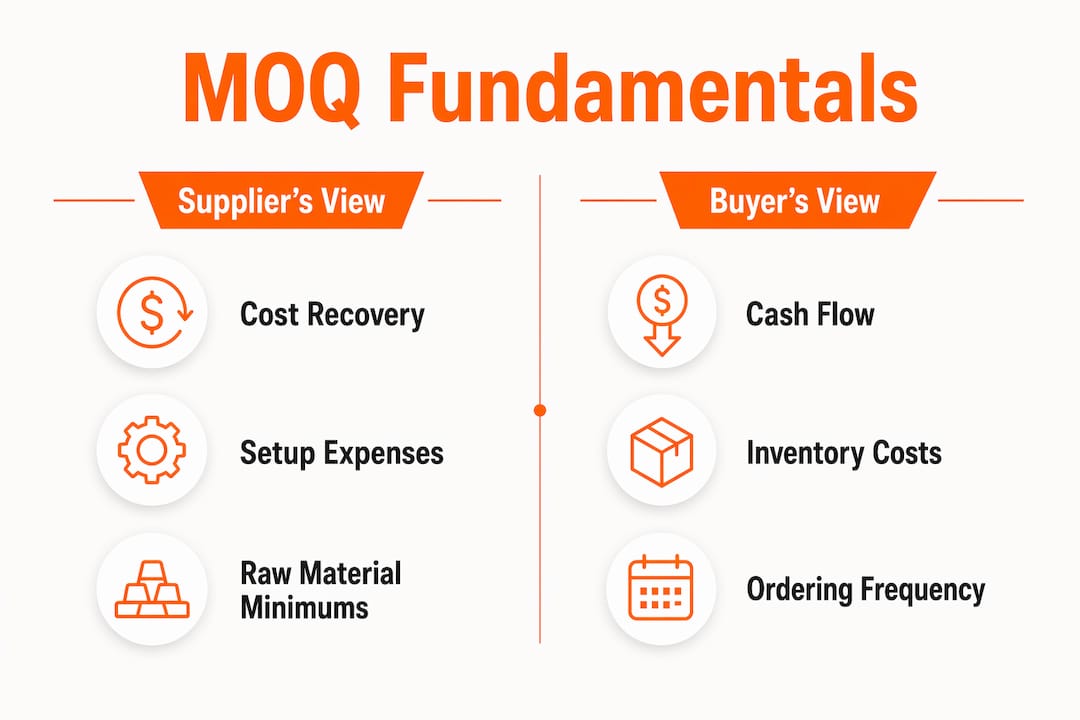
Every MOQ traces back to a cost the supplier is trying to recover. Understanding those costs is the fastest path to a productive negotiation.
Setup costs are usually the biggest driver. A screen printer burns a screen for every color in your design. An injection molder builds a tool or die. A cut-and-sew factory sets up a production line. None of those activities are free, and they happen before a single unit ships. The supplier needs enough units in the run to spread that fixed cost across a price that still leaves margin.

Raw-material minimums compound the problem. Suppliers often face their own MOQs from the mills, dye houses, or component vendors upstream. If a fabric mill won’t sell fewer than 500 yards, the garment maker can’t offer you a 10-piece run without absorbing the cost of 490 unused yards.
Packaging, labeling, and administrative overhead add up too. Processing a 10-unit order takes nearly as much paperwork as a 500-unit order. MOQs help wholesalers and distributors protect margins and filter out buyers whose orders cost more to process than they generate in profit.
Pro Tip: The fastest way to get a supplier to lower their MOQ is to reduce their uncertainty. Share a 6-month purchase forecast, offer a partial prepayment, or commit to a second run within 90 days. Suppliers set high MOQs partly to deter low-commitment buyers, so demonstrating you’re a long-term partner often moves the number more than any other tactic.
How MOQ affects your inventory, cash flow, and ordering cadence
Accepting an MOQ you don’t genuinely need creates a chain of downstream costs that buyers routinely underestimate.
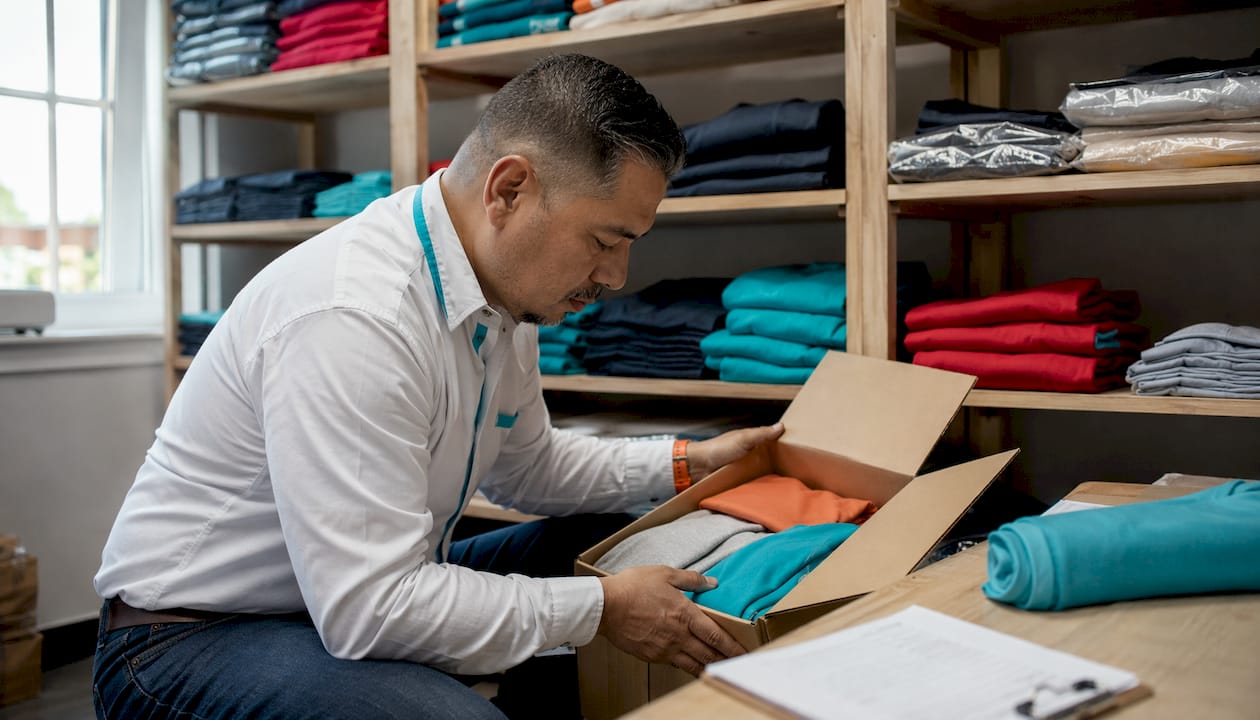
The most immediate hit is cash. If a supplier’s MOQ requires ordering a substantial number of units at a given unit price, you’re committing significant capital before you’ve sold a single piece. That capital is locked in inventory, unavailable for marketing, payroll, or the next product. For a small retailer or a startup, that’s a real constraint, not a theoretical one.
Storage follows. Five hundred units need space, and space costs money whether you’re renting a warehouse or stacking boxes in a back room. Slow-moving inventory also accumulates risk: styles change, seasons end, and products get discontinued. A unit that sat for eight months may need to be marked down or written off entirely.
On the flip side, ordering at exactly your MOQ every time can mean ordering more frequently, which drives up shipping and administrative costs. Lower MOQs often lead to higher per-unit costs and more frequent shipments, eroding the margin savings buyers thought they were capturing.
Consider a small retailer presented with a high MOQ on a seasonal product. At their normal sell-through rate, they may be carrying inventory for multiple months or seasons. The reorder frequency drops to once a year, which sounds efficient, but the storage cost, obsolescence risk, and capital tied up for 10 months may cost more than the per-unit savings justify.
Benefits of MOQs for both sides of the transaction
MOQs are often framed as a supplier’s tool, but buyers who work with them strategically gain real advantages too.
For suppliers:
- Predictable production runs that reduce scheduling complexity and machine downtime
- Lower per-unit handling and packaging costs spread across larger batches
- Protected margins that make each transaction worth fulfilling
- A natural filter that attracts serious, committed buyers over one-time tire-kickers
For buyers:
- Access to lower per-unit pricing, since suppliers pass on some of the efficiency gains from larger runs
- More predictable lead times, because the supplier can schedule your order into a planned production cycle
- Supply security, particularly for custom items where re-setup costs make small reorders impractical
- Stronger supplier relationships, since hitting MOQs consistently signals you’re a reliable account
The trade-off evaluation is straightforward: if the per-unit savings from meeting an MOQ exceed the combined cost of storage, capital tie-up, and obsolescence risk, the MOQ is worth meeting. If they don’t, it’s worth negotiating or sourcing differently. Shopify’s procurement guidance notes that setting MOQs too high can push away promising smaller customers, so suppliers have their own incentive to find a workable number.
Common types of MOQ you’ll encounter in quotes and contracts
MOQ isn’t one-size-fits-all. The form it takes depends on the industry, the product, and how the supplier’s costs are structured.
Per-unit or per-SKU MOQ is the baseline. You need X units of a specific product. Simple, common, and easy to calculate against your demand.
Value-based MOQ sets a dollar floor rather than a unit count. This is common in wholesale distribution, where a supplier carries hundreds of SKUs and doesn’t care which ones you buy, as long as the invoice hits their minimum.
Per-color or per-size MOQ shows up constantly in apparel. Apparel suppliers frequently set minimums by color or size because each variant requires a separate setup or inventory lot. A screen printer might require 24 pieces per color, meaning a two-color design in two sizes could require 96 pieces minimum.
Lot or batch MOQ applies when production runs in fixed increments. A manufacturer might run in batches of 500 because that’s how their equipment is configured. You can order 500 or 1,000, but not 750.
Time-window MOQ is less common but worth knowing. Some suppliers require a minimum purchase volume per quarter or per year rather than per order. Miss the window and you lose preferred pricing or your account status.
For custom apparel specifically, the decoration method drives the MOQ type. Screen printing typically carries per-color, per-design minimums because screen setup is the fixed cost. Embroidery minimums often relate to the digitizing fee and machine setup time. DTF transfers can have lower per-design minimums because there’s no physical screen to burn.
What actually determines a supplier’s MOQ
Knowing which cost driver dominates in your product category tells you exactly which negotiation lever to pull.
Setup and tooling costs are the primary driver in most manufacturing and decorated-apparel contexts. The higher the setup cost relative to the per-unit margin, the higher the MOQ needs to be for the supplier to break even.
Minimum raw-material purchases cascade from upstream suppliers. A garment maker who must buy fabric in 200-yard minimums can’t offer you a 10-piece run without absorbing the rest of that fabric cost. Understanding this constraint helps you negotiate more effectively, because the supplier isn’t being arbitrary.
Labor intensity matters in hand-finished or highly customized products. Each unit requires significant touch time, which makes small runs disproportionately expensive per unit.
Packaging and lot sizing add fixed costs per shipment regardless of quantity. A supplier who boxes product in standard lots of 12 or 24 will structure their MOQ around those increments.
Lead time constraints also play a role. A supplier running a 6-week production cycle won’t schedule a run for 10 units when they could fill that slot with a 500-unit order from another buyer.
In apparel, setup cost dominates. In electronics, component MOQs from chip manufacturers cascade down. In commodity goods like paper or plastic, raw-material minimums and shipping economics drive the number. Knowing which factor dominates in your category tells you whether to negotiate on volume commitment, payment terms, or production scheduling.
How to calculate MOQ: formula and a worked example
There’s no single universal formula, but the most practical approach builds the MOQ from fixed costs and per-unit margin contribution.
The core formula:
This gives you the minimum number of units needed for the supplier to recover their setup costs at their target margin. Buyers can use the same formula to evaluate whether a supplier’s stated MOQ is reasonable.
Required inputs:
- Fixed setup cost (screen fees, tooling, digitizing, etc.)
- Variable cost per unit (materials, labor, packaging)
- Selling price per unit (or target wholesale price)
- Shipping and handling per unit (optional but useful for total landed cost)
Worked example:
| Input | Value |
|---|---|
| Screen setup cost (2 colors) | $80 |
| Margin contribution per unit | $7.00 |
| Calculated MOQ | 12 shirts |
MOQ = $80 ÷ $7.00 = 11.4 → rounded up to 12 shirts
In practice, most suppliers add a buffer for shipping minimums and administrative overhead, which is why real-world MOQs tend to land at round numbers like 24, 48, or 100. The formula gives you the floor; the supplier’s stated MOQ includes that buffer. If their MOQ is 48 and your calculation shows 12, you have a legitimate basis for negotiation.
Pro Tip: Always calculate total landed cost, not just unit price. A supplier offering a 24-piece MOQ at $14 per shirt may cost more than one requiring 48 pieces at $9 per shirt once you factor in two separate shipping charges and the administrative time for two orders.
What to do when a supplier’s MOQ is higher than you need
A supplier’s stated MOQ is a starting point. Suppliers often set high MOQs to filter out low-commitment buyers, and they’ll reduce them for buyers who demonstrate reliability or reduce uncertainty.
Negotiation checklist:
- Present a purchase forecast. Show the supplier your projected volume for the next 6–12 months. A credible growth plan is often enough to unlock a lower MOQ for the first order.
- Request tiered pricing. Ask for a price break structure: 24 units at price A, 48 at price B, 96 at price C. This gives you flexibility and shows you intend to scale.
- Offer a longer lead time. Suppliers can fit smaller runs into their schedule more easily when they have extra time. Giving up speed often buys you a lower minimum.
- Bundle SKUs. If you need three different designs, combine them into one order to hit the threshold. The supplier gets the volume they need; you get the variety you want.
- Propose partial prepayment. Paying 50% upfront reduces the supplier’s risk and signals commitment. Many suppliers will lower MOQs in exchange.
- Ask to split a production run. Some suppliers will run a larger batch and hold your portion for staggered delivery, letting you pay in installments as you sell through.
Operational workarounds when negotiation isn’t enough:
- Split the order with another buyer in your network who needs the same product
- Pre-sell the order before placing it, using deposits to fund the MOQ
- Use a fulfillment partner or buying group that aggregates orders from multiple small buyers
- Schedule staggered deliveries to spread cash outlay across multiple months
Pro Tip: The concessions that move suppliers fastest are the ones that reduce their risk: prepayment, forecasts, and longer lead times. Asking for a lower price while offering nothing in return rarely works. Lead with what you’re giving, then make the ask.
For organizations that order apparel repeatedly, pre-order strategies can solve the MOQ problem structurally by aggregating demand before the order is placed.
MOQ vs. EOQ: what’s the difference and what to do when they conflict
These two metrics measure different things and serve different masters.
MOQ (Minimum Order Quantity) is set by the supplier. It’s the floor below which they won’t process an order. It exists to protect their costs and margins.
EOQ (Economic Order Quantity) is calculated by the buyer. It’s the order size that minimizes the total of ordering costs and holding costs. The classic EOQ formula is:
EOQ tells you the mathematically optimal reorder quantity for your business. MOQ tells you what the supplier will accept. When EOQ is higher than MOQ, you’re in good shape: order at your EOQ and everyone wins. When MOQ exceeds EOQ, you’re forced to hold more inventory than is optimal, which increases your holding costs and ties up capital.
Monitoring the gap between EOQ and MOQ is worth doing regularly. A sustained mismatch signals one of four things: renegotiate the MOQ, consolidate SKUs to reach the threshold more efficiently, source from an alternate supplier with a lower minimum, or accept the higher inventory with a clear-eyed calculation of the carrying cost. Accepting it blindly is the mistake; accepting it with a calculated rationale is a business decision.
For buyers managing reorder timing and branded apparel, the EOQ-MOQ gap is one of the first numbers worth pinning down before placing a repeat order.
Common mistakes businesses make with MOQs
Most MOQ mistakes come from focusing on the wrong number.
- Fixating on per-unit price instead of total landed cost. A lower per-unit price at a higher MOQ can cost more overall once storage, capital cost, and obsolescence risk are included.
- Ignoring carrying costs. Inventory sitting in a warehouse isn’t free. Rent, insurance, shrinkage, and the opportunity cost of tied-up capital all add to the real cost of meeting a high MOQ.
- Underestimating obsolescence risk. Seasonal products, trend-sensitive items, and anything with a shelf life can become worthless before you sell through a large MOQ. Custom apparel with last year’s event date is a perfect example.
- Failing to forecast seasonality. Ordering 500 units of a summer product in June means you’ll be carrying most of them through winter. The MOQ math looks fine in isolation; the timing makes it a cash flow problem.
- Accepting MOQs without reading the fine print. Per-color, per-size, and per-SKU minimums can multiply quickly. A quote that looks like a 24-piece minimum can become a 96-piece requirement once you account for two colors and two sizes.
- Chasing low MOQs without checking the per-unit cost. A supplier offering a 12-piece minimum is often charging a premium per unit that wipes out the flexibility benefit.
The guardrail is simple: before accepting any MOQ, calculate total landed cost per unit (unit price + setup amortized over the run + shipping + storage for the expected sell-through period) and compare it to your selling price. If the margin holds, the MOQ is acceptable. If it doesn’t, negotiate or walk.
For a deeper look at ordering pitfalls specific to custom apparel, Jam4apparel’s guide on common custom apparel ordering mistakes covers the most expensive errors buyers make.
How MOQ works in practice: a Jam4apparel custom-apparel example
Custom apparel is one of the clearest real-world contexts for understanding MOQ mechanics, because every decoration method has a distinct cost structure that drives a specific minimum.
Screen printing at Jam4apparel carries a per-color, per-design setup cost. Each color in your artwork requires a separate screen. A two-color front print means two screens, and those setup costs need to be spread across enough units to keep the per-shirt price reasonable. The practical result is a minimum quantity per design, typically structured so the setup cost represents a small fraction of the total order value.
Embroidery works differently. The fixed cost is the digitizing fee, which converts your artwork into a stitch file. That fee is a one-time cost per design, so the MOQ logic is similar: enough pieces to amortize the digitizing cost at a price that makes sense for the buyer. Jam4apparel’s embroidery service handles everything from polos to hats, and the minimums reflect the decoration complexity rather than an arbitrary threshold.
DTF (Direct-to-Film) transfers have a lower setup cost than screen printing, which means lower practical minimums. This makes DTF a strong option for buyers who need a small run of a complex, multi-color design.
A sample order walkthrough:
- A youth sports organization needs 30 jerseys with a two-color front logo and player numbers on the back.
- They send Jam4apparel their artwork file, size breakdown (youth S through XL), and delivery window.
- Jam4apparel provides a quote that includes: garment cost per unit, screen setup per color, printing cost per unit, and total order cost.
- The organization reviews the quote, confirms the size run, and approves the digital proof before production begins.
- Finished jerseys ship within the agreed lead time, with no surprise minimums because the size and color requirements were confirmed upfront.
The key to a fast, accurate quote is specificity: exact quantities by size, number of colors in the artwork, decoration locations, and your delivery deadline. Vague requests produce vague quotes. Jam4apparel’s small business guide to minimum order custom apparel walks through exactly what to prepare before reaching out.
Key Takeaways
MOQ is a supplier-set floor that protects production economics, but buyers who calculate total landed cost and negotiate with forecasts and volume commitments can almost always find a workable number.
| Point | Details |
|---|---|
| MOQ definition | The smallest unit count or dollar value a supplier will accept in one order. |
| Calculation formula | MOQ = Fixed Setup Cost ÷ (Selling Price per Unit − Variable Cost per Unit). |
| Negotiation leverage | Forecasts, prepayment, longer lead times, and SKU bundling move MOQs faster than price arguments. |
| Hidden cost risk | Lower MOQs often mean higher per-unit cost and more frequent shipping; always calculate total landed cost. |
| Jam4apparel | Offers screen printing, embroidery, and DTF with transparent setup costs and in-house production for fast, flexible custom apparel orders. |
MOQs are negotiable — most buyers just don’t treat them that way
The conventional wisdom treats MOQ as a gate: you either clear it or you don’t. That framing leaves money on the table.
Every MOQ is built from a cost structure, and cost structures have levers. When a supplier quotes you a 500-unit minimum, they’re not reading from a sacred text. They’re telling you the number that makes the order worth their time at their current margin target. Change one variable and the number changes. Offer a forecast and they see a longer relationship. Prepay half and they see reduced risk. Bundle two SKUs and they see a run that fills their production slot. Any of those moves can shift the MOQ without a single argument about price.
The buyers who get the best terms aren’t the ones who push hardest. They’re the ones who understand the supplier’s cost problem well enough to solve it for them. That’s a different conversation entirely, and it’s one worth having before you walk away from a supplier whose product is genuinely right for your business.
For custom apparel specifically, in-house production control matters more than most buyers realize. A supplier who runs their own screens and embroidery machines can make scheduling decisions that an outsourced operation can’t. That’s where flexibility actually lives.
Custom apparel orders without the MOQ guesswork
Figuring out whether a supplier’s minimum works for your budget and timeline shouldn’t require a spreadsheet and three rounds of back-and-forth. Jam4apparel handles custom screen printing, embroidery, and DTF transfers in-house at its Lake in the Hills, Illinois facility, which means setup costs, minimums, and lead times are transparent from the first quote.

Whether you need 24 shirts for a team or 500 pieces for a company event, Jam4apparel structures orders around what you actually need, not a one-size-fits-all threshold. For organizations with recurring needs, employee uniform programs and spirit wear stores let you aggregate demand across your group so MOQs become a non-issue.
To get a fast, accurate quote, send: your quantity by size, the number of colors in your artwork, decoration locations (front, back, sleeve), your artwork file (AI, EPS, or high-res PNG), and your delivery deadline. Jam4apparel provides a free digital proof before production starts. Request a quote and get your order moving today.
Useful sources and further reading
These are the primary sources used throughout this article, organized by what each one covers best.
- Shopify: Minimum Order Quantity (MOQ) Definition and Negotiation Tactics — Strong on the supplier psychology behind MOQs and practical negotiation tactics for buyers. Good starting point for anyone new to procurement.
- NetSuite: Minimum Order Quantity (MOQ) Formula, Tips & Benefits — The most detailed treatment of MOQ calculation, cascading supply-chain constraints, and the hidden costs of chasing low minimums.
- QuickBooks: Minimum Order Quantity (MOQ) — Focused on the distributor and wholesaler perspective; useful for buyers sourcing through distribution channels.
- Sortly: What Is Minimum Order Quantity (MOQ)? — Concise glossary-style entry with good coverage of per-color and per-SKU MOQ variants common in apparel.
- Jam4apparel: Minimum Order Custom Apparel — A Small Business Guide — Brand-specific guidance on navigating apparel MOQs, including what to send for a quote and how to structure orders for small organizations.
- Cambridge Business English Dictionary: Minimum Order Quantity — Authoritative definition for readers who want a formal, dictionary-level reference.
Recommended
Ready to print your design?
Screen print, embroidery, and DTF — no minimums on many styles.