
What Is Fulfillment in Apparel? A Practical Guide
July 27, 2026
What Is Fulfillment in Apparel? A Practical Guide
Apparel fulfillment is the end-to-end logistics process of receiving, storing, picking, packing, shipping, and managing returns for clothing and accessories. For custom-branded apparel specifically, it also governs how your product looks when it arrives — folded correctly, protected, and on-brand. Jam4apparel treats fulfillment as part of the brand experience itself, not an afterthought.
Table of Contents
- What does the apparel fulfillment process look like, step by step?
- How does apparel fulfillment differ from general retail fulfillment?
- Why good apparel fulfillment is a brand and growth lever
- What do turnaround times and costs actually depend on?
- How do you choose between in-house fulfillment and a third-party partner?
- How Jam4apparel approaches apparel fulfillment
- Key Takeaways
- The part most brands underestimate about apparel fulfillment
- Jam4apparel handles custom apparel from production through delivery
- Further reading and industry references
What does the apparel fulfillment process look like, step by step?
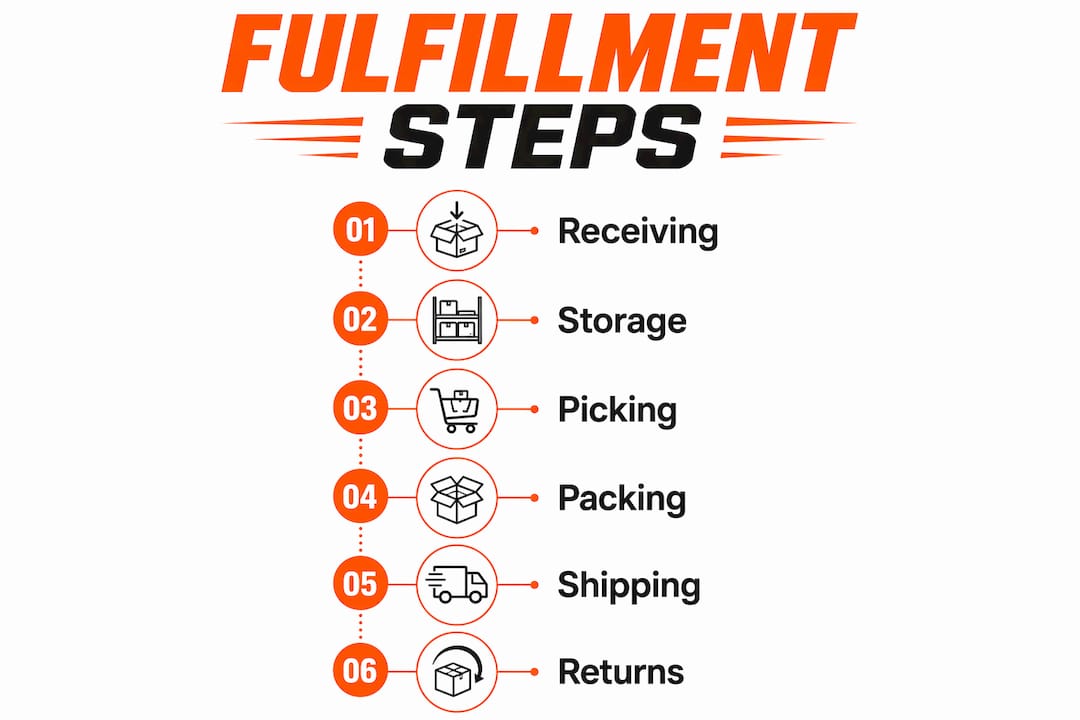
The five core steps of apparel fulfillment are consistent across providers, but the quality of execution at each stage varies enormously.
- Inbound receiving. When inventory arrives, staff verify it against an advance shipping notice (ASN) or purchase order, log each SKU, and inspect for quality issues. A missed defect here becomes a customer complaint later.
- Storage. Apparel requires specialized storage areas — climate-controlled sections, dedicated Garment-On-Hanger (GOH) systems for hanging items, and pick-zone design that groups fast-moving SKUs near packing stations.
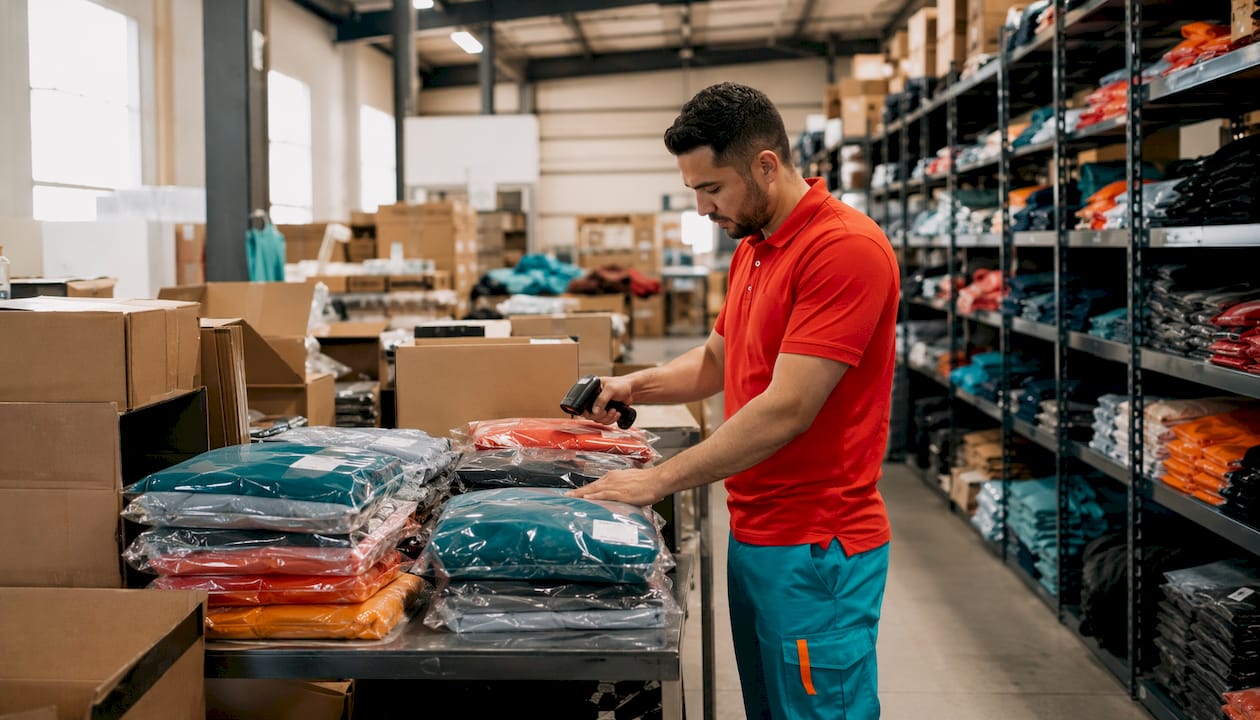
- Picking and packing. This is where brand standards live or die. Branded SOPs cover folding method, poly-bagging, hang-tag preservation, tissue inserts, and ticketing. A provider without documented apparel packing standards will default to whatever is fastest, not whatever protects your brand.
- Outbound shipping. Carrier selection depends on the channel: DTC orders prioritize speed and tracking visibility; wholesale shipments require retailer-specific label formats and compliance documentation. Rate-shopping across carriers keeps costs in check without sacrificing delivery windows.
- Returns processing. Returned items are graded as sellable, damaged, or return-to-vendor. Fast returns engines aim to inspect and restock sellable items within 24–48 hours, preserving inventory availability during peak demand.
Pro Tip: Ask any fulfillment partner to walk you through their returns grading rubric before you sign. A vague answer (“we inspect everything”) is a red flag — you want specific condition tiers and restock time targets in writing.
How does apparel fulfillment differ from general retail fulfillment?
Most general fulfillment operations are built around boxes and units. Apparel breaks that model in three specific ways.
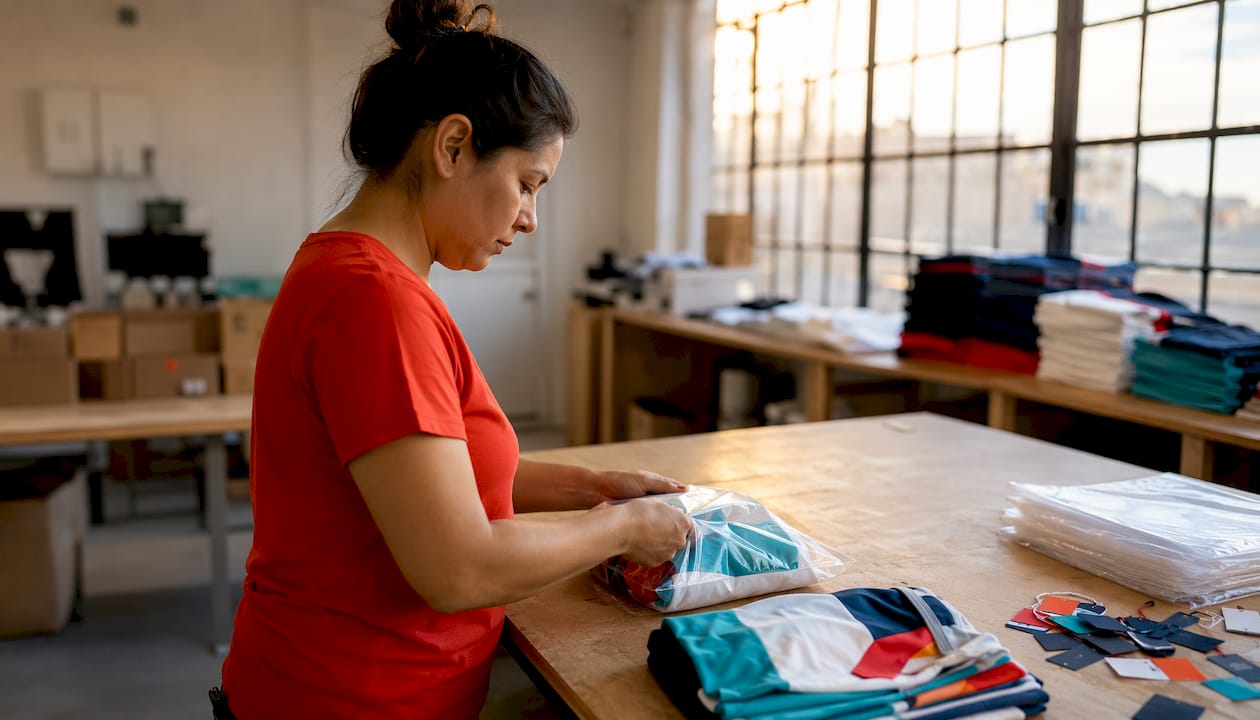
SKU complexity. Each style-size-color combination is a distinct SKU. A single t-shirt in five colors and five sizes is 25 SKUs. That drives the need for color-coded binning, size-specific pick verification, and barcode scanning at every touch point. A generic 3PL that bins “t-shirts” together will generate wrong-size picks at a rate that scales painfully with volume.
Presentation requirements. Poly-bagging, precise folding, hang-tag preservation, and retail-ready packing are labor-intensive steps that add real cost per order. They also require trained packers and documented SOPs — not just good intentions.
Channel-aware requirements. DTC customers expect a branded unboxing moment. Wholesale retailers expect ASN compliance, specific label formats, and sometimes GOH delivery. Successful apparel brands run systems that handle both simultaneously without letting DTC volume drain wholesale allocations.
| Requirement | General Fulfillment | Apparel Fulfillment |
|---|---|---|
| SKU structure | Unit-based | Style × size × color |
| Storage method | Standard shelving | Bins + GOH racks |
| Packing standard | Box or poly mailer | Folding SOP + poly-bag + hang-tag |
| Returns grading | Accept/reject | Sellable / damaged / RTV tiers |
| Channel compliance | Single channel typical | DTC + wholesale simultaneously |
Why good apparel fulfillment is a brand and growth lever
Fulfillment is not just a cost center. Done well, it protects margin and drives repeat purchases. Done poorly, it erodes both.
- The unboxing experience is a primary brand touchpoint — consistent folding, branded inserts, and protective poly-bagging materially affect customer perception and loyalty.
- Online fashion return rates can reach up to 40%. Well-managed returns workflows can recover 60–80% of an item’s original value through resale or restocking.
- Inventory accuracy is the foundation. Data drift across OMS, WMS, and IMS systems creates phantom inventory, which causes canceled orders and damages customer experience at exactly the wrong moment.
Custom apparel brands face this acutely. When your brand identity is literally printed on the product, a wrong-size shipment or a crushed embroidered hat is not just a logistics error. It is a brand failure.
What do turnaround times and costs actually depend on?
Price and speed in apparel fulfillment are not fixed. They move with your product and your channel mix.
Primary cost drivers:
| Variable | Impact on Cost |
|---|---|
| SKU count | More SKUs = more bin space, more pick verification time |
| Per-item finishing | Folding, poly-bagging, steaming add labor per order |
| Storage model | GOH storage costs more than flat-fold bin storage |
| Returns volume | High return rates increase labor and processing time |
Standard DTC orders from a well-organized fulfillment center typically ship within one to two business days of order receipt. Bulk wholesale picks with retailer compliance requirements take longer — three to five days is common when ASN documentation and specific label formats are involved. GOH shipments add handling time on both ends.
Seasonality hits hard. Fashion drops, holiday peaks, and back-to-school cycles compress warehouse labor and carrier capacity simultaneously. Brands that pre-order apparel ahead of peak windows avoid the worst of the surge pricing and availability squeeze.
Questions to ask any fulfillment provider before committing:
- What is your per-order fee, and what does it include?
- How do you charge for poly-bagging, folding, and special finishing?
- What are your storage fees, and do they differ for GOH vs. flat-fold?
- What is your returns processing fee per unit?
- Do you charge surcharges for peak season or rush orders?
How do you choose between in-house fulfillment and a third-party partner?
The right answer depends on volume, channel mix, and how much control over presentation your brand actually needs.
Decision checklist:
- Is your monthly order volume high enough to justify dedicated warehouse space and trained staff?
- Can you match a 3PL’s per-order cost once you factor in labor, space, and software?
- Do you have documented SOPs for folding, packing, and returns grading?
- Can your current tech stack integrate with a WMS and OMS without manual reconciliation?
- How exposed are you to seasonal volume swings that would require hiring and releasing warehouse staff?
If most answers point toward “no,” outsourcing is almost always the better path for growing brands.
Red flags that a provider is not apparel-ready:
- No documented folding or packing SOPs for apparel
- No GOH capability or climate-controlled storage
- Returns grading is binary (good/bad) with no RTV tier
- Cannot provide inventory accuracy rate on request
- No experience with retailer compliance or ASN documentation
Avoid common ordering mistakes by verifying these capabilities before production begins, not after your first shipment goes out wrong.
How Jam4apparel approaches apparel fulfillment
Jam4apparel handles the production-to-delivery workflow in-house from its Lake in the Hills, Illinois facility, which removes the handoff risk between decoration and fulfillment that trips up many brands.
What Jam4apparel controls:
- In-house screen printing, embroidery, DTF transfers, and custom patches — decoration and finishing under one roof
- Custom finishing to brand specifications before outbound shipment
- Local pickup and ship options for Chicagoland clients
- Direct coordination on the custom apparel order process from artwork approval through delivery
Example client workflow:
- Client submits order with size/color breakdown and brand specs
- Jam4apparel produces decorated apparel in-house
- Items are finished, folded, and packed to client’s presentation standard
- Outbound shipment or local pickup is coordinated with the client
- Returns or reprints are handled directly — no third-party loop
To get a fulfillment assessment or quote, contact Jam4apparel directly through the website. The fastest path is a conversation about your volume, channel, and presentation requirements.
Key Takeaways
Apparel fulfillment covers every step from inbound receiving through returns processing, and the quality of each step directly affects brand perception, margin, and your ability to scale.
| Point | Details |
|---|---|
| Five core steps | Receiving, storage, picking and packing, outbound shipping, and returns processing form the full cycle. |
| Presentation is operational | Folding SOPs, poly-bagging, and hang-tag handling are documented processes, not optional extras. |
| Returns urgency | Fast returns engines aim to inspect and restock sellable items within 24–48 hours to protect inventory during peak demand. |
| Ask before you commit | Request SOPs, inventory accuracy rates, returns SLAs, and a sample pack-out before signing with any provider. |
| Jam4apparel | In-house decoration and fulfillment in Chicagoland, with direct coordination from order to delivery. |
The part most brands underestimate about apparel fulfillment
Most conversations about apparel fulfillment focus on speed and cost. Those matter, but the deeper issue is data integrity. A fulfillment operation that cannot tell you, in real time, exactly how many size-medium navy polos are available and sellable is not a fulfillment operation — it is a liability. Phantom inventory causes canceled orders. Wrong-size picks cause returns. Both erode the customer relationship that your decoration budget was meant to build.
The other thing brands consistently underestimate is how much the unboxing moment costs to get right and how much it costs to get wrong. A crushed hat or a shirt folded inside-out is not a warehouse problem. It is the last thing your customer sees before they decide whether to order again. For promotional apparel especially, where the item is often someone’s first physical interaction with your brand, that moment carries disproportionate weight.
Fulfillment is not logistics. It is the last mile of your brand experience.
Jam4apparel handles custom apparel from production through delivery
Jam4apparel produces and fulfills custom-branded apparel entirely in-house at its Lake in the Hills, Illinois facility. That means screen printing, embroidery, DTF transfers, and custom finishing happen under the same roof as outbound coordination — no decoration-to-3PL handoff, no lost specs, no brand standards getting lost in translation.
For small businesses, schools, sports teams, and growing brands across Chicagoland, that setup translates to faster turnaround, tighter quality control, and a single point of contact from artwork approval to delivery. Whether you need custom screen printing for a bulk order or embroidered uniforms for a corporate program, Jam4apparel can walk you through a fulfillment assessment and provide a quote matched to your volume and presentation requirements.
Request a quote at jam4apparel.com to get started.
Further reading and industry references
- Apparel Fulfillment: How to Choose the Right Partner — Shopify — Covers partner selection criteria including inventory management, order processing, and distribution technology.
- Apparel Fulfillment: Cost, 3PL Guide & How It Works — eFulfillment Service — Detailed operational breakdown of the five-step process and cost drivers, including GOH and poly-bagging requirements.
- Best Practices for Apparel Fulfillment — Cart.com — Returns statistics, 24–48 hour restock targets, and unboxing experience guidance.
- Apparel Fulfillment: What It Is and How Apparel Brands Should Run It — Uphance — Operational risk analysis including the broken data foundation problem and scaling implications.
- Apparel Logistics: The Complete Framework — Evolution Fulfillment — Channel-aware allocation strategies for brands managing DTC and wholesale simultaneously.
- How to Master the Complexity of Apparel Fulfillment — AutoStore — Warehouse automation and SKU complexity management for high-volume apparel operations.
Recommended
Ready to print your design?
Screen print, embroidery, and DTF — no minimums on many styles.