
What Is Cause-Based Apparel? Guide for Schools & Nonprofits
August 1, 2026

What Is Cause-Based Apparel? Guide for Schools & Nonprofits
Cause-based apparel is custom-branded clothing sold to raise money or awareness for a social, environmental, or health cause, with a portion of proceeds going to a designated organization or fund. Jam4apparel helps schools, sports teams, small businesses, and nonprofits run these campaigns using three core donation models: percentage of sale, fixed donation per item, and add-on donation at checkout. A fourth structure, co-branded partnerships, pairs a business with a nonprofit for a shared collection. 2025 research on donation proximity shows that causes tied to a supporter’s local community drive stronger brand engagement, especially among younger buyers. If your group needs a fundraiser that builds awareness and delivers a tangible product, cause-based apparel is worth a serious look.
Table of Contents
- How cause-based apparel campaigns actually work
- Why organizations run cause-based apparel campaigns
- Which production method fits your campaign?
- What to budget and expect for turnaround
- Transparency and legal requirements for fundraising apparel
- What to ask a vendor before you order
- How Jam4apparel runs a cause-based campaign
- Key Takeaways
- What actually works in cause-based apparel campaigns
- Jam4apparel makes cause-based campaigns easy to launch
- Useful sources
How cause-based apparel campaigns actually work
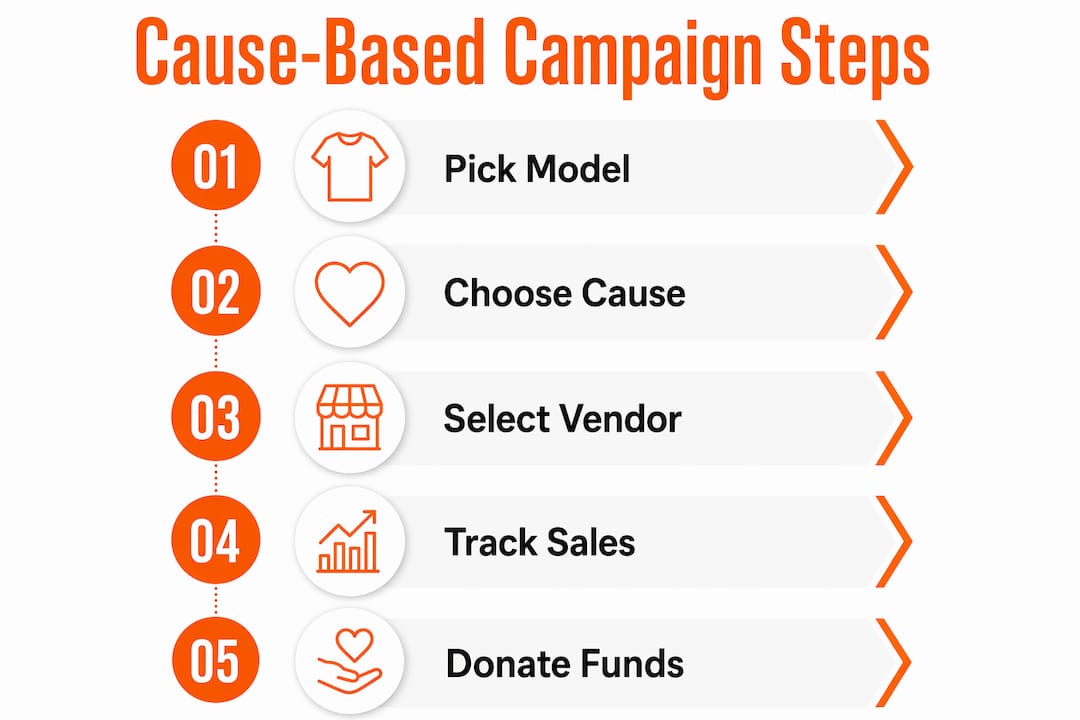
The four dominant models differ mainly in who controls the money flow and when the nonprofit sees funds.
- Percentage of sale: The seller keeps a set share of each transaction and transfers a percentage (commonly 5% of sales or similar) to the cause at campaign close.
- Fixed donation per item: A set dollar amount, such as $1 per shirt sold, is pledged per unit, regardless of sale price. This donation frame is one of the most common according to research and is easier to communicate and audit.
- Add-on donation at checkout: The buyer opts in to donate an extra amount when purchasing. The seller collects and remits on a schedule.
- Co-branded collection/sponsorship: A business and a nonprofit co-design a product line; revenue split and branding rights are defined in a written agreement upfront.
In every model, the seller collects payment at the point of sale. The donation is typically recognized once the campaign closes and sales are reconciled, not at the moment of each transaction. The nonprofit receives funds via a scheduled transfer, often several weeks after campaign end, depending on the agreement. Buyers generally do not receive a tax-deductible receipt unless the nonprofit issues one directly, since the purchase is a retail transaction, not a direct charitable gift.
Cause-related marketing differs from pure corporate philanthropy: the donation is tied to a consumer action (buying the shirt), not a standalone gift. That distinction matters for how you disclose the campaign and how donors understand their contribution.
Pro Tip: Set up a dedicated campaign ledger from day one. Track units sold, gross revenue, and the donation amount owed separately. Reconcile weekly, not at campaign close, so errors are caught early.
Why organizations run cause-based apparel campaigns
Cause-related marketing consistently outperforms ordinary discounts in driving purchase intent, and cause-based apparel adds a layer that a coupon never can: the buyer walks away with something they wear in public, turning every outing into a visibility moment for your cause.
Three scenarios where this model delivers:
- School fundraiser: A middle school sells screen-printed hoodies at $35 each, pledging $5 per unit to a local food pantry. With 150 units sold, the school raises $750 for the pantry and covers printing costs from the remaining margin. Students wear the hoodies all winter, keeping the cause visible.
- Sports team spirit wear: A rec-league soccer team runs a pre-order store for jerseys and tees. A fixed donation amount per item goes to a youth sports scholarship fund. Pre-orders eliminate inventory risk, and the team builds community identity around a shared cause.
- Small business charity collaboration: A local restaurant partners with a neighborhood animal shelter on a co-branded tee. The restaurant covers printing costs; the shelter promotes the campaign to its donor list. Every shirt sold generates a donation, and both organizations gain new audience exposure.
Beyond fundraising dollars, purpose-driven apparel builds brand loyalty when the cause is authentic and consistent. Supporters who wear your gear become walking advocates. Sponsors get logo placement. Donors get a tangible thank-you instead of just a receipt. The custom apparel for nonprofits model works precisely because it turns a purchase into participation.
Pro Tip: Choose a cause geographically close to your buyers. The 2025 donation-proximity research found a medium effect on Gen Z brand preference when the cause was local, meaning “we’re supporting the shelter two blocks away” outperforms a distant national charity for community engagement.
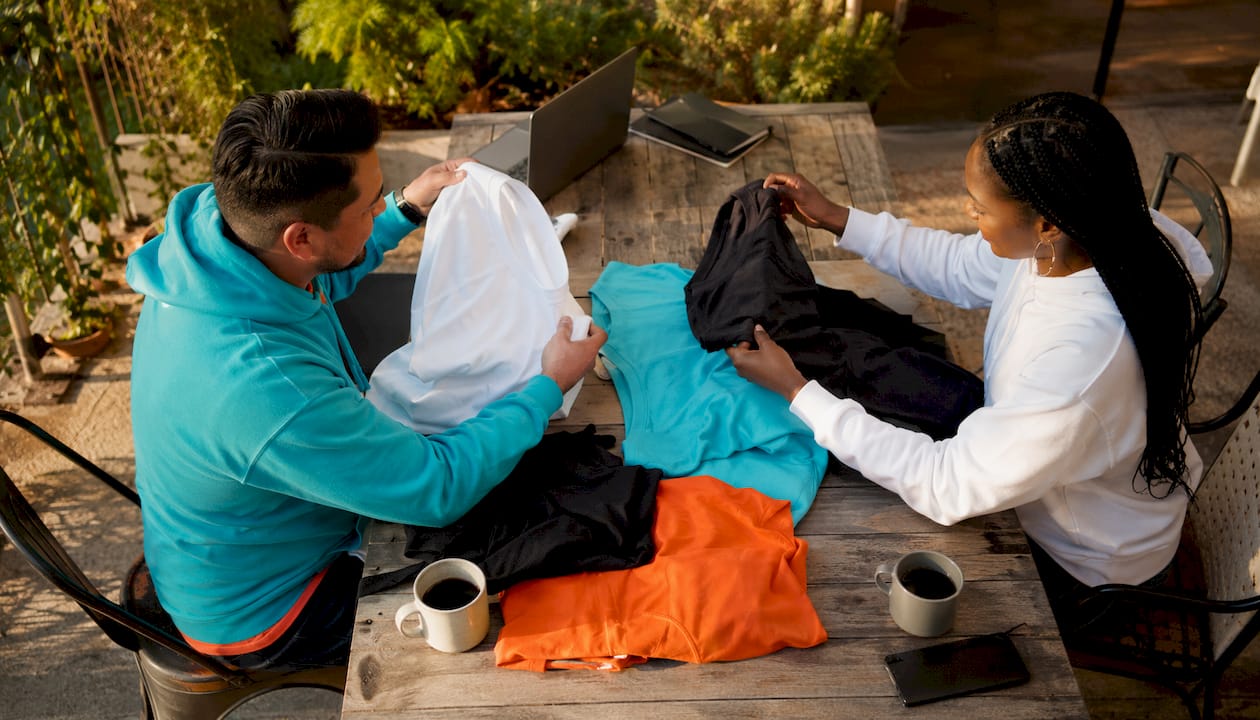
Which production method fits your campaign?
Screen printing, embroidery, DTF transfers, and custom patches each suit different design types, order sizes, and budgets. Here is how they compare:
| Method | Best for | Visual look | Min. order | Durability | Relative cost |
|---|---|---|---|---|---|
| Screen printing | Bold graphics, large runs | Vibrant, flat color | 12–24 pcs | Very high | Low per unit at volume |
| Embroidery | Logos, polos, hats | Textured, premium | 6–12 pcs | Excellent | Moderate; digitizing fee |
| DTF transfer | Full-color photos, small runs | Photo-realistic | 1+ pcs | Good | Higher per unit |
| Custom patches | Jackets, bags, uniforms | Dimensional, collectible | 25–50 pcs | Very high | Moderate |
A few practical design notes:
- Limit screen printing designs to 2–4 spot colors to keep setup fees low and colors consistent across a large run.
- Submit vector art (AI, EPS, or high-res PDF) for embroidery; raster images lose detail during digitizing.
- DTF works well for photographic or gradient artwork on small batches, but unit cost drops slowly with volume compared to screen printing.
- Fabric weight matters: 100% cotton holds screen ink well; moisture-wicking polyester blends require specialty inks or DTF.
Browse Jam4apparel’s product catalog to match garment styles to your campaign’s look and budget before finalizing a decoration method.
What to budget and expect for turnaround
Bulk ordering dramatically reduces unit costs versus print-on-demand, making it the better choice for organizations with an established supporter base. Here are typical U.S. ranges:
| Order type | Decoration | Est. unit cost | Turnaround |
|---|---|---|---|
| Small batch (12–24 pcs) | Screen printing | $12–$20 per piece | 7–12 business days |
| Mid-run (50–100 pcs) | Screen printing | $8–$12 per piece | 7–8 business days |
| Bulk | Screen printing | $5–$8 per piece | 5–7 business days |
| Small batch (12–24 pcs) | Embroidery | $15–$25 per piece | 7–12 business days |
| Any size | DTF | $10–$20 per piece | 3–7 business days |
Ranges are illustrative and vary by vendor, garment cost, and design complexity.
Key budget factors to plan for:
- Setup/digitizing fees: Screen printing setup runs $20–$50 per color per screen; embroidery digitizing is typically a one-time $25–$75 fee.
- Minimums: Most decorators require 12–24 pieces minimum for screen printing; DTF often has no minimum.
- Sponsorships change the math entirely. When a local business sponsors base costs (blanks plus printing), every shirt sold becomes nearly pure profit for the cause. In exchange, the sponsor’s logo goes on the garment. A pre-order strategy eliminates leftover inventory risk and lets you hit minimum order thresholds confidently.
Transparency and legal requirements for fundraising apparel
Transparency is not optional. Most U.S. states require charitable solicitations to disclose the donation amount or percentage, the recipient organization, and how funds will be used. Failing to disclose can expose your organization to state charity enforcement action.
Your campaign page and any marketing materials should clearly state:
- The exact donation amount or percentage per item sold
- The full legal name of the recipient nonprofit
- When funds will be transferred (e.g., “within 60 days of campaign close”)
- Whether the buyer’s purchase is tax-deductible (usually it is not, since it is a retail sale)
- How the nonprofit will use the funds
Statistic callout: A 2025 study on cause-related marketing found that donation proximity positively affected Gen Z brand preference, reinforcing that local cause disclosure (“supporting the McHenry County Food Bank”) is both a legal best practice and a marketing advantage.
This article is general information, not legal or tax advice. Confirm your state’s charitable solicitation registration requirements with a qualified attorney or accountant before launching.
What to ask a vendor before you order
Accurate reporting and reliable fulfillment are the two things a cause-based campaign cannot survive without. A vendor who misses a ship date or can’t produce a donation reconciliation report puts your organization’s credibility on the line.
Ask about proofs and samples. Any reputable decorator provides a digital proof before production. For embroidery, request a physical sew-out sample on the actual garment fabric before approving a large run.
Confirm the production timeline in writing. “About two weeks” is not a commitment. Get a ship date tied to your order approval date, and ask what happens if production runs long.
Clarify minimums, shipping, and returns. Know the per-order minimum, whether setup fees are waived at volume, and the return policy for misprinted items.
Ask for donation reporting support. Can the vendor provide an itemized sales report by SKU? Do they offer a spirit wear store with built-in sales tracking? These features matter when you reconcile donations.
Red flag: A vendor who cannot show you a sample proof, won’t commit to a written timeline, or gives vague answers about donation reporting is a vendor to avoid. Demand a signed memorandum of understanding (MOU) that spells out the donation share, transfer schedule, and reporting format before production begins.
Pro Tip: Ask to see a completed campaign example, not just a portfolio of decorated shirts. A vendor with cause-campaign experience can show you a real sales report and a donation transfer record.
How Jam4apparel runs a cause-based campaign
Here is a typical workflow for a local organization ordering through Jam4apparel’s in-house production facility in Lake in the Hills, Illinois:
- Consultation and design proof (Day 1–2): The organization shares its cause, logo, and garment preferences. Jam4apparel produces a free digital proof showing the decoration placement, colors, and garment style.
- Sponsorship and pre-order setup (Day 2–5): If a local sponsor is covering base costs, their logo is added to the proof. A pre-order window opens so the organization collects orders before production begins.
- Production (Day 5–12): In-house screen printing or embroidery runs once the pre-order window closes and the minimum is confirmed.
- Delivery and reporting (Day 12–15): Orders ship or are available for local pickup. Jam4apparel provides an itemized order report by SKU and size, which the organization uses to reconcile its donation total.
- Donation transfer: The organization calculates the donation owed per its model (e.g., $1 per shirt × 80 units = $80) or 5% of sales, and transfers funds to the nonprofit, using the Jam4apparel report as the audit trail.
Pro Tip: For Illinois organizations, local in-house production cuts turnaround by several days compared to shipping to an out-of-state decorator. That speed matters when your campaign window is tight.
Key Takeaways
Cause-based apparel works best when the donation model is clear upfront, the cause is local, and a reliable vendor provides itemized reporting to back every dollar transferred.
| Point | Details |
|---|---|
| Pick your model early | Choose a donation structure—percentage-of-sale (commonly 5% of sales), fixed per item (e.g., $1 per shirt), or add-on donation—before designing; it shapes pricing and disclosure. |
| Sponsorships maximize profit | When sponsors cover blank and printing costs, campaign sales convert to near-pure fundraising profit. |
| Disclose everything | State the donation amount, recipient org, and transfer timeline on every campaign page to meet U.S. charity rules. |
| Bulk beats print-on-demand | Bulk orders produce lower unit costs and higher fundraising margins for established organizations. |
| Jam4apparel handles production | Jam4apparel’s in-house screen printing, embroidery, and DTF in Chicagoland delivers fast turnaround with itemized order reports for donation reconciliation. |
What actually works in cause-based apparel campaigns
Most organizations overthink the cause and underthink the logistics. The campaigns that actually raise meaningful money share one trait: they nail the operational basics before the launch. A clear donation model, a written vendor agreement, a pre-order window to hit minimums, and a sponsor covering base costs. Get those four things right and the cause almost sells itself.
What consistently trips up first-time organizers is the assumption that a good cause is enough. It is not. Buyers want to know exactly how much of their $30 shirt goes to the food bank, and they want to see it stated plainly, not buried in fine print. Fashion activism has real cultural momentum, but that momentum evaporates fast if the campaign feels vague or the shirts arrive late.
The other underrated move: commit to the cause beyond one campaign. Research shows that consistent, long-term participation in cause activities has a significant effect on brand preference among younger customers. One shirt drop is a fundraiser. A recurring annual campaign is a brand identity.
Jam4apparel makes cause-based campaigns easy to launch
When your school, team, or nonprofit is ready to move from idea to order, Jam4apparel’s in-house production in Lake in the Hills, Illinois gives you a direct line to screen printing, embroidery, DTF, and custom patches, all under one roof. No middlemen, no guessing on timelines.
You get a free design proof before anything goes to production, itemized order reports for donation reconciliation, and the flexibility to run a pre-order campaign or a bulk order depending on your model. Local Chicagoland organizations can arrange pickup directly, cutting days off the standard turnaround. Browse custom apparel by industry to find the right fit for your campaign, or go straight to the screen printing service page to request a quote and get your proof started today.
Useful sources
- Brands for A Cause: Effect of Cause-Related Marketing on Gen Z Brand Preference — 2025 study on donation proximity and Gen Z engagement with cause-driven clothing brands.
- Systematic Review of CRM and Purchase Intention (Griffith University) — Review of 68 experimental studies on cause-related marketing effectiveness and donation framing.
- How to Start a Custom Apparel Fundraiser from Scratch — Practical guide covering bulk vs. print-on-demand economics, sponsorship strategies, and campaign logistics.
- Benefits of Aligning Your Apparel Brand with a Social Cause — Industry perspective on cause alignment, brand loyalty, and avoiding performative activism.
- Cause marketing (Wikipedia) — Overview of cause marketing models, transactional vs. non-transactional campaigns, and nonprofit partnership structures.
- Why Retailers Offer Themed Apparel: A 2026 Guide — Retail merchandising tactics applicable to cause-driven apparel promotion strategies.
Recommended
Ready to print your design?
Screen print, embroidery, and DTF — no minimums on many styles.