
Types of Custom Sports Bags: A Team Buyer's Guide
July 13, 2026
Types of Custom Sports Bags: A Team Buyer’s Guide
Custom sports bags are specialized gear carriers designed with personalization and sport-specific functionality in mind. Choosing the right type matters more than most teams realize. The wrong bag means lost gear, poor organization, and a brand that looks generic on the sideline. This guide covers every major style of custom athletic bag, explains which customization methods hold up under real use, and helps you match the right bag to your team, event, or organization. Jam4apparel works with sports teams and organizations throughout Chicagoland to get this right.
What are the top types of custom sports bags?
Backpacks, duffel bags, totes, wheeled bags, drawstring bags, and specialized sport bags are the six main categories. Each one serves a different user and a different sport. Knowing the difference before you order saves money and prevents regret.
Duffel bags
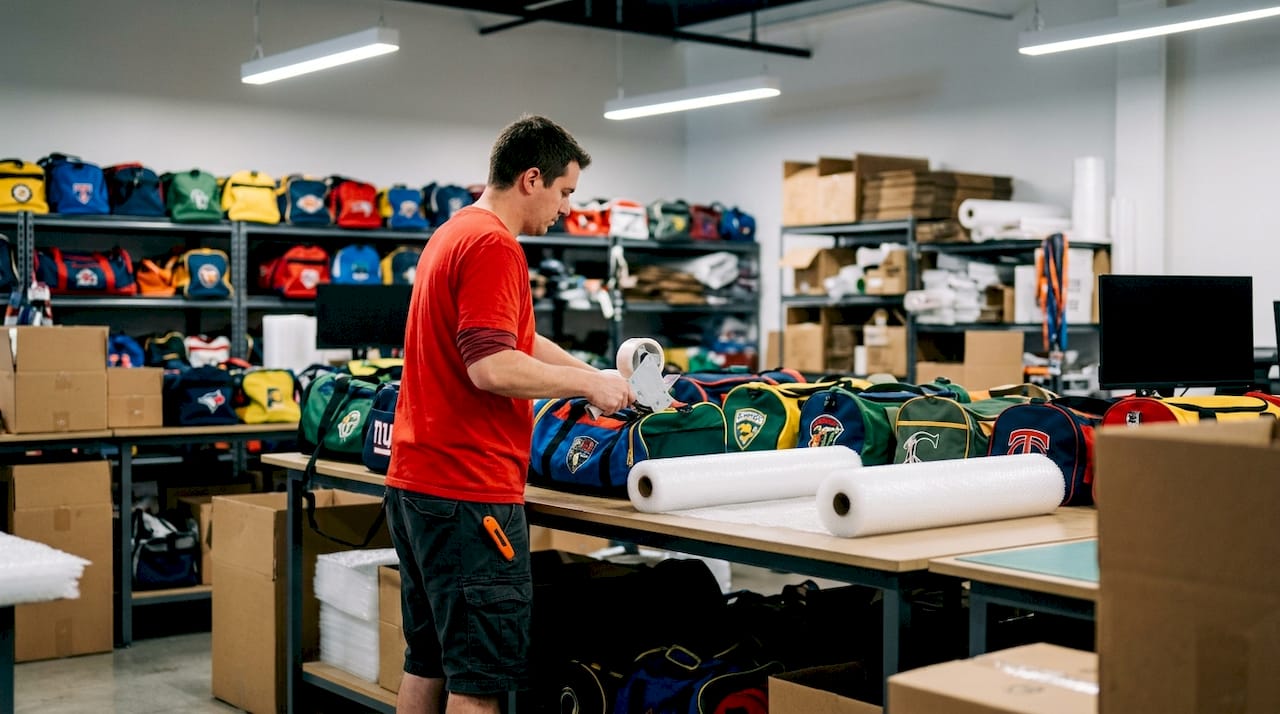
Custom duffel options are the most popular choice for team sports. They offer the most usable interior space, and sport-specific versions include dedicated compartments for helmets, pads, or cleats. Sport-specific layouts improve organization and bag longevity compared to standard open-interior designs. A baseball duffel with a vented shoe pocket is a fundamentally different product from a generic gym bag with a logo slapped on it.
Personalized sports backpacks
Personalized sports backpacks work best for athletes who travel light or commute between school and practice. They distribute weight evenly across both shoulders, which matters for younger athletes carrying gear all day. Customization options include full-panel screen printing, embroidered logos on the front pocket, and custom zipper pulls. Backpacks also double as everyday carry, which extends your brand’s visibility beyond the field.
Drawstring bags
Drawstring bags are the most cost-effective option for events, tournaments, and giveaways. They weigh almost nothing, fold flat for shipping, and accept full-color screen printing across the entire back panel. The trade-off is capacity. Drawstring bags hold light gear only, so they work best as a secondary bag or a promotional item rather than a primary equipment carrier.
Tailored sports totes
Tailored sports totes occupy the space between a drawstring bag and a full duffel. They carry more than a drawstring bag but stay open at the top for quick access. Teams use them for swim meets, yoga classes, and light gym sessions. Totes accept embroidery well on the exterior panels and look polished at corporate wellness events or school fundraisers.
Wheeled bags
Wheeled bags solve one specific problem: heavy equipment over long distances. Hockey players, baseball catchers, and travel softball teams all deal with gear that weighs 40 or more pounds. A wheeled bag with a telescoping handle removes that burden entirely. Custom branding on wheeled bags is highly visible because the bag sits upright in airports, hotel lobbies, and dugouts.
Specialized sport bags
Specialized bags are built around one sport’s exact requirements. A tennis bag holds two to six rackets in padded sleeves. A swim bag uses mesh panels for ventilation and drainage. A lacrosse bag has a long, narrow profile sized for stick shafts. Custom team bags with specialized compartments extend usability and hygiene, which matters most for youth teams managing helmets and shoes together.
Pro Tip: Order one sample bag before committing to a full team run. The difference between a 600D polyester duffel and a 1680D nylon version is obvious the moment you pick them up.
How customization methods affect your bag’s look and durability
The decoration method you choose affects how your branding holds up after a season of abuse. Each technique has a clear use case, and picking the wrong one wastes money.
-
Embroidery. Embroidery is the most durable decoration method for heavy fabrics. Thread stitched directly into the bag material will not crack, peel, or fade after repeated washing. It creates a premium, three-dimensional look that reads as high quality. The trade-off is detail. Embroidery cannot reproduce fine gradients or photographic images, so it works best for logos with clean lines and limited colors.
-
Screen printing. Screen printing is cost-effective for bulk orders and produces vibrant, flat graphics across large panels. The minimum order threshold for screen printing is typically 100 or more units to reach economic feasibility. That makes it ideal for tournaments, school spirit events, and corporate giveaways where you need volume. Ink can crack over time on bags that flex constantly, so screen printing suits lighter-use bags more than heavy-duty team gear.
-
Sublimation. Sublimation printing produces vibrant, fade-resistant graphics that will not crack or peel because the dye bonds directly into the fabric fibers. It handles complex imagery, gradients, and all-over patterns that embroidery and screen printing cannot match. The limitation is fabric. Sublimation only works on 100% polyester materials, so it is not an option for canvas totes or nylon duffels.
-
Hardware and lining customization. Customizing straps, zipper pulls, and interior lining panels delivers a premium result and better durability than applying logos alone. A bag with team-colored lining and branded zipper pulls reads as a cohesive product, not an afterthought. This level of detail also improves team brand cohesion across a full uniform set.
Pro Tip: Match your decoration method to your fabric. Use embroidery on 600D polyester duffels, sublimation on lightweight polyester drawstring bags, and screen printing on canvas totes for the best long-term result.
Feature comparison of custom sports bag styles
The table below compares the six main bag styles across the features that matter most for athletes and teams.
| Bag type | Capacity | Compartments | Material durability | Portability | Best use |
|---|---|---|---|---|---|
| Duffel bag | High | Sport-specific options | High (600D–1680D) | Shoulder or hand carry | Team sports, travel |
| Backpack | Medium | Multiple pockets | Medium to high | Hands-free | School, gym, commute |
| Drawstring bag | Low | Single main pocket | Low to medium | Hands-free | Events, giveaways |
| Tote bag | Medium | Open top, side pockets | Medium | Hand carry | Swim, yoga, light gym |
| Wheeled bag | Very high | Organized sections | High | Rolling | Travel, heavy equipment |
| Specialized bag | Varies | Sport-specific | High | Varies | Tennis, swim, lacrosse |
Ventilated mesh compartments and wet/dry pockets significantly improve the user experience for athletes storing sweaty or wet gear. This feature matters most in youth sports, where a single bag often holds cleats, a wet uniform, and a water bottle at the same time. Bags without ventilation trap odor and moisture, which shortens the bag’s usable life.
Fabric weight critically affects bag lifespan. The industry standard for balanced durability and weight is 600D polyester. Heavy-duty team travel bags use 1680D nylon, which resists abrasion and holds up under the stress of airline baggage handling. Choosing the right fabric at the start is cheaper than replacing bags mid-season.
Which bag type fits your situation?
Selecting a bag depends heavily on the intended user and use case. Professional athletes and serious travel teams have different needs than recreational gym users or event organizers. Here is how to match bag type to situation.
-
Professional and travel teams. Choose wheeled bags or heavy-duty duffels in 1680D nylon. Prioritize sport-specific compartments and embroidered branding. Custom bags with premium embroidery and reinforced bottoms typically cost $45–$80 per unit, with additional cost for player names and numbers. That investment pays off over multiple seasons.
-
Recreational and gym users. A personalized sports backpack or a branded gym bag in 600D polyester covers most needs. These users prioritize comfort and aesthetics over maximum capacity. Screen printing works well here because the bags see lighter daily use.
-
Youth sports teams. Specialized bags with ventilated shoe compartments and wet/dry pockets are the right call. Basic custom duffels without player names cost $25–$45 per unit, which fits most youth league budgets. The hygiene features protect gear and reduce odor complaints from parents.
-
Corporate events and giveaways. Drawstring bags and totes are the practical choice. They are inexpensive per unit, accept full-color printing, and are easy to ship in bulk. For a more premium corporate gift, a branded backpack with embroidered logo carries more perceived value.
-
School spirit and fundraising. Totes and drawstring bags work well for spirit stores and PTO fundraisers. They sell at accessible price points and appeal to a wide age range. Jam4apparel sets up online spirit stores for schools, which removes the upfront inventory risk entirely.
-
Tournament and event merchandising. Drawstring bags with full-panel screen printing are the standard for tournament giveaways. Order quantities above 100 units bring the per-unit cost down significantly, and the bags serve as walking advertisements for your event long after the tournament ends.
Key Takeaways
The right custom sports bag matches the user’s sport, load, and budget. Fabric, compartment design, and decoration method matter more than the logo placement alone.
| Point | Details |
|---|---|
| Match bag type to sport | Specialized compartments improve organization and extend bag life for team sports. |
| Choose decoration by fabric | Use embroidery on heavy fabrics, sublimation on polyester, and screen printing for bulk events. |
| Fabric weight determines durability | 600D polyester suits most uses; 1680D nylon is the standard for heavy travel bags. |
| Budget by user type | Youth and recreational bags run $25–$45; premium team bags with embroidery run $45–$80. |
| Hygiene features matter | Ventilated compartments and wet/dry pockets reduce odor and extend bag usability. |
What I’ve learned from watching teams order the wrong bag
The most common mistake I see is teams choosing a bag based on price per unit without accounting for the decoration method or the fabric weight. A cheap drawstring bag with screen printing looks great on day one. Six months later, the ink is cracking and the bag is sitting in a closet. That is not a savings. That is a wasted order.
The second mistake is ignoring sport-specific design. A generic duffel with a logo is not a custom sports bag. It is a standard bag with a logo on it. The real value of customization comes from integrating the right compartments, the right fabric, and the right hardware for how the bag actually gets used. A swim team bag needs drainage. A baseball bag needs a vented shoe pocket. A travel hockey bag needs reinforced handles that survive airline baggage handling.
My advice is to start with the use case, not the price. Ask: where does this bag go, what goes inside it, and how often does it get thrown around? The answers tell you the fabric weight, the compartment layout, and the decoration method. Then you price it. Working with a shop like Jam4apparel that handles screen printing and embroidery in-house means you can ask those questions directly and get real answers, not a catalog recommendation.
The teams that get the most value from custom bags are the ones that treat the bag as part of their uniform, not an afterthought. When the bag, the jersey, and the hoodie all share the same logo and color treatment, the team looks like a program. That perception matters, especially for youth teams trying to build culture and for organizations using bags as branded merchandise.
— Adam
Jam4apparel’s custom bag decoration services
Jam4apparel specializes in screen printing, embroidery, and DTF transfers for sports teams, schools, and organizations throughout the Chicagoland area. Whether you need 12 embroidered duffels for a travel baseball team or 500 screen-printed drawstring bags for a tournament giveaway, the in-house production setup keeps turnaround times fast and quality consistent.
Every order starts with a conversation about your sport, your team size, and your budget. Jam4apparel’s team helps you pick the right bag style, the right fabric, and the right decoration method before anything goes to production. Browse the full range of custom apparel by industry to see how teams and organizations across every sport get their gear done right.
FAQ
What are the main types of custom sports bags?
The six main types are duffel bags, backpacks, drawstring bags, totes, wheeled bags, and specialized sport bags. Each type suits a different sport, load size, and use case.
Which customization method lasts the longest on sports bags?
Embroidery is the most durable method for heavy fabrics like 600D polyester and 1680D nylon. Sublimation is the most durable option for lightweight polyester bags because the dye bonds directly into the fabric fibers.
How much do custom team sports bags cost?
Basic custom duffels without player names cost $25–$45 per unit. Bags with premium embroidery, reinforced bottoms, and heavy-duty construction cost $45–$80, with additional cost for individual player names and numbers.
What fabric should I choose for a team sports bag?
600D polyester is the industry standard for most team bags, offering a good balance of durability and weight. Heavy-duty travel bags for contact sports or airline travel perform better in 1680D nylon.
Are drawstring bags good for sports teams?
Drawstring bags work well as event giveaways or secondary bags for light gear. They are not suitable as primary equipment carriers because they lack the capacity and compartment structure that team sports require.
Recommended
Ready to print your design?
Screen print, embroidery, and DTF — no minimums on many styles.