
Turnaround Time for Custom Apparel Explained
June 10, 2026
Turnaround Time for Custom Apparel Explained
Turnaround time for custom apparel is the total span from order placement to finished product delivery, covering design approval, production, quality control, and shipping. Business owners and event organizers who misread this timeline end up with late uniforms, missed event deadlines, and rushed decisions that cost more money. The good news is that once you understand each phase and the variables that affect it, you can plan orders with confidence. This article breaks down every stage of the custom apparel production schedule, identifies the factors that slow orders down, and gives you a practical framework for managing your next order without surprises.
What phases make up custom apparel turnaround time?
Turnaround time for custom apparel is not a single countdown. It is a chain of sequential stages, and each one must complete before the next begins. Missing or delaying any link in that chain pushes your delivery date back.
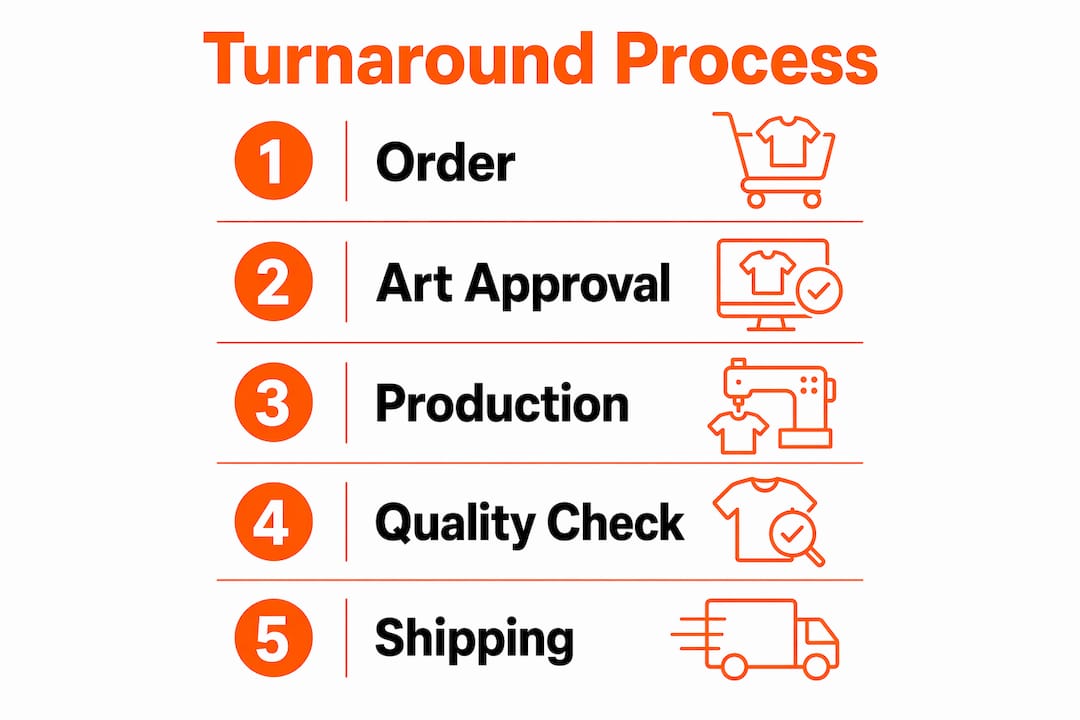
Here are the five core phases that make up the total custom clothing lead time:
-
Design and art approval. Your provider creates a digital proof based on your artwork or brief. This phase ends only when you approve the final proof. The turnaround clock starts only after final art approval, not at the moment you place the order. Waiting two days to review a proof is two days added to your timeline before production even begins.
-
Sampling and prototype review. For larger or more complex orders, a physical sample is produced before bulk manufacturing starts. Each revision round typically adds 3 to 7 days. That means three rounds of vague feedback can push your start date back by three weeks.
-
Bulk production and decoration. This is where screen printing, embroidery, DTF transfers, or other decoration methods are applied across your full order quantity. Production time scales with order size, complexity, and the decoration method chosen.
-
Quality control and packing. Finished garments are inspected for print alignment, color accuracy, and construction quality before being folded, bagged, and boxed. Skipping or rushing this phase is how errors reach your door.
-
Shipping and delivery. Domestic ground shipping typically adds 2 to 5 business days. Air freight internationally takes 3 to 7 days, while sea freight can stretch 3 to 5 weeks plus customs clearance. The shipping method you choose at checkout is not a minor detail. It is a major variable in your total delivery time.
Pro Tip: When you receive your art proof, review it the same day. A 24-hour turnaround on approvals is the single fastest thing you can do to protect your delivery date.
Which factors affect custom apparel turnaround time?
Understanding the phases is step one. Understanding what makes those phases longer or shorter is where real planning happens. Several variables directly affect your apparel order processing time, and most of them are within your control.
-
Order size and complexity. Small batch orders of 12 to 48 pieces move through production faster than bulk orders of 500 or more. Large orders require longer press runs, more thread changes for embroidery, and extended quality checks. Multi-location decoration, such as a front chest logo plus a sleeve print plus a back graphic, multiplies production time at every stage.
-
Artwork readiness. Submitting print-ready vector files in formats like AI or EPS eliminates the art preparation step entirely. Submitting a low-resolution JPEG or a phone screenshot adds hours of art rebuilding time and often triggers a revision cycle before production can start.
-
Fabric and material availability. If your chosen blank garment is out of stock at the distributor, your provider must source an alternative or wait for replenishment. Pre-production work like fabric approvals and color matching can consume 25% to 40% of the total manufacturing timeline. Choosing in-stock blanks from brands like Gildan, Bella+Canvas, or Next Level Apparel eliminates this risk entirely.
-
Seasonal demand. Production capacity fluctuates throughout the year. Factories prioritize large contracts during peak retail seasons, which means orders placed in October or November before the holiday rush face longer queues. Building a 10 to 20% buffer into your planning calendar accounts for this reality.
-
Your responsiveness. Late or vague feedback on samples is one of the most common causes of timeline extensions. A provider cannot move forward without your sign-off. Every hour you delay a decision is an hour added to your delivery date.
The practical takeaway here is that most delays in custom apparel delivery time originate on the buyer’s side, not the production floor. Artwork problems, slow approvals, and last-minute changes are the leading causes of missed deadlines.
How to set realistic timelines for your custom apparel order
Knowing the phases and the variables is useful. Translating that knowledge into a working order plan is what actually protects your deadline. Here is how to manage your apparel production schedule from the start.
Lock your artwork before you contact a provider. The most overlooked cause of delays is assuming turnaround starts at order placement, when it actually begins post final art approval. Have your logo files, color codes (Pantone or CMYK), and placement specs ready before you request a quote. This eliminates the most common pre-production bottleneck.
Consolidate your internal feedback. If three people on your team need to approve a proof, collect all feedback in one round and send it together. Multiple back-and-forth email threads with conflicting opinions are a reliable way to burn a week before production starts.
Plan for peak seasons. If your event or product launch falls in September, October, or December, place your order 6 to 8 weeks earlier than you think you need to. Custom manufacturing timelines can reach up to 90 days for complex orders with sampling phases. Even standard orders benefit from a wider planning window during high-demand periods.
Build in buffer time. Buffer time should be built into plans, especially for complex, multi-location decoration, to absorb supply chain or scheduling disruptions. A good rule is to add 20% to whatever timeline your provider quotes. If they say 10 business days, plan for 12.
Communicate milestones with your provider. Ask for a written production schedule that lists each phase and its expected completion date. Providers who offer transparent milestone tracking, the way Jam4apparel does with its in-house production model, give you the visibility to catch problems before they become crises.
Pro Tip: Standard production time for custom apparel typically runs 7 to 14 business days for small to medium orders. Use that as your baseline and add time for each complicating factor your order includes.
How do decoration methods compare on turnaround time?
The decoration method you choose is one of the biggest levers you have over your custom clothing lead time. Each method has a different setup process, production speed, and minimum order consideration.
| Decoration method | Typical production time | Best for | Rush availability |
|---|---|---|---|
| Screen printing | 7 to 14 business days | Bulk orders, bold graphics | Yes, with added cost |
| DTF (Direct-to-Film) | 3 to 7 business days | Small runs, full-color detail | Yes, faster setup |
| DTG (Direct-to-Garment) | 3 to 7 business days | On-demand, low quantity | Yes |
| Embroidery | 7 to 14 business days | Hats, polos, structured items | Limited |
| Specialty finishes | 10 to 21 business days | Patches, woven labels, appliqué | Rarely |
Screen printing remains the standard for bulk orders because the per-unit cost drops significantly at volume. The setup time for screen printing includes film output, screen burning, and press setup, which means small orders do not benefit from the same speed advantage as large ones. DTF transfers, a specialty at Jam4apparel, close that gap for smaller quantities because there is no screen setup. You can get a full-color, photographic-quality print on 12 shirts as fast as a 500-piece screen print run.
Custom embroidery services carry a longer lead time because digitizing the artwork (converting it to a stitch file) adds a one-time setup step. Once digitized, reorders move faster. Specialty finishes like custom patches or woven labels involve separate manufacturing steps and often require the longest lead times of any decoration category.
Rush orders are available from most providers, including Jam4apparel, but rush fees add 20 to 45% to the total cost. That premium buys you compressed production scheduling, not faster shipping. Factor in both when calculating whether a rush order makes financial sense for your situation.
Key takeaways
Custom apparel turnaround time starts at final art approval, not order placement, and the decoration method, order complexity, and your responsiveness are the three variables that control how fast you receive finished products.
| Point | Details |
|---|---|
| Turnaround starts at art approval | The production clock begins only after you approve the final proof, not when you place the order. |
| Standard lead time is 7 to 14 days | Small to medium orders typically ship within this window; complex or bulk orders can reach 90 days. |
| Pre-production consumes up to 40% of time | Fabric approvals, color matching, and sampling can use nearly half your total timeline before sewing starts. |
| Decoration method changes your timeline | DTF and DTG are faster for small runs; screen printing and embroidery require more setup time. |
| Rush orders cost 20 to 45% more | That premium compresses production scheduling, not shipping speed, so plan accordingly. |
What I’ve learned about turnaround time after years in custom apparel
The single most expensive mistake I see business owners make is treating the order date as the start date. They place an order on a Monday, expect shirts in two weeks, and then spend three days going back and forth on a proof before approving it. Those three days do not disappear. They get added to the end of the timeline, and suddenly a two-week order becomes a three-week order with a frustrated customer.
The second pattern I see constantly is the “factory calendar” assumption. Buyers read a provider’s quoted timeline and treat it as a guarantee. A quoted timeline is a best-case scenario built on the assumption that artwork arrives clean, approvals happen fast, and materials are in stock. When any of those conditions fail, the calendar shifts. The providers I respect most are the ones who tell you this upfront rather than quoting an optimistic number to win the order.
My honest advice for anyone ordering custom apparel for a business event, a team, or a product launch: add two weeks to whatever you think you need, finalize your artwork before you make the first call, and choose a provider with in-house production. In-house production means fewer handoffs, fewer points of failure, and a team that can actually answer your questions about where your order stands. Outsourced decoration adds a layer of communication delay that compounds every other variable. That is not a small distinction when your event is in three weeks.
— Adam
Get your custom apparel order right the first time with Jam4apparel
Jam4apparel handles screen printing, embroidery, and DTF transfers entirely in-house at its Lake in the Hills, Illinois facility, which means your order does not travel between vendors before it reaches you. Whether you need 24 shirts for a company event or 500 pieces for a product launch, the team provides transparent milestone updates so you always know where your order stands.

Jam4apparel serves businesses, schools, sports teams, and nonprofits across the Chicagoland area, with local service locations in Barrington and McHenry, IL. If you need custom screen printing or embroidery with a clear, honest turnaround timeline, request a quote today and get a production schedule before you commit.
FAQ
What is turnaround time for custom apparel?
Turnaround time for custom apparel is the total duration from final art approval to delivery of finished products, covering production, quality control, and shipping. It does not begin at order placement.
How long does a standard custom apparel order take?
Standard production for small to medium custom apparel orders typically runs 7 to 14 business days, not counting shipping time. Complex or bulk orders with sampling phases can take up to 90 days.
What causes the most delays in custom apparel orders?
Slow artwork approvals and unclear feedback on proofs are the leading causes of delays. Each revision round adds 3 to 7 days, and the production clock does not start until the final proof is approved.
Can I get a rush order for custom printed shirts?
Yes. Most providers offer rush production for custom apparel, but rush fees add 20 to 45% to the total order cost. Rush service compresses production time, not shipping time, so factor in both when planning.
Which decoration method has the fastest turnaround?
DTF (Direct-to-Film) and DTG (Direct-to-Garment) printing typically offer the fastest turnaround for small runs, often completing in 3 to 7 business days, because they require no screen setup or digitizing steps.
Recommended
Ready to print your design?
Screen print, embroidery, and DTF — no minimums on many styles.