
Lower Cost Per Lead: Trade Show Giveaway Ideas for Exhibitors in 2026
September 7, 2026
Lower Cost Per Lead: Trade Show Giveaway Ideas for Exhibitors in 2026
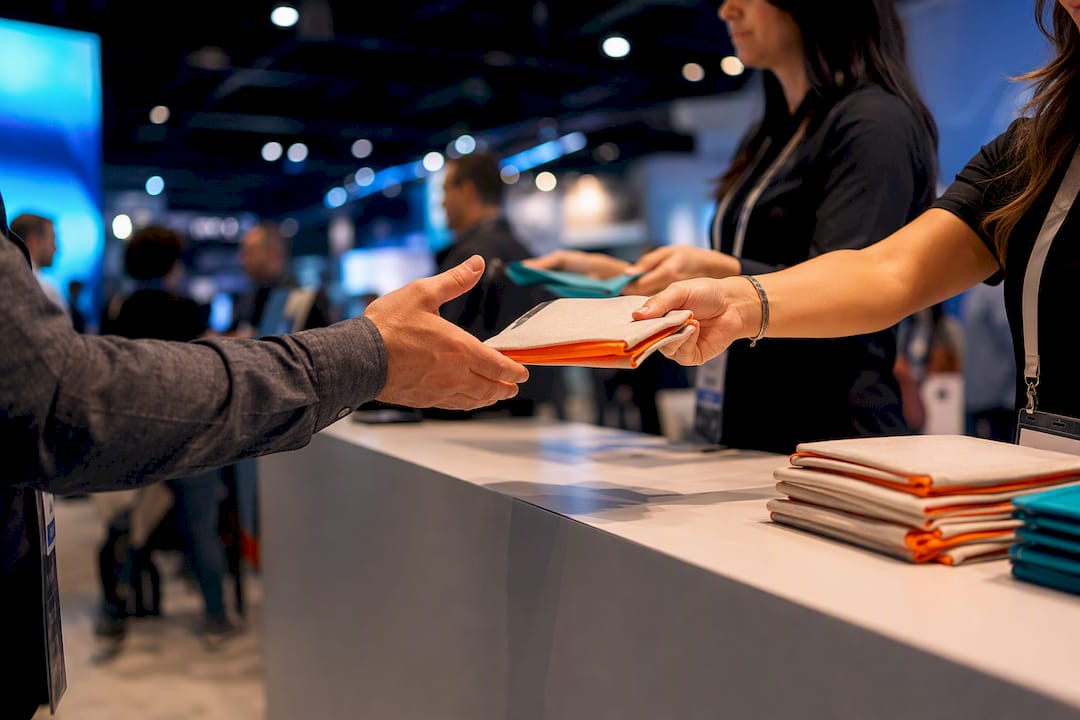
The most effective trade show giveaway strategy is a two-tier system: a useful, high-visibility Tier One item for every visitor, paired with a gated Tier Two reward for qualified leads. Tier One picks should be things people actually use daily, like a well-made tote or a compact power bank. Tier Two items, reserved for people who book a demo or complete a conversation, might be a premium branded tumbler or a custom event T-shirt. The rest of this guide breaks down categories, budget bands, and the timing details that make this system work.
TL;DR:
- Use a 70/30 budget split to maximize ROI by combining high-volume Tier One items with exclusive Tier Two lead qualification rewards.
- Prioritize practical, high-utility items like power banks, notebooks, or branded apparel that promote long-term brand impressions and real engagement.
- Implement gating rules for Tier Two items, such as booking a demo or completing a quick walkthrough, to improve lead quality and reduce wasted spend.
- Plan manufacturing timelines at least three weeks in advance for custom and premium items, especially embroidery or specialty finishes, to avoid last-minute delays.
- Enhance perceived value with thoughtful packaging and presentation, using contrast, branding details, and reveal moments to increase item remembrance.
Table of Contents
- Why Giveaways Still Work (and What They Have to Accomplish)
- Giveaway Categories That Actually Perform
- Budget Bands and Ordering Guidance
- How to Choose the Right Giveaways for Your Goals
- Giveaways That Skip the Landfill
- Wearables Done Right: Notes From an Apparel Producer
- Turning Giveaways Into Booked Meetings
- 50 Practical Giveaway Ideas by Budget
- Sourcing and Timing: Getting Giveaways to the Show on Time
- Packaging and Branding Ideas That Make Giveaways Memorable
- Author Perspective: Tradecraft Notes From a Custom-Apparel Producer
- How Jam4apparel Helps You Execute Giveaways That Actually Get Used
- Sources
Why Giveaways Still Work (and What They Have to Accomplish)
A giveaway that doesn’t serve a business goal is just a cost center. Every item on your table should push toward one of four outcomes: pulling foot traffic to your booth, starting a real conversation, keeping your brand visible after the show ends, or helping staff separate a browser from a buyer.
That last point is where most exhibitors get it wrong. Handing out large volumes of identical cheap pens may seem efficient, but it often results in high volume, low recall, and no indication of genuine interest in your product. Successful exhibitor playbooks for 2026 favor useful desk gear, printed reference tools, and industry-specific items over generic low-cost swag, because perceived value drives whether someone keeps an item or tosses it in a hotel trash can before their flight home.
The fix is tiered distribution, paired with tracking discipline. Before the show, decide what you’ll measure:
- Booth traffic (scans, badge swipes, or headcount)
- Qualified leads (people who complete a demo, meeting, or specific action)
- Cost per lead (total giveaway spend divided by qualified leads, not total visitors)
Trade show giveaways perform best when built into a strategy that gates premium items behind qualification and tracks cost per lead, rather than treated as a flat expense line. Get that structure right, and even a modest budget outperforms a bigger one spent on volume alone.
Giveaway Categories That Actually Perform
Not every item type fits every booth. Match the category to your audience, your booth size, and how long people typically linger at your table.
Tech and mobile accessories
Portable power remains one of the most requested items at any conference, because phone batteries die and everyone knows it. A slim power bank in the $6 to $15 range earns real use long after the show. Webcam covers, USB hubs, and phone stands round out this category for a B2B software audience. Practical tech items and high-utility office gear consistently rank among the most effective giveaway categories, largely because people carry them into meetings and use them at their own desks, not just at the show.
NFC and QR-enabled items deserve their own mention here. A small NFC card or tag (commonly the NTAG213 chip) lets you turn a giveaway into a trackable touchpoint, linking a physical item to a landing page, a demo booking form, or a downloadable resource.
Desk gear and daily-use items
This is the category that quietly wins the most long-term brand impressions. Notebooks with a useful insert, like a one-page reference chart or checklist tied to your product, get pulled out during actual work meetings, not just at the show. Insulated tumblers, cable organizer kits, and desk plants with a branded pot all fall here.
- Notebook with a printed integration guide or checklist insert
- Insulated tumbler or drinkware
- Cable and charger organizer kit
- Desk plant or small succulent with branded pot
Integration notebooks and role-specific micro-kits act as productized samples that buyers keep as reference material, which extends your booth conversation well past the show floor. An ops-team checklist or a finance-department quick-reference card does more for recall than a stress ball ever will.
Wearables
A quality T-shirt, hat, or quarter-zip is worth the higher per-unit spend when the design earns its place. This is the category where fabric weight, print method, and fit decide whether an item gets worn once or gets worn for two years. Screen printing suits bold, high-contrast graphics on cotton blends; embroidery holds up better on caps and structured garments where a printed logo would crack over time.
Consumables and hospitality activations
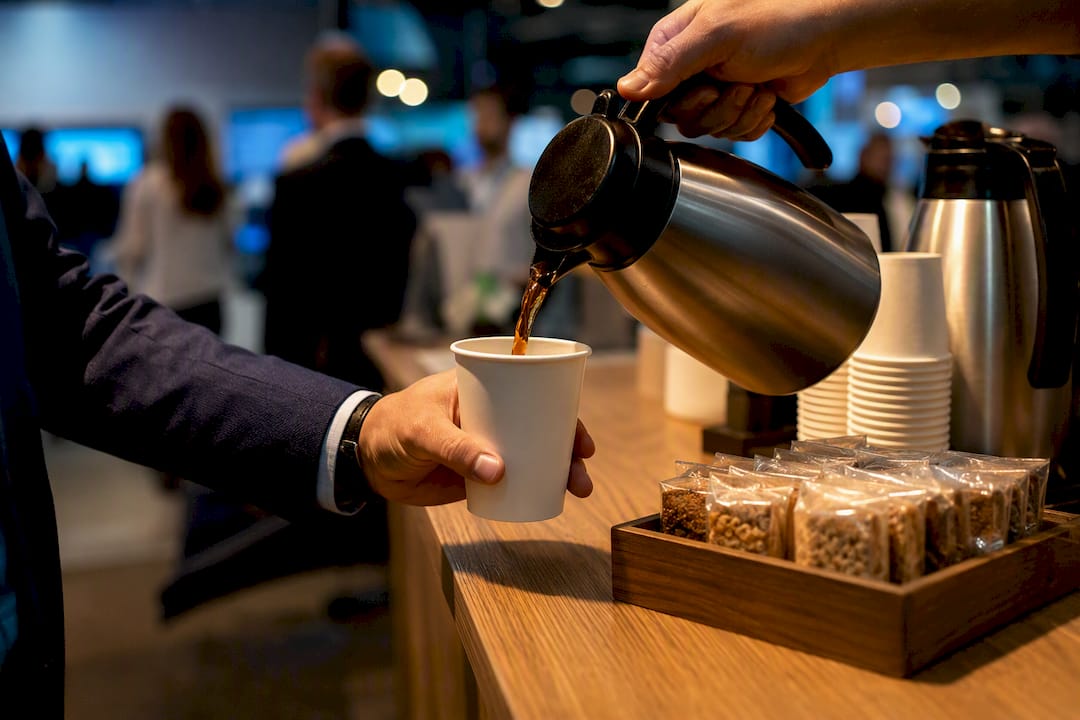
Coffee bars, snack stations, and personalization stations (think on-the-spot monogramming or a quick engraving setup) don’t leave the show floor with your visitor, but they buy something more valuable: time. Hospitality activations like coffee bars and personalization stations increase dwell time and create natural staff engagement opportunities, which matters more at crowded shows where five seconds of eye contact is the difference between a scanned badge and a real conversation.
Novelty and visibility items
Novelty items exist to draw eyes across a crowded hall, not to get kept. A giant inflatable, a photo booth prop, or an oversized branded object can pull people toward your booth from thirty feet away. Use these sparingly and pair them with something functional, or you’ll get foot traffic with no follow-through.
Digital-first tokens
For international shows, or any event where carry-on weight and customs are a real concern, physical giveaways create friction. A gated PDF report, a QR-triggered self-assessment tool, or a digital coupon code solves that problem entirely. Digital-first tokens reduce airline and customs friction at international shows and work well where weight is a constraint, and they’re often the cheapest item on this list to produce at scale.
Budget Bands and Ordering Guidance
Three budget bands cover almost every situation you’ll face, and the band should match the tier, not the other way around.
- Low tier ($1 to $5 per unit): stickers, pens, lanyards, basic tote bags, digital tokens. This is your Tier One volume category, meant for anyone who walks past your booth.
- Mid tier ($6 to $22 per unit): power banks, insulated drinkware, notebooks with inserts, branded caps. This band works as either a strong Tier One item at a smaller show or a light Tier Two item at a larger one.
- Premium tier ($15 to $45 per unit): custom apparel, embroidered outerwear, high-end tech accessories, curated gift sets. Reserve this tier for qualified leads only.
A 70/30 split between high-volume traffic items and premium qualification-gated items is a common and effective giveaway budgeting framework. On a $3,000 giveaway budget, that means roughly $2,100 goes to Tier One volume and $900 goes to Tier Two premium items reserved for real conversations.
Quantity planning depends heavily on booth footprint. A standard 10x10 booth at a regional show typically sees 150 to 400 visitors over two or three days; a 10x20 corner booth at a major industry event can see 800 or more.
| Budget band | Cost per unit | Best use |
|---|---|---|
| Low tier | $1 to $5 | Tier One volume, every visitor |
| Mid tier | $6 to $22 | Tier One at small shows or light Tier Two |
| Premium tier | $15 to $45 | Tier Two, gated to qualified leads |
Over-ordering low-tier items rarely hurts you much financially, but over-ordering premium items without a gating rule wastes the budget line meant to separate real prospects from casual walkers. Planned scarcity, meaning a visibly limited premium item, also gives your booth staff a natural reason to ask a qualifying question before handing one over.
How to Choose the Right Giveaways for Your Goals
Before you place any order, run every candidate item through three questions.
- Does this fit the actual audience walking this show, not just your general customer base?
- Will this get used daily, or does it sit in a drawer after the flight home?
- Does it tie back to an active campaign, product launch, or message you’re pushing this quarter?
An item that fails all three is a candidate for cutting, no matter how cheap or clever it seems.
Gating rules for Tier Two items should be simple enough for booth staff to apply without hesitation. Gating premium items behind a completed demo or a booked meeting consistently improves lead quality and lowers cost per qualified lead. A common structure: anyone gets the tote or the sticker, but the embroidered quarter-zip or the premium tech kit goes only to someone who books a follow-up call or completes a five-minute product walkthrough at the booth.
Train staff on the script in advance. “Grab a bag” works for Tier One. “Let me show you something, then I’ve got a shirt for you” works for Tier Two. Watch for the red flag of staff handing out premium items just to clear inventory near closing time. That single habit quietly erodes your entire cost-per-lead number.
Pro Tip: Keep your logo placement subtle on premium items and invest the savings into decoration quality. A small, well-placed embroidered logo on a heavyweight quarter-zip reads as a gift; a giant logo across the chest reads as an ad, and people wear ads far less often.
Giveaways That Skip the Landfill
Sustainability resonates when it matches your buyer’s own priorities, not because it’s trendy. A recycled or rPET tote, a seed-paper business card that grows into herbs, or a limited-run enamel pin all create the sense of a considered gift rather than mass-produced clutter.
- Recycled or rPET fabric totes and bags
- Seed-paper cards or plantable giveaways
- Limited-run enamel pins (numbered or dated for scarcity)
- Digital tokens in place of physical waste for high-traffic shows
Scarcity does more for perceived value than sustainability messaging alone. A pin numbered “47 of 200” gets kept for reasons that have nothing to do with the environment. Save the sustainability angle for audiences in construction, sustainability consulting, or consumer goods, where it lands as relevant. At a pure software or finance show, it can read as noise unless it ties directly to your product story.
Wearables Done Right: Notes From an Apparel Producer
Apparel earns its higher price tag when the fabric, weight, and decoration hold up past the show floor. A thin, poorly printed shirt gets worn once as a painting shirt. A heavyweight cotton blend with a well-placed embroidered logo gets worn to the gym, to the grocery store, and eventually to next year’s show. Quality apparel produces longer-term brand impressions when fabric and decoration hold up over repeated wear, and thoughtful logo placement extends how long someone keeps wearing it.
A few production details separate a giveaway shirt that lasts from one that doesn’t:
- Chest placement in a smaller format outperforms full-front graphics for repeat wear
- Screen printing suits bold, high-contrast colors on cotton and cotton blends
- Embroidery holds shape better on structured items like caps, polos, and outerwear
- High-contrast thread or ink against the garment color keeps a logo legible from across a room
Jam4apparel works directly with exhibitors on custom event T-shirts and embroidered apparel, with in-house production and fast digital proofs built to fit tight show deadlines rather than the six-week lead times common with overseas suppliers.
Turning Giveaways Into Booked Meetings
Giveaways shouldn’t start or end at the booth. A pre-show mailer sends a “half-kit,” meaning half of a two-piece item like one glove of a branded pair, with a note that the other half waits at your booth. It’s a simple mechanic, but it forces a visit rather than hoping for one.
- Mail a partial kit before the show to guarantee a booth stop
- Reserve premium Tier Two items strictly for booked meetings or completed demos
- Ship the premium item after the show with a personal note if the meeting happens post-event
- Track item-driven conversions using NFC tags or QR codes with unique UTM parameters
NFC tags like the NTAG213 chip and QR codes are widely used to make giveaways trackable at low weight and low cost. Pairing that hardware with campaign-specific UTM links, a tactic covered well in BonusQR’s guide to QR code marketing, turns a giveaway from a one-time impression into a measurable path back to your pipeline.
50 Practical Giveaway Ideas by Budget
Low tier ($1 to $5): stickers, pens, lanyards, phone grip stands, tote bags, temporary tattoos, seed packets, keychains, bottle openers, magnets, luggage tags, mints, digital coupon cards, QR-code table cards, NFC cards, basic drawstring bags, silicone wristbands, notepads, carabiner clips, stress balls.
Mid tier ($6 to $22): power banks, insulated tumblers, branded caps, notebooks with checklist inserts, cable organizer kits, webcam covers, Bluetooth speakers (small), phone sanitizers, socks with logo pattern, canvas totes (heavier weight), coffee mugs, umbrellas, portable phone chargers with cables built in, desk plants, enamel pins, playing cards, journals, tech organizer pouches, mini first-aid kits, branded snack boxes.
Premium tier ($15 to $45): embroidered quarter-zips, custom event T-shirts (heavyweight), branded backpacks, wireless charging pads, premium hardcover journals with slipcase, curated gift boxes, insulated jackets, leather portfolios, high-end Bluetooth headphones, noise-canceling earbuds, custom hoodies, monogramming station experiences, personalized apparel bundles, embroidered duffel bags, premium drinkware sets, branded outerwear vests, custom puff-embroidery caps, VIP dinner invitations, curated local gift baskets, one-on-one demo kits shipped post-show.
Sourcing and Timing: Getting Giveaways to the Show on Time
Lead time is where most giveaway plans fall apart, and it’s rarely the design that causes the delay. It’s the ordering.
Screen printing and embroidery both need real production windows. A straightforward screen-printed order typically needs one to two weeks once art is approved, while embroidery digitizing, meaning converting your logo into a stitch file, can add a few extra days on top of that for a first-time design. Puff embroidery and specialty finishes need even more lead time because the process itself takes longer per piece.
Work backward from your show date. If your booth date is set, your art approval deadline should land at least three weeks before shipping, and your shipping date should build in a buffer of several business days beyond standard transit time, since trade show freight and drayage schedules are notoriously unforgiving about late arrivals. Booths have been built with giveaway boxes still sitting in a warehouse two states away.
Low-tier items like stickers and pens usually ship faster and can be reordered close to the date if you run short. Premium items, especially anything embroidered or custom-cut, need to be locked in early since reprints aren’t a same-week option.
A practical rule: order Tier One volume items first, since they’re simpler and faster to produce, then finalize Tier Two premium items once your qualification criteria and expected qualified-lead count are set. That sequencing keeps your biggest budget line, the premium tier, from being rushed through production under deadline pressure.
Packaging and Branding Ideas That Make Giveaways Memorable
The item itself is only half the impression. How it’s presented at the booth, and how it looks once someone gets it home, shapes whether it gets remembered as a gift or forgotten as clutter.
A branded sleeve or simple kraft paper bag with a wax seal sticker turns a $10 tumbler into something that feels considered. Layering a small printed card inside, explaining what the item is or how to use a related feature, extends the touchpoint past the handoff. For apparel specifically, folding a shirt with a branded belly band, rather than stuffing it loose into a tote, signals quality before anyone even unfolds it.
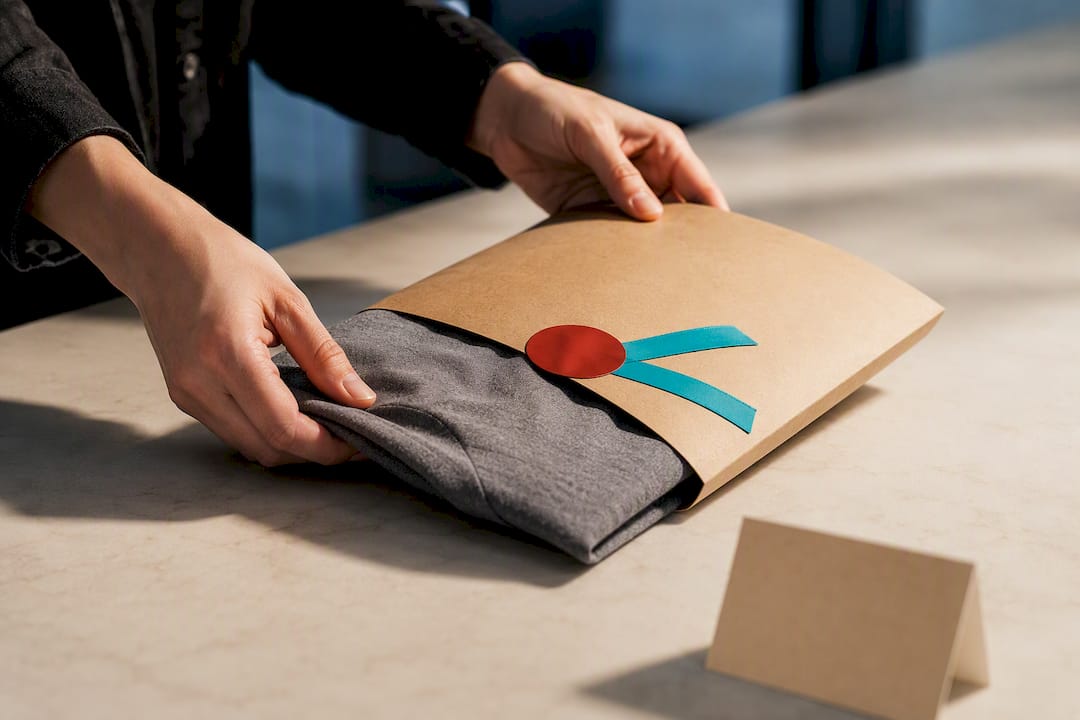
Color contrast matters more than most exhibitors budget for. A logo printed in a color close to the garment or item base tends to disappear at a glance across a show floor; a high-contrast combination reads clearly from ten feet away, which matters when your booth competes with a hundred others for the same walking path.
Consider a “reveal” moment for premium Tier Two items instead of a flat handoff. Presenting an embroidered jacket in a simple branded box, rather than pulling it off a shelf mid-conversation, changes how the recipient values it. Small packaging choices like a ribbon tie, a thank-you card with a handwritten name, or a QR code printed directly on the packaging (linking to a personalized follow-up page) all cost little but shift how the item gets perceived once the show badge comes off.
Author Perspective: Tradecraft Notes From a Custom-Apparel Producer
Timelines break more giveaway plans than budget ever does. Clients routinely approve art the week before shipping and expect embroidery to move at screen-printing speed, when digitizing a logo alone can eat several days. The fix is boring but effective: lock your design three weeks out, no exceptions. Local, in-house production earns its keep specifically in that final stretch, when overseas fulfillment simply can’t absorb a last-minute size change or a rush reorder.
— Adam
How Jam4apparel Helps You Execute Giveaways That Actually Get Used
A faster, local alternative to overseas bulk suppliers exists for the apparel piece of your giveaway plan, with production based in the Chicago area and fast digital proofs to help preview logo placement on items.
Whether you need screen-printed Tier One shirts for a big trade show floor or a small embroidered run of premium Tier Two jackets reserved for qualified leads, in-house production means fewer handoffs and fewer surprises close to your ship date. Jam4apparel handles screen printing for higher-volume runs, embroidery and puff embroidery for structured or premium pieces, DTF transfers for detailed full-color designs, and custom patches for a more textured, premium feel on outerwear. Explore options by industry or request a quote directly through Jam4apparel’s site to get a proof back before your next show’s deadline sneaks up on you.
Sources
- Trade Show Giveaway Ideas 2026 | ExhibitionsVoice
- How to Choose the Best Tradeshow Giveaways for Maximum ROI - TPG Live Events
- Trade show giveaway ideas that actually work in 2026 | Pure Exhibits
Recommended
Ready to print your design?
Screen print, embroidery, and DTF — no minimums on many styles.