
The Role of Screen Mesh in Printing: 2026 Guide
June 8, 2026
The Role of Screen Mesh in Printing: 2026 Guide
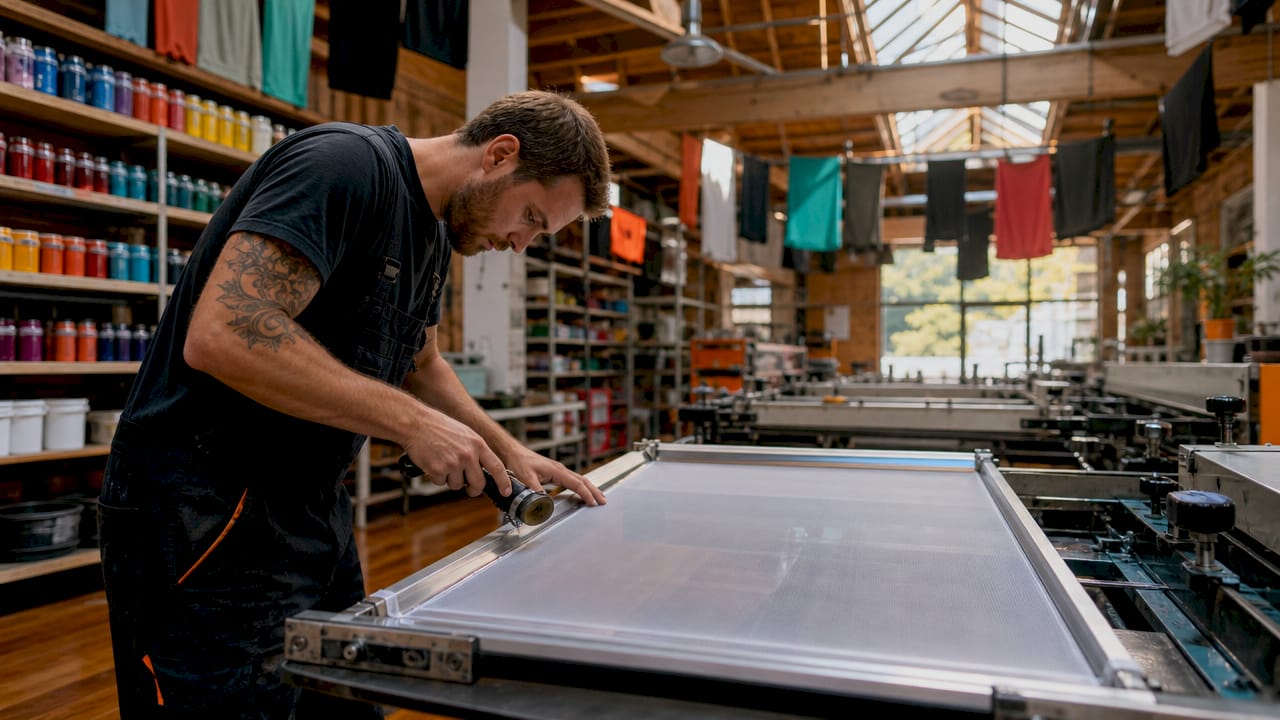
Screen mesh is the physical gatekeeper between your ink and your substrate, controlling exactly how much ink passes through, at what resolution, and with what texture. The role of screen mesh in printing determines whether a design lands as a crisp, vibrant graphic or a blurry, washed-out disappointment. Mesh count, measured in threads per square inch, is the primary variable print professionals adjust to match ink type, design complexity, and substrate. In 2026, polyester mesh dominates production environments because of its tension stability and resistance to moisture, making it the default choice for shops running multi-color jobs at volume.
How the role of screen mesh in printing shapes quality
Mesh count is the key factor determining print quality and ink deposit, with standard counts ranging from 110 for heavy coverage to 305 and above for fine graphic printing. That range is not arbitrary. Each step up or down changes how much ink flows through the screen, how sharp your edges appear, and how the finished print feels against the fabric.
Lower mesh counts like 110 leave larger openings between threads, allowing thick ink deposits to pass through freely. This makes them ideal for bold block colors, white underbases on dark garments, and any application where opacity matters more than fine detail. Higher counts in the 200 to 305 range restrict ink flow, producing thinner layers that sit closer to the fabric surface. The result is a softer hand feel and sharper detail, but only when the ink viscosity supports it.
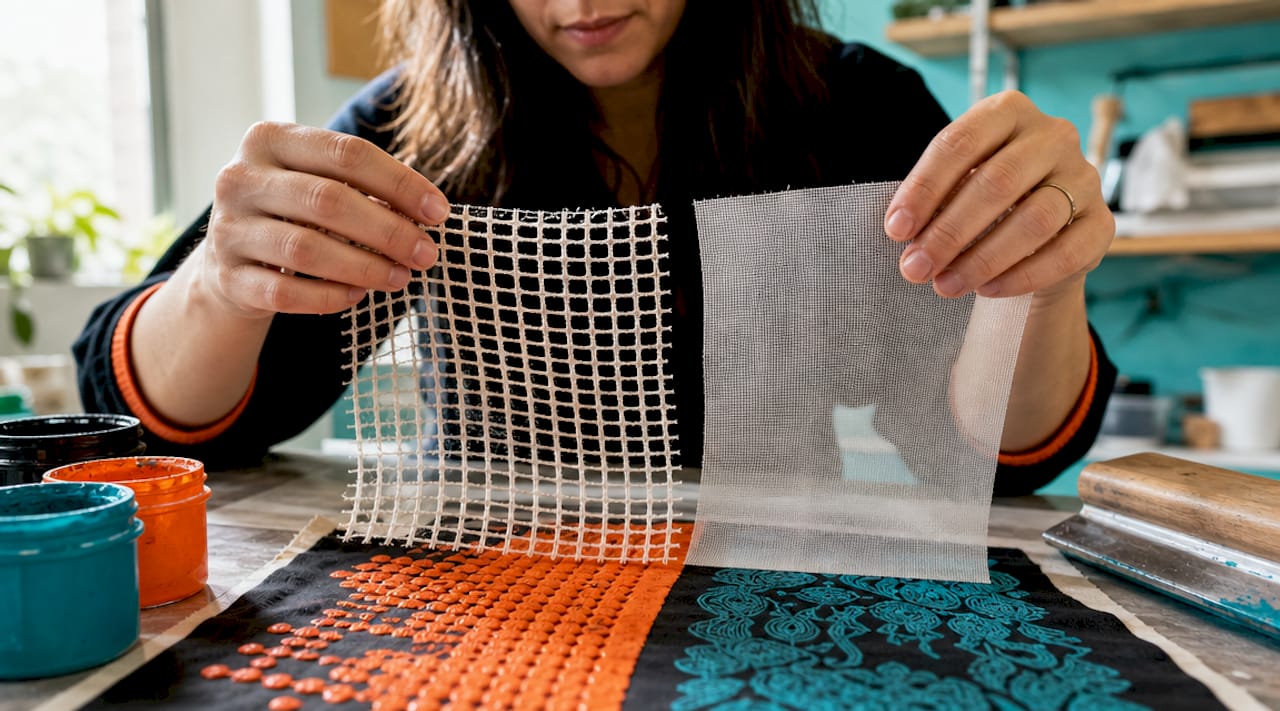
Halftone printing adds another layer of complexity. Mesh count should be 4 to 5 times the halftone screen frequency to prevent moiré patterns. For a 45 LPI halftone, you need 200 mesh or higher. For 55 LPI work, 230 to 305 mesh is the correct range. Ignoring this ratio produces the telltale interference pattern that makes photorealistic prints look amateurish.
Here is a practical reference for matching mesh count to application:
| Mesh count | Ink type | Best for |
|---|---|---|
| 86–110 | Thick plastisol, glitter | Heavy coverage, specialty inks |
| 156–180 | Standard plastisol | General apparel, spot colors |
| 200–230 | Water-based, discharge | Soft-hand prints, fine detail |
| 255–305 | Water-based, fine detail | Halftones, photorealistic art |
Pro Tip: Test a print on scrap fabric before committing to a full run. A single test pull at the correct mesh count saves you from reprinting hundreds of shirts.
How mesh material and thread diameter affect performance
Polyester mesh is the industry standard because it holds tension consistently under production conditions and absorbs almost no moisture. Nylon, once common, stretches under humidity and loses tension over a run, causing registration drift in multi-color jobs. For any shop printing more than one color, polyester is not optional. It is the baseline.
Thread diameter is the variable most printers overlook. Mesh is classified by thread thickness using designations like S (thin), T (standard), and HD (heavy duty). Thinner threads at the same mesh count increase the open area of the mesh, allowing more ink to pass through without changing the count itself. This means a 230S mesh deposits more ink than a 230T at the same squeegee pressure, giving you a finer adjustment than simply switching counts.
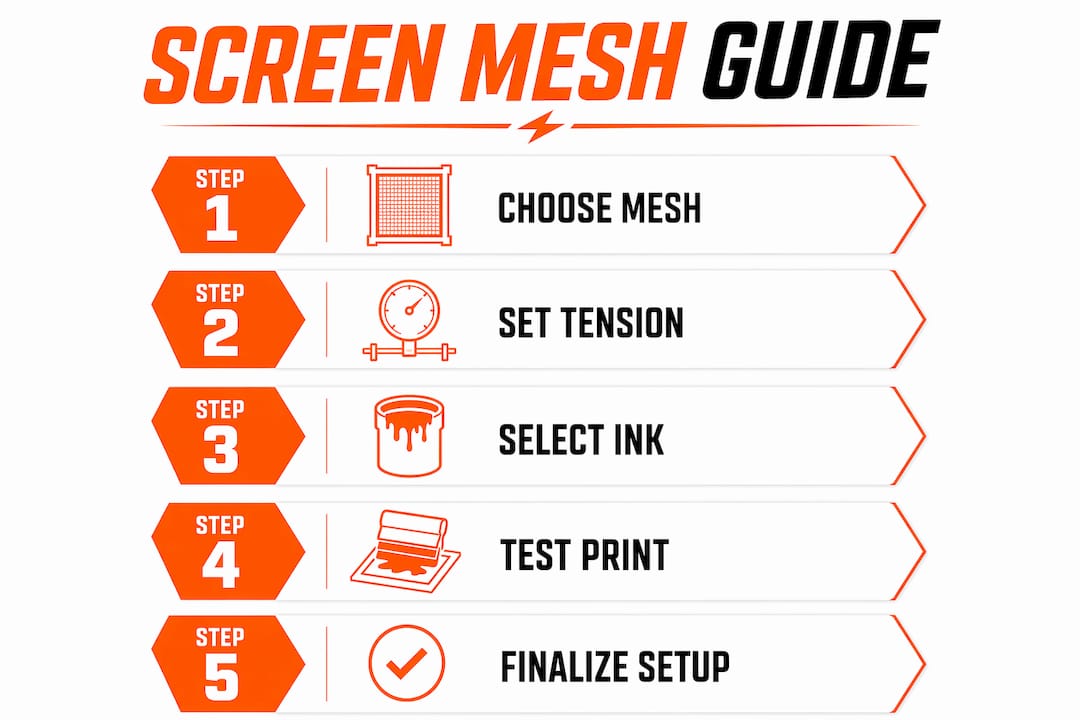
Color also matters in ways that surprise most beginners. Yellow mesh reduces light scattering during screen exposure, acting as a filter that prevents undercutting along fine lines and halftone dots. White mesh scatters light in all directions during exposure, softening stencil edges and reducing sharpness. For fine-line artwork or detailed halftones, yellow mesh is the correct choice, not a premium upgrade.
Pro Tip: When ordering screens for a high-detail job, specify both the mesh count and the thread diameter. Ordering 230T when you needed 230S can cost you an entire production run.
The combination of material, thread diameter, and color creates a matrix of options that goes well beyond simply picking a number. Shops that treat mesh as a commodity and reorder the same count for every job are leaving print quality on the table.
Choosing the right screen mesh for different inks and substrates
Matching mesh to ink type is where theory becomes practice. Here is a structured approach for the most common printing scenarios:
-
White plastisol on dark garments. White plastisol printing requires 110 to 156 mesh for adequate opacity. Going higher forces you to increase squeegee pressure, which pushes ink into fabric fibers rather than onto the surface. The result is a gray, washed-out white instead of a bright opaque one.
-
Water-based and discharge inks. These inks are thinner and penetrate fabric rather than sitting on top. They perform best on 200 to 230 mesh, where the restricted opening controls deposit and prevents flooding. Choosing 200 mesh over 110 produces a softer hand feel because the thinner ink layer bonds with the fiber rather than coating it.
-
Specialty inks with particles. Glitter, shimmer, and metallic inks contain flakes or particles that physically cannot pass through high mesh counts. These inks require 40 to 86 mesh, with openings large enough to let the particles through without clogging. Running glitter ink through a 160 mesh screen is a guaranteed blockage.
-
Underbases and paper printing. Underbases on dark garments need maximum opacity, so 110 mesh is standard. Paper printing requires more care because paper does not stretch and absorbs ink differently than fabric. A 160 to 200 mesh prevents flooding on paper while maintaining enough deposit for solid coverage.
-
Fine-detail and photorealistic designs. Designs with thin lines, small text, or halftone gradients need 230 to 305 mesh. At this count, the stencil holds fine detail without the mesh openings causing bleed. Pair this with yellow mesh and a thin-thread designation for the sharpest possible result.
The substrate matters as much as the ink. A 50/50 cotton-polyester blend absorbs ink differently than a 100% ringspun cotton shirt. Tighter weave fabrics require slightly higher mesh counts to prevent ink from pooling in the texture. Loose weave fabrics can handle lower counts without bleeding.
Common mistakes in screen mesh selection and how to fix them
Mesh count is the most important variable for print consistency, yet it is the one most often treated as an afterthought. These are the errors that show up repeatedly in production environments:
- Defaulting to one mesh count for everything. Shops that run all jobs on 160 mesh are compromising both their detailed work and their heavy-coverage work simultaneously. No single count is universal.
- Assuming higher is always better. Higher mesh count is not always the right choice. Thick inks through high mesh counts cause ink starvation, requiring excessive squeegee pressure that drives ink into the fabric instead of onto it.
- Ignoring mesh tension over time. Mesh tension affects opening geometry and ink flow consistency. A screen that printed perfectly at the start of a run can produce inconsistent results by the end if tension has drifted. Scheduled tension checks with a tension meter are not optional for shops running long production runs.
- Skipping thread diameter as a variable. Most ordering decisions stop at mesh count. Thread diameter is a free adjustment that can solve ink deposit problems without requiring new screens.
- Neglecting mesh as a quality control factor. Screen mesh acts as a gatekeeper for product consistency, influencing results under varying conditions including humidity and screen wear. A worn screen with stretched openings will print differently than a fresh one at the same count.
Pro Tip: Keep a mesh log for each screen in your shop. Record the count, thread diameter, number of print runs, and any tension readings. This data tells you exactly when a screen needs reclaiming or replacement before it starts affecting print quality.
Correct mesh selection also directly affects how long prints last after washing. Correct mesh choice enhances wash durability and reduces reprints, which matters both for customer satisfaction and your shop’s bottom line. A print that fades after three washes because the ink was pushed into the fiber rather than deposited on it is a mesh selection problem, not a curing problem.
Key takeaways
Screen mesh selection is the single most controllable variable in screen printing quality, and getting it right requires matching count, thread diameter, and material to each specific ink and substrate combination.
| Point | Details |
|---|---|
| Mesh count controls ink deposit | Counts from 110 to 305+ determine opacity, detail, and hand feel for every print. |
| Thread diameter is an overlooked variable | S, T, and HD designations adjust ink flow at the same count without reburning screens. |
| Polyester is the production standard | It holds tension under humidity and multi-color registration demands better than nylon. |
| Yellow mesh improves stencil sharpness | It filters light during exposure to preserve fine lines and halftone dot integrity. |
| Mesh maintenance prevents quality drift | Scheduled tension checks and a screen log protect consistency across long production runs. |
What I’ve learned from years of watching mesh decisions make or break a print
The most expensive mistake I see shops make is treating mesh selection as a one-time decision. They pick a count that works for their most common job, order a warehouse full of screens, and then wonder why their specialty work looks off. Mesh is not a fixed input. It is a variable you adjust per job, per ink, per substrate.
What I have found is that the shops producing the most consistent work are the ones running test prints before every new design type, not just new colors. They are also the ones tracking screen wear systematically. A screen that has run 500 impressions of white plastisol on black shirts is not the same screen it was at impression one. The tension has changed. The opening geometry has shifted. The ink deposit is different.
The other thing worth saying plainly: the importance of screen mesh is not just technical. It is financial. A wrong mesh choice on a 500-piece order means reprints, wasted ink, wasted time, and a customer who does not come back. Getting it right the first time is a business decision as much as a craft decision.
New mesh technologies, including thinner thread constructions and improved yellow mesh formulations, are making it easier to hit fine detail at lower counts than was possible five years ago. The shops that stay current with these options and test them systematically are the ones pulling ahead on quality. The ones still running the same mesh they ordered in 2019 are falling behind without realizing it.
— Adam
How Jam4apparel puts mesh expertise to work for your brand

Jam4apparel’s in-house screen printing operation in Lake in the Hills, Illinois, selects mesh count, thread diameter, and material for every job based on the specific ink, design, and garment combination. That means your white plastisol on a black hoodie gets a different screen than your water-based soft-hand print on a tri-blend tee. The result is prints that are sharper, more vibrant, and more durable than what you get from shops that run one mesh count for everything. Whether you need bulk custom screen printing for a team, a school, or a growing brand, Jam4apparel brings the technical depth to match. If screen printing is not the right fit for your project, DTF printing is available with no minimums.
FAQ
What is the role of screen mesh in printing?
Screen mesh regulates how much ink passes through the screen onto the substrate, controlling print detail, ink deposit thickness, and overall print quality. Mesh count, thread diameter, and material all influence the final result.
What mesh count should I use for white plastisol on dark shirts?
White plastisol requires 110 to 156 mesh for adequate opacity on dark garments. Higher counts force excessive squeegee pressure that drives ink into the fabric rather than depositing it on the surface.
Why is polyester mesh preferred over nylon?
Polyester holds tension consistently under production conditions and resists moisture absorption, which prevents registration drift in multi-color jobs. Nylon stretches under humidity, making it unreliable for precise, repeatable printing.
How does thread diameter affect print quality?
Thread diameter, designated as S, T, or HD, changes the open area of the mesh at any given count. Thinner threads increase ink flow and detail without requiring a different mesh count or a new screen burn.
What mesh count works best for halftone printing?
Mesh count should be 4 to 5 times the halftone screen frequency to prevent moiré patterns. For 45 LPI halftones, use 200 mesh or higher; for 55 LPI work, 230 to 305 mesh produces the cleanest dot structure.
Recommended
Ready to print your design?
Screen print, embroidery, and DTF — no minimums on many styles.