
Calculate Worn Piece Cost Before Choosing a Team Store or Bulk Order
September 5, 2026
Calculate Worn Piece Cost Before Choosing a Team Store or Bulk Order
Bulk ordering wins on price for small, stable groups under about 20 people who all need the same items once a year. Team stores win on total cost and sanity for anything bigger, more spread out, or prone to roster changes, because they trade a lower invoice price for less admin work and zero deadstock. The real decision hinges on worn-piece cost, not the number on the quote.
TL;DR:
- Bulk orders work best for groups under 20 people with stable rosters who order once a year, as they offer the lowest per-unit costs.
- Team or company stores are ideal for groups with frequent roster changes, multiple locations, or personalized needs, reducing deadstock and admin effort.
- The true per-piece cost should include deadstock, admin hours, rush reorders, and storage, often surpassing the initial invoice price by several dollars.
- A hybrid approach combining bulk for essentials and store for personalized or fluctuating items balances cost savings with flexibility.
- Proper planning involves estimating worn-piece costs, assessing roster stability, and setting clear ordering windows to avoid surprises.
Table of Contents
- Team Store vs Bulk Order at a Glance
- What Is a Team Store, Exactly?
- What Is a Bulk Order?
- Cost, Admin, and Risk: The Real Head-to-Head
- When Bulk Wins and When a Store Wins
- Running Both: The Hybrid Model
- Your Decision Checklist Before You Order
- Putting Either Model Into Action
- What Jam4apparel Sees Working in Practice
- The Real Lesson Buyers Miss
- Get Your Order Right the First Time
- Sources
Team Store vs Bulk Order at a Glance
The invoice price almost never tells the whole story. Here’s how the two models stack up on the factors that actually determine what you pay and how much of your time gets eaten up.
Bulk order, in short:
- Lowest per-unit invoice price, especially past 50 or 100 pieces
- One vendor payment, one shipment, one delivery date
- You collect sizes, handle distribution, and store leftovers
- Best for orders placed once or twice a year with a known headcount
- Typical minimums of 12 to 24 pieces per style and lead times of 2 to 3 weeks
Team or company store, in short:
- Individuals order and pay for their own sizes, cutting deadstock to near zero
- Campaign windows typically run 2 to 4 weeks before production batches, while on-demand items ship in roughly 7 to 10 business days
- Higher per-unit price, but almost no admin time after setup
- Handles late joiners and reorders without a coordinator scrambling
- Best for growing rosters, multiple locations, or frequent personalization
What Is a Team Store, Exactly?
A team or company store is a branded online storefront where individual members pick their own sizes and pay directly, instead of one person collecting a spreadsheet and a check. There are three flavors worth knowing.
Campaign stores open for a fixed window, usually two to four weeks, and only go into production once that window closes and the minimum is hit. This is the model most sports teams and school groups use for a single season kickoff.
On-demand stores have no minimum at all. Every order triggers a single print run, so the store can stay live indefinitely for new hires, replacement jerseys, or fan gear. Items typically ship within 7 to 10 business days of an order.
Stocked stores hold a small inventory of best-selling sizes for instant shipping, then fall back to on-demand for anything outside that range. It costs more per unit than pure on-demand, but it solves the “I need it this week” problem.
In every version, the individual enters their own size and shipping address, and pays through the store checkout. That single shift removes the two biggest headaches in group apparel: collecting money and guessing sizes.
What Is a Bulk Order?
A bulk order is a single purchase of a fixed quantity, negotiated at one invoice price per unit, with the whole batch shipped to one address. Suppliers price it in tiers: order 12 shirts and you pay one rate, order 100 and the per-unit cost drops noticeably, because setup costs like screens or embroidery digitizing get spread across more pieces. Most shops set a minimum order quantity, often 12 to 24 pieces per style, before those tiered discounts kick in.
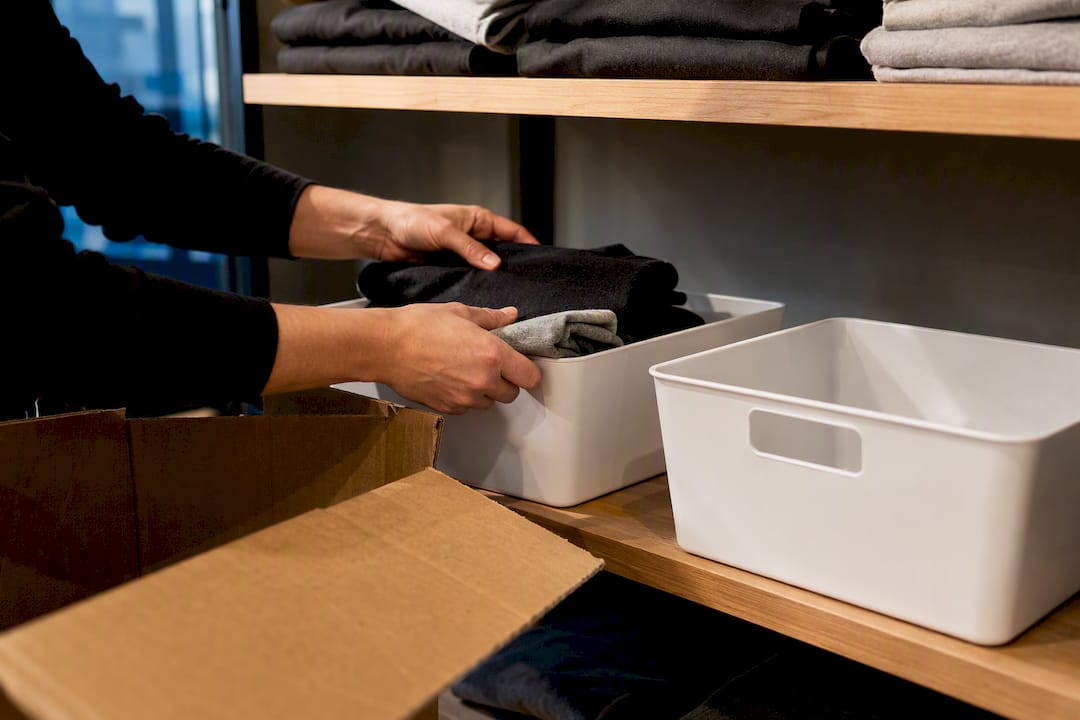
The operational flow is straightforward on paper: one person (a coach, office manager, or club treasurer) collects sizes, submits the order, pays the invoice, and receives one box or pallet. Then the real work starts. Someone has to unbox, sort by size, and hand pieces out, and someone has to find a closet, garage, or storage room for whatever doesn’t get claimed right away.
That’s where the hidden costs show up. Bulk buying spreads fixed costs across more units, but storage and carrying costs can quietly eat those savings. A batch ordered on a rough headcount guess almost always produces a few wrong sizes, a couple of leftover mediums nobody claims, and an awkward rush reorder when three new players show up in week two. None of that appears on the original invoice, but all of it hits your budget eventually.
Cost, Admin, and Risk: The Real Head-to-Head
The invoice price is the number vendors quote you. The worn-piece cost is what each shirt actually costs once you count everything that happens after the invoice is paid, and advisory guides increasingly push buyers to measure that instead. Four variables move that number more than any sales rep will tell you:
- Deadstock rate. Even a well-run bulk order typically leaves 5 to 15 percent of pieces unclaimed or in the wrong size. Those units still cost money; they just don’t get worn.
- Admin hours. Someone spends real time collecting sizes, chasing payments, sorting boxes, and handling complaints. At $20 to $30 an hour, five hours of coordinator time on a 50-piece order adds a dollar or two to every single shirt.
- Reorder penalty. A rush reorder for three latecomers rarely gets the bulk discount and often carries an expedite fee, sometimes doubling the per-unit cost for that mini-batch.
- Storage and shrinkage. Boxes sitting in a closet for a season have a way of disappearing, getting damaged, or simply being forgotten until someone finds them a year later.
Run those numbers on a 40-piece youth soccer order and a $14 invoice shirt can easily land closer to $17 or $18 once deadstock and admin time are counted. That’s not a knock on bulk pricing. It’s a reminder that the sticker price is the floor, not the ceiling.
Admin burden splits the two models cleanly. Bulk ordering front-loads almost all the work into one person for one week: collect sizes, place the order, distribute, repeat. A team store front-loads the setup (product selection, artwork approval, window dates) and then removes the coordinator from the loop almost entirely, since members handle their own sizing and payment.
Inventory risk follows the same pattern. Bulk orders create a pile of physical stock somebody has to house and track. Campaign and on-demand stores carry no leftover inventory at all, because nothing gets made until it’s already sold. That single difference is why company stores are frequently recommended once a group crosses a certain size: more people means more size variance, and more size variance means more deadstock in a bulk model.
Sizing accuracy and personalization tell a similar story. A bulk order works fine when every piece is identical. The moment you add player numbers, individual names, or a roster that changes mid-season, a store handles that variation without extra coordinator effort, while a bulk run means a manual side-order for every late addition.
Delivery timing is the one place bulk still has an edge for tight-knit groups. A single batch shipment to one address, handed out at practice, beats waiting on individual shipments when everyone is in the same room anyway. But for distributed teams, remote employees, or franchise locations, direct-to-recipient shipping from a store is strictly less work, because nobody has to play mail carrier.
Pro Tip: Before comparing quotes, build a quick worn-piece cost estimate: invoice price, plus expected deadstock percentage, plus your own hourly admin cost times hours spent, plus any rush-reorder history. That number, not the line-item price, is what actually predicts your budget.
Late players and reorders are the stress test for either model. In a bulk setup, a reorder means going back to the same vendor for a handful of units, usually at a worse per-piece rate and a longer wait since it’s outside the original production run. In a store setup, a late joiner just places their own order on the existing storefront, at the same price everyone else paid, without anyone having to manage a side transaction.
When Bulk Wins and When a Store Wins
Team size and turnover decide this more than budget does. A few clear patterns show up across most groups:
- Under roughly 20 people, bulk usually wins. A stable roster of 12 to 18 people who order once a year has little size variance to manage, and the coordinator’s time investment stays small enough that the invoice discount outweighs the admin cost.
- Between 20 and 50, it depends on turnover. A stable adult league team of 30 people who reorder every two years still leans bulk. A youth program with rolling enrollment and mid-season additions leans store, even at the same headcount, because the reorder frequency is what drives cost, not the roster size alone.
- Above roughly 50, a store usually wins. Vendors and buyers alike report that past this point, the admin time saved and deadstock avoided outweighs the higher per-unit price almost every time.
A useful shortcut some vendors use: if you’re placing more than two reorders a year, or if one person has quietly become your permanent “uniform coordinator,” a store will usually save both time and money. One-off events, like a single tournament weekend or a company picnic, almost always favor bulk regardless of headcount, because there’s no ongoing reorder cycle to worry about.
Running Both: The Hybrid Model
Most experienced buyers land on hybrid programs, not a strict either/or choice. Core items go through bulk to lock in the lowest invoice price, while everything discretionary or personalized lives on a store.
- Bulk the essentials: practice jerseys, game-day uniforms, or company-issued base layers that everyone needs on day one, ordered once with accurate headcounts.
- Store the extras: fan hoodies, personalized name-and-number gear, replacement pieces, and anything a new team member might need after the initial bulk run ships.
- Split by predictability, not by product type. If demand is known and stable, bulk it. If demand fluctuates or personalization is involved, put it on the store.
The one operational trap: keep the two systems from competing on the same SKU at different prices, or members will notice and complain. Set clear windows for each, communicate which items live where, and treat the store as the permanent fallback once the bulk batch is gone.
Your Decision Checklist Before You Order
Work through these questions before requesting quotes, and you’ll avoid most of the surprises that turn a simple order into a budgeting headache.
- How stable is your roster? Low turnover points to bulk; frequent joiners point to a store.
- Who has time to manage sizing and distribution? If nobody can own that job for a week, lean store.
- What’s your storage situation? No closet or office space to hold boxes is a vote for on-demand.
- Do you need personalization? Names, numbers, or role-specific gear favor a store’s per-order flexibility.
- What are your real deadlines? Ask suppliers directly about production triggers, split shipments, and rush fees before you commit.
- What’s the vendor’s sample and reorder policy? A supplier who can’t answer this clearly is a red flag regardless of price.
When you talk to a supplier about custom athletic apparel, ask specifically what happens if your headcount changes mid-order, and get their answer in writing.
Pro Tip: Plug real numbers into a simple spreadsheet: invoice price per unit, expected deadstock percentage from last year’s order, hourly cost of admin time, and average rush-reorder markup. Most teams are surprised by which model actually comes out cheaper once it’s on paper.
Putting Either Model Into Action
If you’re going bulk: collect sizes with a simple form two to three weeks before ordering, confirm mockups and colors before production starts, place the order at the agreed cadence (once a season, not once a month), and assign one person to receive, sort, and log distribution so you know exactly what’s left over.
If you’re launching a team store: set your storefront live for a defined campaign window, usually two to four weeks, communicate the closing date at least twice, monitor order volume against your minimum, and confirm whether the vendor ships in batches to one address or direct to each individual.
For rush situations either way: keep a running log of every reorder and its cost, so you have real numbers the next time someone asks whether bulk or a store makes more sense for your group.
What Jam4apparel Sees Working in Practice
Running screen printing, embroidery, DTF transfers, and spirit wear stores in-house from Lake in the Hills, Illinois, means Jam4apparel handles both sides of this decision daily, for everyone from martial arts academies to growing sports programs. The pattern holds up consistently: small, stable rosters do fine with a bulk run, and once a group starts adding people mid-season or needs personalized gear, a store setup pays for itself in saved coordinator hours within the first reorder cycle.
The thresholds discussed throughout this guide, under 20 for bulk, 20 to 50 as a judgment call, 50-plus favoring a store, match what shows up across order histories for schools, teams, and small businesses alike.
The Real Lesson Buyers Miss
Most groups compare vendors on invoice price and call it a decision. That’s backwards. The vendor with the cheapest per-shirt quote can easily produce the most expensive outcome once you count deadstock, rush reorders, and the hours someone spent chasing payments through a group chat.
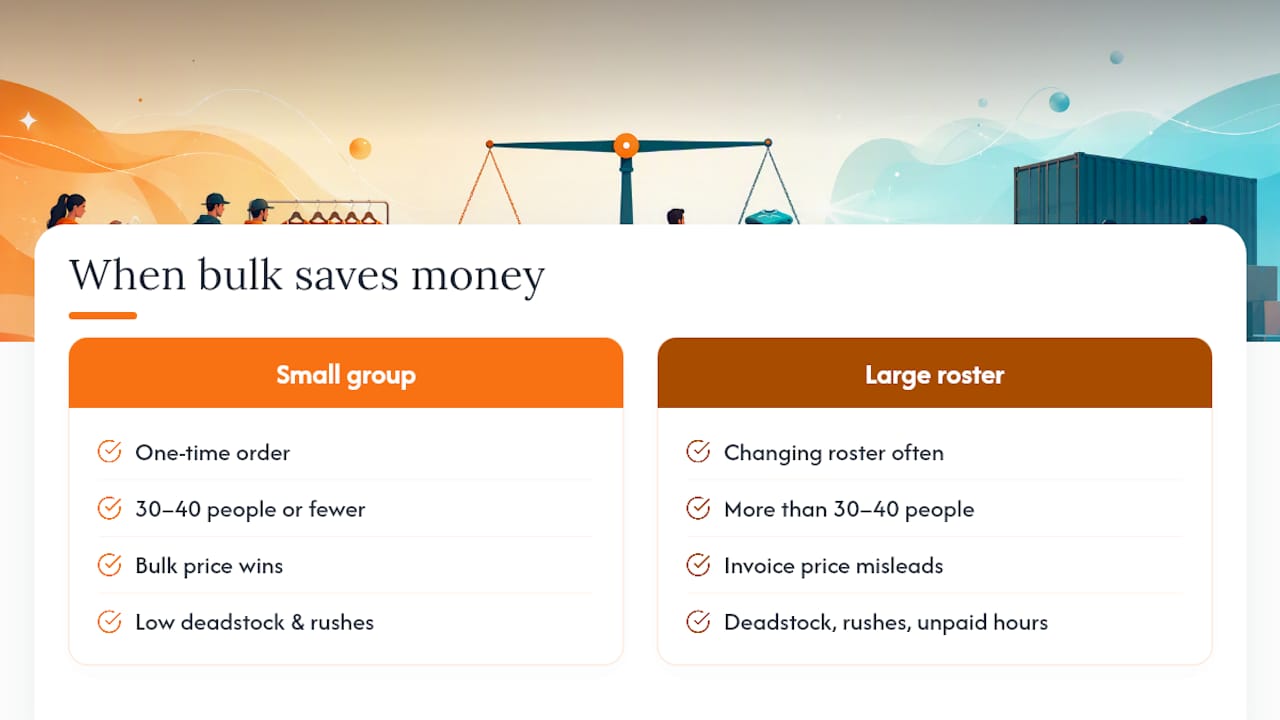
The conventional advice, “buy in bulk to save money,” is true only for the specific case it describes: a small, stable group ordering once. Stretch that advice past 30 or 40 people, or apply it to a roster that changes every few months, and it quietly stops being cheaper. It just moves the cost from the invoice to somebody’s unpaid Saturday spent sorting boxes.
If you take one thing from this guide, make it this: calculate worn-piece cost before you compare quotes, not after you’re stuck with 15 unclaimed mediums. The number on the invoice is a starting point, never the answer.
— Adam
Get Your Order Right the First Time
Some vendors offer both bulk ordering and team store options, so switching from a bulk order to a hybrid setup mid-season doesn’t necessarily mean starting over with a new supplier.
Sizing mistakes, late reorders, and fulfillment headaches are common pain points, and many apparel providers offer design proofs and clear production timelines to address these issues. In-house production can help maintain fast turnaround times without necessarily adding a markup for rush requests.
Browse custom apparel by industry to see how teams and businesses similar to yours have structured their orders, or head straight to Jam4apparel’s home page to request a quote and talk through whether a bulk run, a team store, or a hybrid setup fits your group best.
Sources
- How to Set Up a Profitable Team Store for Your Organization
- Bulk Ordering vs Company Store: The Real Math for Contractors | Bighorn Threads
Recommended
Ready to print your design?
Screen print, embroidery, and DTF — no minimums on many styles.