
Screen Printing Ink Types Explained for Custom Apparel
June 14, 2026
Screen Printing Ink Types Explained for Custom Apparel
Screen printing inks are specialized formulations designed to bond with fabric and substrates, and the four main categories are plastisol, water-based, discharge, and specialty inks. Each type delivers a different hand feel, opacity level, and curing requirement. Choosing the wrong ink for your fabric or project scale costs you time, money, and print quality. This guide breaks down every major ink category, compares their real-world performance, and gives you a clear framework for making the right call on your next custom apparel or promotional order.
What are the main screen printing ink types explained?
Plastisol, water-based, discharge, and specialty inks are the four core categories every screen printer and apparel buyer needs to understand. Each one solves a different problem. Plastisol handles high-volume commercial work. Water-based inks serve soft-hand fashion prints. Discharge inks remove dye from dark garments. Specialty inks create effects that standard formulas simply cannot produce.
The ink you choose affects everything downstream: screen mesh selection, curing temperature, press speed, and the final feel of the garment. Getting familiar with these categories before you place an order puts you in control of the outcome.
Why is plastisol ink the industry standard?
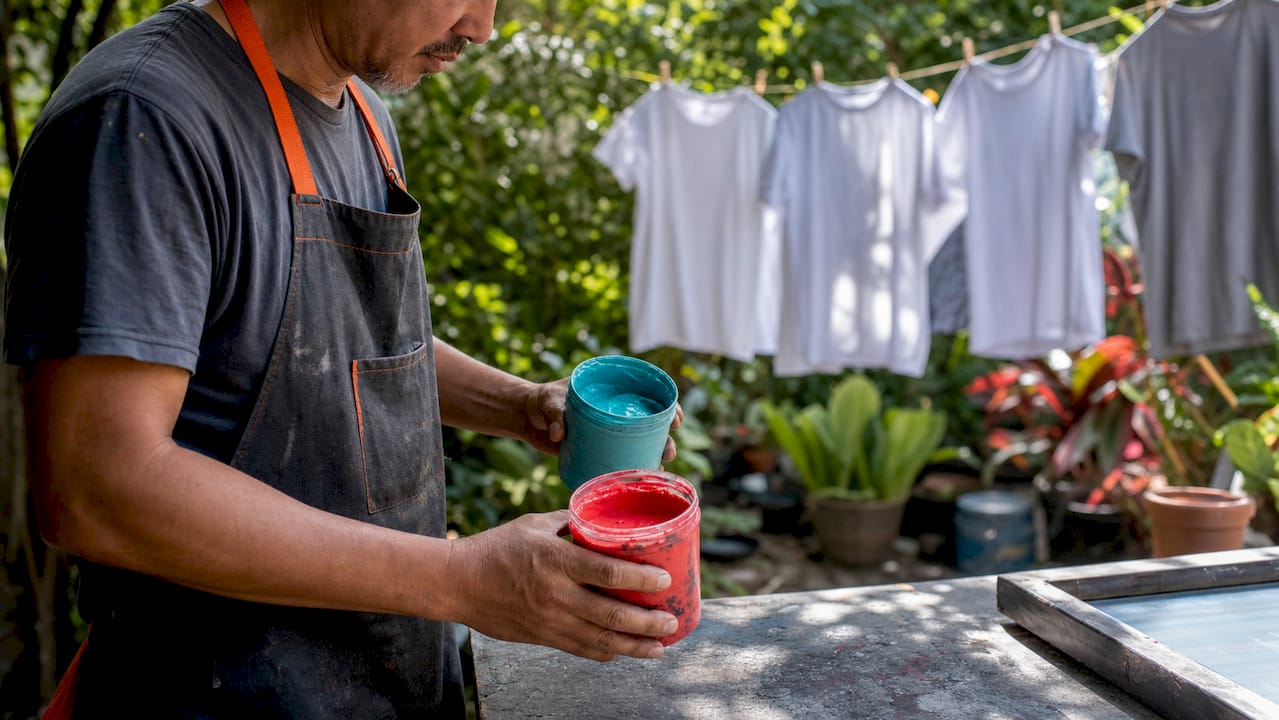
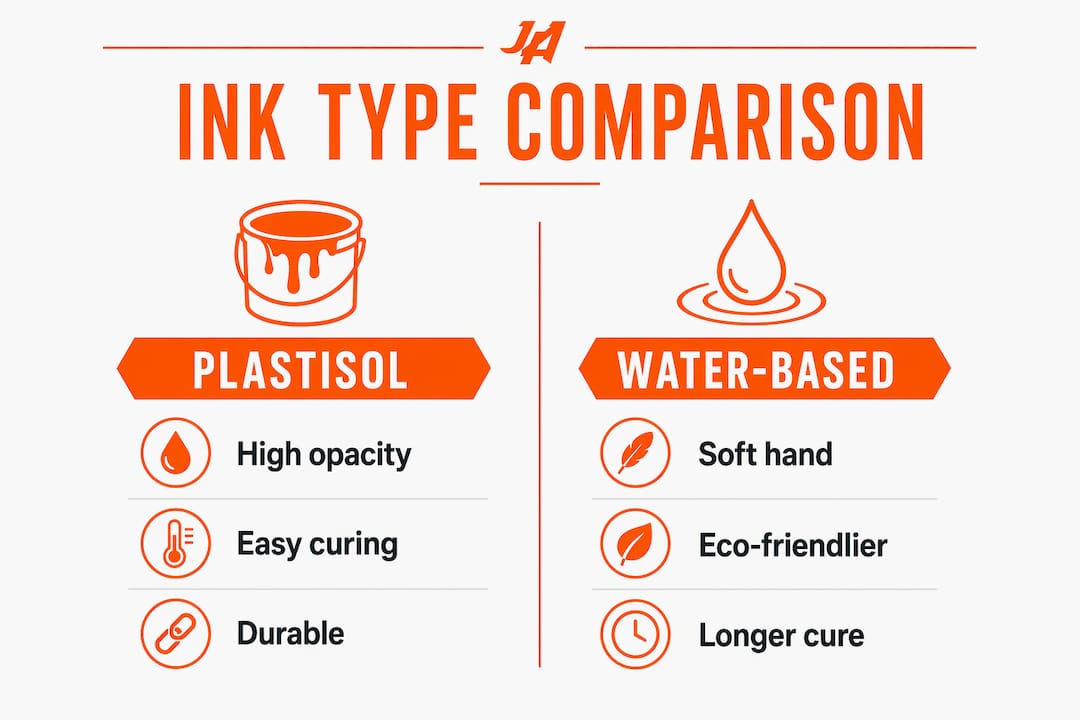
Plastisol ink is a PVC resin suspended in a plasticizer, and it dominates commercial screen printing for one simple reason: it does not dry in the screen. That single property makes it forgiving, fast, and reliable at scale.
Key plastisol advantages:
- Opacity: Plastisol produces vibrant, opaque colors that cover dark fabrics without a base layer in many cases.
- Curing: It cures at 320°F (160°C) with consistent results across large runs.
- Open time: Plastisol’s stability gives printers longer open time, which is a major advantage for beginners and high-volume shops alike.
- Durability: The cured ink sits on top of the fabric, creating a raised, rubbery feel that holds color through repeated washing.
- Cost efficiency: For volume runs exceeding 100 pieces, plastisol is the most cost-effective and operationally reliable choice due to process stability and curing speed.
The trade-offs are real. Plastisol feels heavier on lightweight fabrics, and its PVC content raises environmental concerns. Printing on polyester adds another complication: standard plastisol causes dye migration during curing, which means you need low-bleed or low-cure formulas for synthetic fabrics.
Pro Tip: If you are printing on 100% cotton in quantities above 48 pieces, plastisol is almost always the right call. It is consistent, affordable, and the color payoff on dark shirts is hard to beat.
How do water-based inks differ from plastisol?
Water-based ink uses water as its carrier instead of PVC, and it penetrates garment fibers rather than sitting on top of them. The result is a print that feels like part of the shirt, not a layer added to it. That soft, breathable quality makes water-based inks the preferred choice for fashion tees, retail brands, and anyone who prioritizes wearability over maximum opacity.
The process demands more discipline than plastisol. Here is what you need to manage:
- Screen preparation: Water-based inks require water-resistant emulsions to prevent premature breakdown of the stencil during printing.
- Climate control: Humidity and temperature on press directly affect how fast the ink dries in the mesh. Dry conditions accelerate clogging.
- Curing: These inks cure between 280–320°F and require careful moisture evacuation to fully cure without scorching the fabric.
- Opacity management: Water-based inks struggle on dark fabrics. You typically need a discharge base or multiple passes to achieve solid coverage.
- Shelf life after mixing: Once activated, some water-based formulas have a limited working window before they thicken or degrade.
Water-based ink is not a magic bullet for sustainability. Lower VOC emissions are a genuine benefit, but the longer curing times and higher process complexity offset some of that environmental advantage. The ink is better for the air in your shop, but it demands more energy and attention to get right.
Pro Tip: Ask your printer whether they use water-resistant emulsion and have humidity control on press. If the answer is no to either, water-based results will be inconsistent. The ink is only as good as the process behind it.
What are specialty inks and when should you use them?
Specialty inks solve specific problems and create effects that plastisol and water-based formulas cannot. They are not everyday workhorses. They are tools for targeted results.
Discharge ink removes the dye from a garment rather than printing on top of it. The result is a soft, vintage-looking print on dark fabrics with almost no hand feel. Discharge inks require activators that shorten shelf life to roughly 8 hours after mixing. They only work on reactive-dyed 100% cotton, so fabric selection is critical.
Metallic and glitter inks add shine and texture to a design. Metallic inks use fine metal particles suspended in a base. Glitter inks use larger flake particles for a more dramatic effect. Both require coarser screen mesh to allow the particles to pass through cleanly.
Puff inks contain a heat-activated expanding agent. When cured, the ink rises off the fabric surface to create a three-dimensional, raised effect. Puff works well for bold text and simple shapes. Fine detail gets lost in the expansion.
Acrylic inks are gaining traction as air-drying alternatives that reduce dye migration on polyester. They cure without the high heat that triggers polyester dye bleed, making them a practical solution for athletic wear and performance fabrics.
Specialty inks enable distinctive branding with textures and effects that standard inks cannot replicate. For niche markets like sports teams, event merchandise, and premium retail, that differentiation is worth the added complexity.
| Ink Type | Best Use Case | Key Limitation |
|---|---|---|
| Discharge | Soft prints on dark cotton | Requires reactive-dyed cotton only |
| Metallic | Shine and premium look | Needs coarse mesh, limited detail |
| Puff | 3D raised text and logos | Not suited for fine detail |
| Acrylic | Polyester and performance fabrics | Slower drying, limited color range |
How do you compare screen printing inks side by side?
Choosing between ink types comes down to five practical factors: fabric type, opacity needs, curing requirements, production volume, and environmental priorities.
| Factor | Plastisol | Water-Based | Discharge | Specialty |
|---|---|---|---|---|
| Fabric compatibility | Cotton, blends | Cotton, linen | Reactive-dyed cotton | Varies by formula |
| Opacity on dark fabric | Excellent | Poor to moderate | Excellent (soft) | Varies |
| Curing temperature | 320°F | 280–320°F | 300–320°F | Varies |
| Drying in screen | None | High risk | Moderate risk | Varies |
| Environmental impact | Higher (PVC) | Lower VOCs | Moderate | Varies |
| Best production scale | High volume | Small to mid runs | Small to mid runs | Accent use |
Polyester fabrics deserve special attention. Standard plastisol at full cure temperatures causes dye migration, where the garment’s dye bleeds into the ink and shifts the color. Low-bleed plastisol formulas and acrylic inks are the two reliable solutions. Understanding screen mesh selection also plays a role here, since coarser meshes are required for metallic and glitter inks while finer meshes suit water-based formulas.
Pro Tip: For orders that mix light and dark garments in the same design, plastisol with a white underbase on dark shirts is the most consistent approach. It keeps color matching tight across the full run.
How to choose the right screen printing ink for your project
Matching ink to project is a decision with real consequences for print quality and cost. Use these criteria to narrow your choice:
- Fabric content: Cotton favors plastisol, water-based, and discharge. Polyester requires low-bleed plastisol or acrylic. Blends need testing before committing to a full run.
- Garment color: Dark fabrics need high-opacity inks like plastisol or discharge. Light fabrics open up more options, including water-based.
- Desired hand feel: Soft and breathable points to water-based or discharge. Bold and durable points to plastisol.
- Order quantity: Above 100 pieces, plastisol wins on cost and consistency. Below that threshold, water-based or specialty inks become more practical.
- Design complexity: Fine detail and halftones work best with water-based inks on fine mesh. Bold graphics and solid fills are plastisol territory.
- Environmental priorities: Water-based inks lower VOC output, but they require more energy to cure and more process control. The trade-off is real, not automatic.
- Special effects: If your brand needs metallic shine, raised texture, or a vintage washed look, plan for specialty inks from the start. Retrofitting a design for specialty inks after the fact adds cost.
Mixing ink types across a single order is also a legitimate strategy. A plastisol base with a metallic accent color, for example, gives you production efficiency plus a premium visual detail.
Key takeaways
The best screen printing ink is the one matched to your fabric, design, and production scale, not the most popular or the most eco-friendly on paper.
| Point | Details |
|---|---|
| Plastisol dominates volume work | It does not dry in the screen and delivers consistent opacity on dark fabrics at scale. |
| Water-based requires process control | Humidity, emulsion type, and curing management determine whether results are soft or inconsistent. |
| Discharge is fabric-specific | It only works on reactive-dyed 100% cotton and has an 8-hour working window after activation. |
| Polyester needs specialized inks | Low-bleed plastisol or acrylic inks prevent dye migration on synthetic fabrics. |
| Specialty inks serve targeted needs | Metallic, puff, and glitter inks create effects no standard formula can replicate. |
What i’ve learned from watching ink choices go wrong
The most common mistake I see is treating water-based ink as the automatic “better” choice because it sounds cleaner. It is not simpler. It is not always greener when you factor in longer cure times and the energy required to manage moisture. Shops that switch to water-based without upgrading their emulsion, controlling humidity, and training their press operators end up with inconsistent prints and frustrated clients.
Plastisol gets a bad reputation it does not fully deserve. Yes, the PVC content is a real environmental concern. But for a school in Elgin ordering 500 spirit wear shirts, or a martial arts academy in McHenry needing 200 uniform pieces, plastisol delivers reliable color, sharp edges, and durability that water-based simply cannot match at that scale without significantly more setup cost.
My honest recommendation: start with plastisol for any order above 72 pieces on cotton or cotton blends. Use water-based when the client specifically wants a soft, retail-quality hand feel and you have the process controls in place. Reach for discharge when the design calls for a vintage look on a dark garment. And treat specialty inks as a branding investment, not a default. A single metallic accent on a team hoodie can make the whole design feel premium. That is worth planning for.
Communicate with your printer about what you want the final print to feel like. A good shop will tell you which ink fits your fabric and design. If they cannot answer that question, find a shop that can.
— Adam
Get the right ink for your custom order with Jam4apparel
Jam4apparel handles custom screen printing for businesses, schools, sports teams, and nonprofits throughout the Chicagoland area, with in-house production that covers plastisol, water-based, and specialty ink applications.
Whether you need 50 soft-hand fashion tees or 500 bold spirit wear hoodies, the team at Jam4apparel matches the right ink to your fabric, design, and deadline. From low-bleed formulas for polyester athletic wear to metallic accents for premium branded merchandise, every order gets the ink treatment it actually needs. Visit the custom screen printing page to request a quote or talk through your project with the team. You can also explore the full range of custom apparel services to see what Jam4apparel can produce for your brand.
FAQ
What is the most common ink used in screen printing?
Plastisol ink is the industry standard for screen printing because it does not dry in the screen and cures consistently at 320°F. It is the preferred choice for high-volume commercial orders on cotton and cotton-blend fabrics.
Is water-based screen printing ink better than plastisol?
Water-based ink produces a softer, more breathable print but requires more process control and performs poorly on dark fabrics without a discharge base. Plastisol is more reliable for large runs and dark garments, while water-based suits fashion-forward soft-hand applications.
Can you screen print on polyester with standard inks?
Standard plastisol causes dye migration on polyester during curing, which shifts print colors. Low-bleed plastisol formulas or acrylic inks are required to maintain print quality on synthetic and performance fabrics.
What is discharge ink used for?
Discharge ink removes the dye from a garment and replaces it with a soft, low-profile print color. It works only on reactive-dyed 100% cotton and has a short working window of about 8 hours after the activator is mixed in.
How do i choose between screen printing ink types for my order?
Match ink to fabric content, garment color, desired hand feel, and order quantity. Plastisol fits high-volume dark-fabric orders, water-based suits soft-hand light-fabric runs, and specialty inks address specific effects or fabric challenges like polyester dye migration.
Recommended
Ready to print your design?
Screen print, embroidery, and DTF — no minimums on many styles.