
Screen Printing Cost in 2026: A Practical Pricing Guide
August 10, 2026
Screen Printing Cost in 2026: A Practical Pricing Guide
For a one-color front print on a moderate number of light-colored shirts, expect to pay a moderate per-shirt price for the print decoration alone, not counting the garment itself. That range shifts fast depending on how many colors you’re printing, how many shirts you order, and whether you’re starting from scratch or reusing existing screens.
Here’s what a typical invoice includes and excludes at a glance:
What’s usually included in per-shirt print pricing:
- Ink and labor for the print itself
- Screen use (amortized into the per-shirt rate on larger runs)
- Basic quality control
What’s typically excluded and billed separately:
- Garment/blank cost ($3–$15+ per shirt depending on style)
- One-time screen setup fees ($15–$35 per color, per screen)
- Art setup or file prep charges
- Rush fees and shipping
Quick ranges by run size:
- 12–24 shirts: $10–$20+ per shirt for printing (setup fees hit hardest here)
- 24–100 shirts: $6–$12 per shirt
- 250–500+ shirts: $2–$6 per shirt
The per-shirt print cost on a large run can be significantly less than on a very small run for the same design. That gap is almost entirely explained by how setup fees amortize across units.
Key Takeaways
Screen printing cost is driven primarily by quantity and color count, and understanding setup fees is the single most important step to reading any quote accurately.
| Point | Details |
|---|---|
| Per-shirt print ranges | Expect $2–$6 per shirt at 500+ units and $8–$20 at 12–24 units, decoration only. |
| Setup fees are fixed | Screen charges of $15–$35 per color hit small runs hardest; they amortize on larger orders. |
| Dark garments cost more | A white underbase adds one screen and one print pass, effectively increasing color count by one. |
| Reorders save money | Shops that store screens for 6–12 months often waive or reduce setup fees on repeat orders. |
| Jam4apparel | Offers in-house screen printing with free design proofs and itemized quotes for Chicagoland customers. |
Table of Contents
- How screen printing cost changes with quantity and color count
- What you’re actually paying for: setup fees, screens, and reorders
- What actually moves your quote: the main cost drivers
- Screen printing vs. DTG and DTF: which method actually costs less?
- How to calculate a realistic all-in quote
- How to price screen printing if you’re the vendor
- Practical ways to lower your screen printing spend
- Rush fees and turnaround: what to expect and how to plan
- What the pricing guides get wrong about screen printing costs
- Fast, itemized screen printing quotes from Jam4apparel
- Sources
How screen printing cost changes with quantity and color count
The single biggest lever in any screen printing quote is quantity. Add colors, and the second lever kicks in hard.
| Quantity | 1-Color, Light Shirt | 1-Color, Dark Shirt | 4-Color, Light Shirt | 4-Color, Dark Shirt |
|---|---|---|---|---|
| 24 | $8–$12 | $10–$14 | $14–$20 | $17–$23 |
| 50 | $6–$8 | $8–$10 | $10–$15 | $12–$18 |
| 100 | $4–$7 | $6–$8 | $7–$12 | $9–$13 |
| 250 | $3–$5 | $4–$6 | $5–$8 | $6–$10 |
| 500+ | $2–$4 | $3–$5 | $3–$6 | $4–$8 |
Print decoration only. Garment cost and one-time setup fees are not included.
Dark garments cost more because they require a white underbase, which is an extra screen, extra ink pass, and extra labor. A four-color design on a black shirt is effectively a five-color job.
To find your all-in per-shirt cost, add garment cost and amortized setup fees to the print rate. For example, a run with moderate garment and setup costs plus print price results in a total per-shirt cost combining these factors.
Per-unit costs can drop from over $15 on tiny runs to under $2 on high-volume screen-print jobs, which is why quantity decisions matter more than almost any other variable in a quote.
What you’re actually paying for: setup fees, screens, and reorders
Setup fees are the most misunderstood line item in screen printing. They’re fixed costs, not per-shirt costs, and they don’t scale with your order size.
Screen setup fees typically run $15–$35 per screen per spot color. A three-color design means three screens, so expect $45–$105 in setup fees before a single shirt is printed. On a 12-shirt run, that’s $3.75–$8.75 added to every shirt just for screens. On a 200-shirt run, the same fees add less than $0.53 per shirt.
Typical one-time and setup fees to ask about:
- Screen charge: $15–$35 per color
- Film/transparency output: $5–$15 per color (some shops bundle this)
- Art setup or file prep: $25–$75/hour if your file isn’t print-ready
- Color separation for complex designs: $25–$100+
- Screen storage fee: $5–$15/month per screen (varies widely by shop)
Reorder pricing is where things get interesting. Many shops store your screens for 6–12 months. When you reorder within that window, you skip the screen charge entirely or pay a reduced reclaim fee. That can cut $50–$100 off a reorder invoice compared to a first-time order.
Pro Tip: Ask every vendor two questions before you sign off: “How long do you store screens?” and “What’s the reorder fee if I come back within that window?” A shop that stores screens for a year and waives setup on reorders is worth more than one that’s $0.50 cheaper per shirt on the first run.
For Illinois-based buyers, screen printing setup fees and what they mean for your budget is worth reading before you request your first quote.
What actually moves your quote: the main cost drivers
Not all variables hit your invoice equally. Here’s how they rank:
High impact:
- Quantity — the dominant driver. Doubling your order size often cuts per-shirt cost by 30–50%.
- Number of print colors — each color is another screen, another setup fee, more ink, more passes. Going from 1 color to 4 colors can double the print cost per shirt on small runs.
Medium impact:
- Garment blank cost — a $4 Gildan tee vs. a $14 Next Level tri-blend changes your all-in cost dramatically, especially on larger runs.
- Print placement — a front chest print is standard. Add a back print, sleeve print, or oversized print and you’re adding another screen setup and another print pass.
- Ink coverage — a small left-chest logo uses far less ink than a full-front bleed. High-coverage designs cost more to run.
Lower impact (but worth knowing):
- Specialty inks and effects — metallic, puff, glow-in-the-dark, and discharge inks all carry surcharges, typically $0.50–$2.00 per shirt extra.
- Regional labor and overhead — shops in major metro areas (New York, Los Angeles, Chicago) tend to price 10–20% higher than shops in smaller markets, reflecting rent and labor differences.
Reducing color count and batching multiple designs into a gang print are the two fastest ways to cut per-unit cost on short runs. A two-color design that could work as one color with a slightly bolder treatment is worth reconsidering before you finalize artwork.
Pro Tip: If your design uses gradients or photographic detail, that’s not a 4-color job — it’s a simulated process print that can require 6–8 screens. Ask your vendor how they’d handle it before assuming a color count.
Screen printing vs. DTG and DTF: which method actually costs less?
The honest answer: it depends entirely on order size and design complexity.
| Method | Setup Fee | Per-Shirt Cost (small run) | Per-Shirt Cost (large run) | Best For |
|---|---|---|---|---|
| Screen printing | $15–$35/color | $8–$20 | $2–$6 | 50+ units, simple/bold designs |
| DTG | None | $8–$20 | $6–$15 | Under 24 units, full-color photos |
| DTF | Minimal | $5–$15 | $3–$8 | 12–50 units, complex art, dark garments |
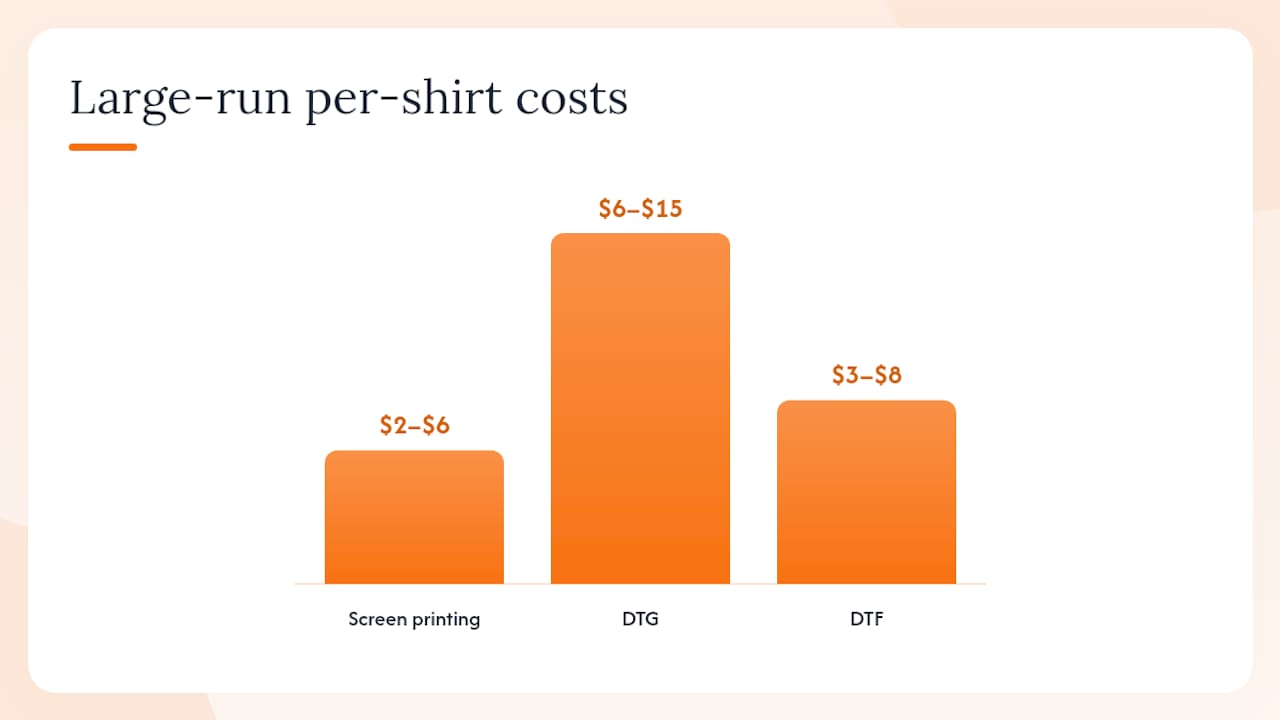
Screen printing wins on cost above roughly 48–144 units, depending on how many colors are in the design. Below that threshold, DTG or DTF often produces a lower all-in cost because there are no screen setup fees to absorb.
A few practical rules:
- Under 24 shirts with complex, full-color art: DTG or DTF is almost always cheaper.
- 50+ shirts with 1–3 bold colors: Screen printing wins on per-unit cost.
- Dark garments in any volume: Screen printing handles underbases more efficiently at scale; DTF is competitive on small dark-garment runs.
- Mixed runs (some shirts, some hoodies, different sizes): Ask for a mixed-method quote. Some shops will DTF the small-quantity items and screen print the bulk.
For a deeper look at how these methods compare on quality and durability, the DTF vs. screen printing buyer’s guide breaks it down by use case.
How to calculate a realistic all-in quote
The formula is straightforward. What trips people up is forgetting to include every line item.
Pricing formula:
Example 1: 24 shirts, 1 color, light garment
- Setup fee: 1 screen × $25 = $25
- Garment cost: 24 × $5 = $120
- Print labor and ink: 24 × $5 = $120
- Overhead (15%): ($25 + $120 + $120) × 0.15 = $39.75
- Shipping: $18
- Total: $322.75 ÷ 24 = $13.45 per shirt
Example 2: 100 shirts, 2 colors, dark garment
- Setup fees: 2 screens × $25 + white underbase screen × $25 = $75
- Garment cost: 100 × $6 = $600
- Print labor and ink: 100 × $8 = $800
- Overhead (15%): ($75 + $600 + $800) × 0.15 = $221.25
- Shipping: $35
- Total: $1,731.25 ÷ 100 = $17.31 per shirt
Online pricing calculators can automate this amortization, but they’re only as accurate as the inputs you give them. Use real screen charge figures and your actual garment cost, not placeholder numbers.
Shop pricing guides consistently recommend requesting an itemized quote that breaks out setup, per-shirt print, garments, shipping, art charges, and tax separately. A single “per shirt” number from a vendor tells you almost nothing about where the cost is sitting.
How to price screen printing if you’re the vendor
If you’re running a side hustle or small print shop, the math above is your cost floor. Pricing above it is where most new vendors undercharge.
Markup guidance:
- Keystone (100% markup): Double your all-in cost per shirt. A $7 cost becomes a $14 retail price. Standard for retail and event shirts.
- 50% margin target: Divide cost by 0.50. A $7 cost becomes a $14 price. Same result as keystone, different framing.
- Wholesale/bulk pricing: 30–40% margin is common when selling to resellers or large corporate accounts.
Break-even and overhead:
- Calculate your fixed monthly overhead (equipment depreciation, rent, utilities, software).
- Divide by your expected monthly billable units to get an overhead cost per shirt.
- Add that figure to every job before applying markup.
A shop running $2,000/month in overhead and printing 1,000 shirts per month needs to recover $2.00 per shirt before profit.
Pro Tip: Build a tiered pricing sheet with three quantity brackets (under 50, 50–149, 150+) and publish it. Customers who see transparent tiers order more to hit the next break. Reorder discounts (waived setup fees for returning customers) close repeat business faster than any other incentive.
Practical ways to lower your screen printing spend
Most cost-saving moves happen before the order is placed, not during negotiation.
- Reduce color count. Going from 3 colors to 2 eliminates one screen setup fee and speeds the print run. If a color in your design is decorative rather than essential, cut it.
- Increase quantity. If you’re at 45 shirts, pricing 50 often costs less per shirt total because you cross a quantity break.
- Gang printing. Printing multiple designs on the same screen in one run splits setup fees across designs. Ask your vendor if they offer gang runs.
- Choose lighter garments for lighter ink coverage. A midweight tee on a light color requires less ink than a heavyweight dark garment with an underbase.
- Consolidate placements. A front-only print is cheaper than front plus sleeve. Every additional placement is another screen and another pass.
- Bring print-ready files. Submitting vector files avoids art-hour charges that can add $25–$75 to a small order. AI or EPS files at the correct size save everyone time.
- Ask about garment sourcing. Most shops source blanks at wholesale and pass savings on. Bringing your own garments can sometimes save money, but many shops charge a handling fee for customer-supplied goods, and they won’t warranty print quality on unfamiliar blanks.
Pro Tip: Approve your digital proof before production starts. Art adjustments after screens are burned cost real money and delay your order. One round of careful proofing beats two rounds of corrections.
Rush fees and turnaround: what to expect and how to plan
Standard turnaround for most screen printing shops runs 7–14 business days for new artwork jobs and 5–10 days for reorders. Those windows assume your files are approved and garments are in stock.
Rush orders compress that timeline, and shops charge for it:
- 3–5 business day rush: Typically 15–25% surcharge on the total order
- 24–72 hour rush: 30–50% surcharge, sometimes a flat fee of $50–$150 on top of the order total
- Same-day or next-day: Usually requires a direct conversation and may not be available at all shops
The math on rush fees is punishing on small orders. A $200 order with a 40% rush surcharge adds $80 to your invoice. On a 24-shirt run, that’s $3.33 per shirt just for speed.
The simplest way to avoid rush fees: build a 3-week buffer between when you need to place the order and when you need the shirts in hand. That window covers file approval, production, and shipping without any premium.
Pro Tip: When you contact a shop, ask for their “current production queue time” rather than their standard lead time. Queue time reflects real workload; standard lead time is the best-case scenario. Knowing the actual queue helps you decide whether to pay for rush or wait.
What the pricing guides get wrong about screen printing costs
Most screen printing pricing articles focus on per-shirt cost as the headline number, and that framing misleads buyers more than it helps them.
Per-shirt cost is a useful benchmark, but it’s an incomplete one. The number that actually determines whether a job is affordable is total order cost, which means setup fees, garments, shipping, and any art charges all have to be in the calculation before you compare vendors. A shop quoting $5 per shirt with $150 in setup fees is often more expensive than one quoting $7 per shirt with $50 in setup fees, especially on a 50-shirt run.
The second thing most guides underemphasize is the reorder advantage. Screen printing’s economics improve dramatically on the second and third order because setup fees either disappear or shrink. Buyers who treat screen printing as a one-time purchase miss the real cost efficiency of the method. If you’re ordering branded shirts for a business or team, plan for at least two runs before you evaluate whether the method is cost-effective.
Finally, the advice to “just get multiple quotes” is correct but incomplete. Quotes are only comparable when they’re itemized the same way. A quote that bundles garments and setup into a single per-shirt number is not comparable to one that separates them. Always ask for the same line items from every vendor: screen setup per color, garment cost per unit, print cost per unit, shipping, and any art fees. That’s the only apples-to-apples comparison.
Fast, itemized screen printing quotes from Jam4apparel
Knowing your numbers before you order is exactly what Jam4apparel is built for. As an in-house screen printing operation serving the Chicagoland area, Jam4apparel gives you transparent, itemized quotes that break out setup fees, garment costs, and print charges separately, so you can see exactly where every dollar is going.

You get a free design proof with every order, which means no surprises when production starts. Jam4apparel handles everything from small business branded tees and school spirit wear to team uniforms and corporate bulk orders, all produced in-house for faster turnaround and direct quality control. Whether you’re ordering 24 shirts or 500, the quote process is the same: clear, specific, and built around your actual specs.
To get started, request a custom screen printing quote with your garment type, quantities, number of print colors, placements, and artwork files. Jam4apparel serves businesses, schools, sports teams, and nonprofits across industries throughout Chicagoland.
Sources
- T-Shirt Printing Cost Breakdown: How Much Does It Really Cost — Printable Press
- Screen Printing Pricing Calculator
- A Guide to Pricing Screen Printed Garments and Turning …
When comparing quotes from multiple vendors, always request the same itemized line items from each. A single per-shirt number without a setup fee breakdown is not a complete quote.
Recommended
- Custom Screen Printing | Bulk T-Shirts, Hoodies & Apparel | Jam 4 Apparel | Jam 4 Apparel
- Screen Printing Process Explained for Small Businesses | Jam 4 Apparel
- Screen Printing Setup Fee: What Illinois Businesses Need to Know | Jam 4 Apparel
- Digital Screen Printing vs. Screen Printing: Full Guide | Jam 4 Apparel
Ready to print your design?
Screen print, embroidery, and DTF — no minimums on many styles.