Minimum Order Custom Apparel: A Small Business Guide
June 13, 2026
Minimum Order Custom Apparel: A Small Business Guide
Minimum order custom apparel refers to the smallest quantity of customized clothing a manufacturer will produce in a single run, a threshold set to recover fixed setup, labor, and material costs. For small business owners in Chicagoland ordering 12 branded polos or an event organizer needing 30 custom t-shirts, understanding minimum order quantity (MOQ) is the difference between a smooth project and a costly surprise. The industry term is MOQ, and it governs everything from screen printing and embroidery to DTF (Direct-to-Film) transfers. This guide covers why MOQs exist, what typical thresholds look like, how production methods affect them, and how to order smart at any quantity.
What is the minimum order quantity for custom apparel?
MOQ for custom apparel is the floor quantity a printer or manufacturer requires before starting production. MOQ protects manufacturers from unprofitable small orders by ensuring each run covers setup, labor, and material costs. That logic is straightforward, but the application surprises most first-time buyers.
The critical detail most buyers miss: MOQs are per style and per colorway, not per total order. A 100-unit MOQ on a shirt offered in three colors means you need 300 total units to satisfy the requirement. This multiplier effect can inflate your order size and budget unexpectedly, especially for event organizers who want the same design in multiple team colors.
US manufacturers typically set MOQs between 50 and 500 units depending on garment complexity and factory size. Smaller studios can run 50 units profitably, while large facilities often need 300 or more to break even. Knowing where your supplier falls on that spectrum before you request a quote saves significant back-and-forth.
Why do manufacturers set minimums on custom clothing orders?
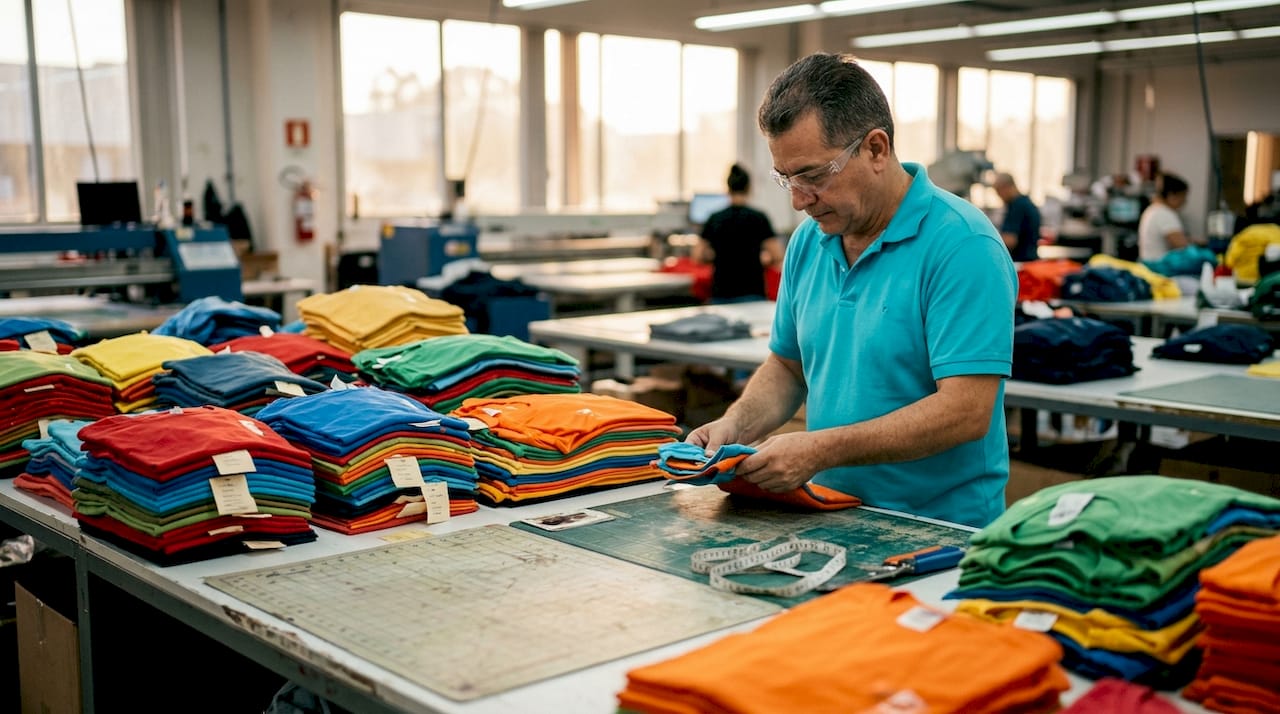
The core reason is fixed cost recovery. Setup costs for custom printing are nearly the same whether you are making 20 shirts or 2,000. Screen preparation, machine calibration, quality control checks, and labor for digitizing a logo all happen before the first shirt is printed. Spreading those fixed costs across more units is how printers stay profitable.
Here is what those fixed costs actually include:
- Screen preparation: Each color in a design requires a separate screen, costing time and materials regardless of run size.
- Digitizing for embroidery: Converting artwork into a stitch file is a one-time labor cost that does not scale with quantity.
- Machine setup and calibration: Presses and embroidery machines require configuration specific to each job.
- Quality control: First-article inspection and color matching happen on every run, not just large ones.
- Material minimums: Blank garment suppliers often have their own minimums that printers must absorb.
Garment complexity also drives MOQ levels higher. A simple one-color chest print on a t-shirt carries a lower MOQ than a multi-location, multi-color jacket with embroidered patches. The more decisions a design requires, the more setup time it demands.
Pro Tip: Ask your printer to quote a one-color version of your design alongside the full-color version. The MOQ and per-unit price difference is often significant enough to justify simplifying the artwork.
How do pricing and batch size interact for small runs?
Unit costs for small batches of around 50 pieces run 15 to 40 percent higher than bulk orders of 1,000 or more units. That premium is real, but it does not tell the whole story. Small-batch orders carry lower total upfront investment and far less inventory risk, which matters enormously for a startup brand or a one-time event.
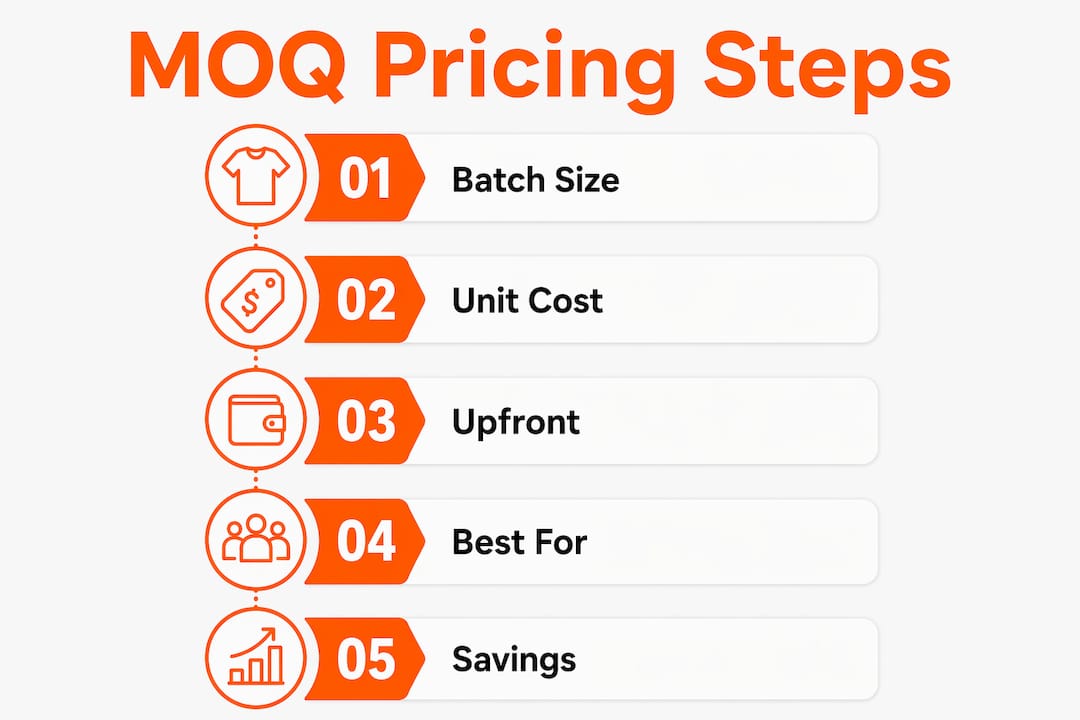
Pricing structures follow predictable breakpoints. Per-piece costs drop noticeably at 12, 24, 48, 72, and 144 units. Hitting one of those thresholds, even by adding a few extra shirts, can reduce your per-unit cost enough to offset the additional spend.
| Batch size | Typical per-unit premium | Upfront investment level | Best for |
|---|---|---|---|
| 12 units | Highest (30–40% above bulk) | Very low | Samples, VIP gifts |
| 24–48 units | Moderate (20–30% above bulk) | Low | Small events, startups |
| 72–144 units | Lower (10–20% above bulk) | Medium | Growing teams, retail |
| 300+ units | Near bulk pricing | High | Established brands |
Small-batch orders reduce inventory risk by limiting exposure to unsold stock, acting as insurance for brands that are still testing designs or sizing. A 50-piece run that sells out is more valuable than a 500-piece run that leaves 300 shirts in a storage unit.
Which production method fits your order size and budget?
The printing or embroidery method you choose directly determines your custom apparel quantity limits and per-unit cost. Each method has a different fixed-cost structure, which is why MOQs vary so widely across techniques.
Screen printing is the most cost-efficient method for larger runs. Screen printing often requires minimums of 48 units or more because each color requires a separate screen setup. The per-piece cost drops sharply as quantity rises, making it the right choice for bulk custom clothing orders of 72 units and above. For Illinois businesses, understanding screen printing setup fees upfront prevents sticker shock on small runs.
DTF (Direct-to-Film) printing changes the math entirely. DTF and digital printing methods allow for no-minimum or very low minimum orders, though the per-piece cost runs higher than screen printing at large volumes. For a small business ordering 10 to 30 pieces, DTF is often the most practical and affordable path. Full-color, photographic-quality designs are also possible without the per-color cost penalty that screen printing carries.
Embroidery sits in a different category. Embroidery requires specific digitizing and often carries higher minimums due to setup complexity. The digitizing fee is a one-time cost, so embroidery becomes more economical as quantity increases. Polos, hats, and jackets for corporate uniforms or team apparel are the strongest use cases.
Pro Tip: If your design includes a photograph or gradient, DTF is your only realistic low-minimum option. Screen printing cannot reproduce gradients without expensive halftone separations, and embroidery cannot replicate photographic detail at any quantity.
How to reduce minimum order requirements and costs
Small business owners and event organizers have more leverage than they realize. These strategies consistently produce better pricing and lower effective minimums.
-
Simplify your design. Simplifying design by using fewer ink colors and print locations reduces MOQ surcharges and opens negotiation room. A two-color design costs less to set up than a six-color design, and the visual impact is often comparable.
-
Stick to one style and one color. Since MOQs apply per style and per colorway, ordering one shirt style in one color concentrates your quantity and satisfies the minimum faster. Add variety in a future order once your design is proven.
-
Use local printers for short runs. Local printing and clear supplier communication improve order flexibility and reduce turnaround time. Local shops like Jam4apparel in Lake in the Hills, Illinois, can run smaller quantities profitably because their overhead structure differs from large national fulfillment centers.
-
Consolidate orders with partners. A nonprofit and a local sports team ordering the same blank garment from the same printer can combine quantities to hit a lower price tier, even if the designs differ. Ask your printer if they allow combined-order pricing.
-
Ask about sample orders. Many printers offer single-piece or small-run samples at a premium before committing to a full order. This is worth the cost when you are testing a new design or a new supplier.
-
Time your order to avoid rush fees. Rush production adds cost on top of small-run premiums. Planning four to six weeks ahead gives your printer flexibility to batch your order with similar jobs, which can reduce your effective per-unit cost.
Key takeaways
Choosing the right production method and batch size is the single most effective way to control costs on a minimum order custom apparel project.
| Point | Details |
|---|---|
| MOQ applies per style and colorway | Ordering one design in three colors triples your minimum quantity requirement. |
| Small batches cost 15–40% more per unit | That premium is offset by lower inventory risk and smaller upfront investment. |
| DTF printing removes quantity barriers | No-minimum DTF options make small runs of 10–30 pieces financially practical. |
| Design simplicity lowers effective MOQ | Fewer colors and one print location reduce setup costs and negotiation friction. |
| Local printers offer more flexibility | Smaller shops can profitably run 50 units or fewer with faster turnaround times. |
Why most small businesses overthink the MOQ problem
I have worked with enough small business owners and event organizers to recognize a pattern. They spend weeks researching minimum order quantities, get intimidated by the numbers they find on large wholesale platforms like Alibaba or Maker’s Row, and either over-order to hit a price tier they do not need or abandon the project entirely. Both outcomes are avoidable.
The real issue is that most MOQ information online is written for brands scaling to thousands of units. That is not your situation. If you need 24 shirts for a 5K fundraiser or 36 polos for your restaurant staff, the right supplier is not a factory in Southeast Asia with a 300-unit minimum. It is a local shop with in-house production that can run your job alongside similar orders and still turn a profit at your quantity.
The other mistake I see constantly is treating MOQ as a fixed wall rather than a starting point for conversation. Printers rarely waive minimums outright, but they will often adjust pricing, reduce color counts, or suggest a production method switch that brings your order into range. You have to ask. Most buyers do not.
My honest advice: start with your actual need, not a round number that feels safe. If you need 30 shirts, order 36 to hit a breakpoint. Do not order 72 because you think it signals seriousness. Excess inventory is a real cost that rarely shows up in MOQ calculators.
— Adam
How Jam4apparel makes low-minimum orders work for you
Jam4apparel, based in Lake in the Hills, Illinois, specializes in exactly the kind of flexible, small-batch custom apparel that small businesses and event organizers need. Whether you are ordering custom screen printing for a team of 24 or exploring DTF printing with no minimum for a one-time event, Jam4apparel’s in-house production handles it without the volume requirements of large national suppliers.
Services include screen printing, embroidery, DTF transfers, custom patches, and spirit wear stores, all produced locally for faster turnaround and direct communication. Jam4apparel serves Chicagoland businesses, schools, sports teams, and nonprofits from its Lake in the Hills facility. Visit Jam4apparel to request a quote and find out exactly what your order will cost before you commit.
FAQ
What is the minimum order quantity for custom t-shirts?
Most screen printers set a minimum of 24 to 48 units for custom t-shirts, though DTF and digital printing options can go as low as one piece. The method you choose determines the floor quantity more than any other factor.
Why are small custom apparel orders more expensive per shirt?
Setup costs are nearly identical whether you print 20 or 2,000 shirts, so those fixed costs spread across fewer units on small runs. Small batches typically run 15 to 40 percent more per unit than bulk orders of 1,000 or more.
Can I order custom apparel with no minimum?
Yes. DTF printing and some digital decoration methods offer no-minimum custom apparel options, though per-piece pricing is higher than screen printing at larger volumes. For orders under 30 pieces, no-minimum DTF is usually the most cost-effective path.
How do I lower my total cost on a small custom apparel order?
Simplify your design to one or two colors, stick to a single garment style, and consolidate your order to hit a pricing breakpoint at 24, 48, or 72 units. Working with a local printer also reduces shipping costs and allows for faster, more flexible production.
Does ordering more colors increase my minimum order quantity?
Yes. MOQ applies per colorway, so a design offered in three shirt colors at a 50-unit minimum requires 150 total units to satisfy the requirement. Limiting your initial order to one color is the fastest way to reduce your aggregate minimum.
Recommended
Ready to print your design?
Screen print, embroidery, and DTF — no minimums on many styles.