How to Order Custom Work Uniforms for Your Team
July 4, 2026
How to Order Custom Work Uniforms for Your Team
Custom work uniforms are branded apparel that unify your team’s appearance, reinforce your company identity, and signal professionalism to every customer who walks through your door. When you order custom work uniforms correctly, you get garments that fit your team’s roles, carry your logo cleanly, and hold up through daily wear. Get it wrong, and you’re stuck with mismatched sizes, delayed shipments, or logos that fade after three washes. This guide covers uniform types, preparation steps, the ordering process, and the mistakes that cost small business owners the most time and money.
What types of custom work uniforms should you order?
The most common types of custom work uniforms fall into five categories: polos, button-down shirts, safety workwear, outerwear, and specialized garments like aprons or scrubs. Each category serves a different work environment, and choosing the wrong type is one of the most expensive mistakes a team manager can make.
Polos and button-downs
Custom polos are the most versatile choice for customer-facing roles. They look professional, accept embroidery cleanly, and work across retail, hospitality, and service industries. Button-down shirts signal a higher level of formality and suit real estate teams, financial services, and front-desk staff.
Safety and specialized workwear
High-visibility vests, reinforced pants, and flame-resistant jackets fall under safety workwear. OSHA standards require specific visibility ratings for workers near traffic or heavy machinery, so fabric choice here is not just about branding. Aprons, chef coats, and medical scrubs are specialized garments that need both durability and function.
Fabric matters more than most managers realize
Fabric selection directly affects comfort, durability, and how well a uniform performs in a specific work environment. Moisture-wicking polyester blends work well for warehouse and outdoor crews. Wrinkle-resistant cotton blends suit office and retail environments. Custom workwear budgets typically range from $8 to $25 per set depending on fabric density, measured in GSM (grams per square meter), and order quantity. Higher GSM means a heavier, more durable garment. That range gives small business owners a realistic starting point for budgeting before they ever contact a supplier.
Embroidery vs. screen printing
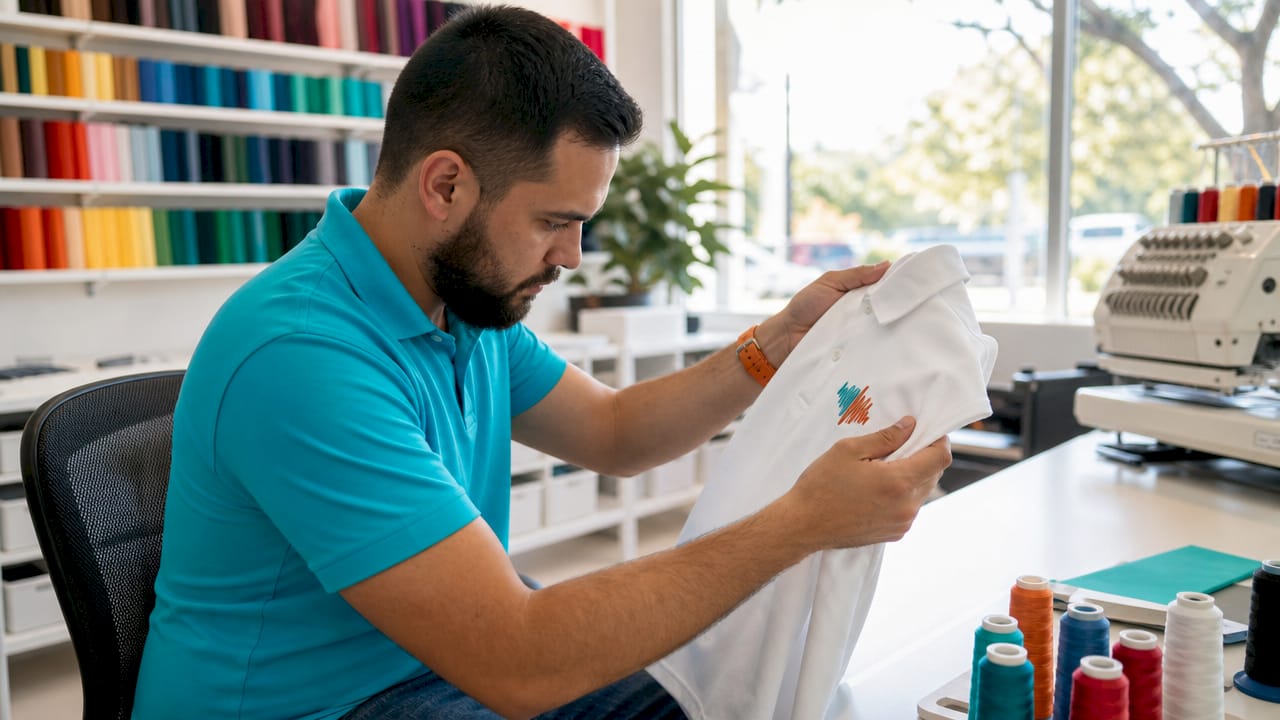
Embroidery creates durable, professional logos that hold their shape after repeated washing. It works best on polos, hats, and outerwear where a premium look matters. Screen printing covers larger design areas at a lower cost per unit and suits T-shirts and casual workwear. DTF (Direct-to-Film) transfers offer a middle ground: full-color detail without the setup cost of screen printing. Jam4apparel offers all three methods in-house, which means faster turnaround and tighter quality control.
Pro Tip: Match your decoration method to your fabric. Embroidery on thin, lightweight shirts can pucker the fabric. Ask your supplier to confirm the minimum fabric weight for embroidery before you finalize your garment choice.
What to prepare before you place your order
Preparation is where most small business owners lose time. Showing up to a supplier conversation without the right files, sizes, or quantities adds days or weeks to your timeline.
-
Count your team by role. List every position that needs a uniform and how many employees fill each role. Break it down by size. A crew of 20 rarely needs 20 mediums. Collect actual size measurements or run a size survey before you contact a supplier.
-
Prepare your logo files. Vector files (.AI, .EPS, or .SVG) are the standard for professional apparel decoration. A JPEG or PNG from your website will not reproduce cleanly at embroidery or print scale. If you only have raster files, ask your supplier if they offer art preparation services.
-
Choose your colors and styles. Pick uniform colors that align with your brand palette. Confirm that your chosen garment is available in those colors before you fall in love with a style. Suppliers carry limited colorways per style, and substitutions can throw off your brand consistency.
-
Understand minimum order quantities. Tailored or cut-and-sew garments often require minimum order quantities of 30 or more units because of the pattern-cutting process. Standard decorated apparel typically has lower minimums. Know your number before you start shopping.
-
Check stock availability. Failing to verify supplier stock is one of the most common and costly preparation errors. Even garments listed as available can be backordered, causing 4–6 week delays on your order. Request a stock check before you finalize any design decisions.
Pro Tip: Order 10–15% more units than your current headcount. New hires, size exchanges, and damaged garments are predictable. Running a second small order later costs more per unit than padding your first order.
How to place an effective order for custom work uniforms
A clear ordering process prevents miscommunication and protects your budget. These five steps apply whether you’re ordering 12 shirts or 500 jackets.
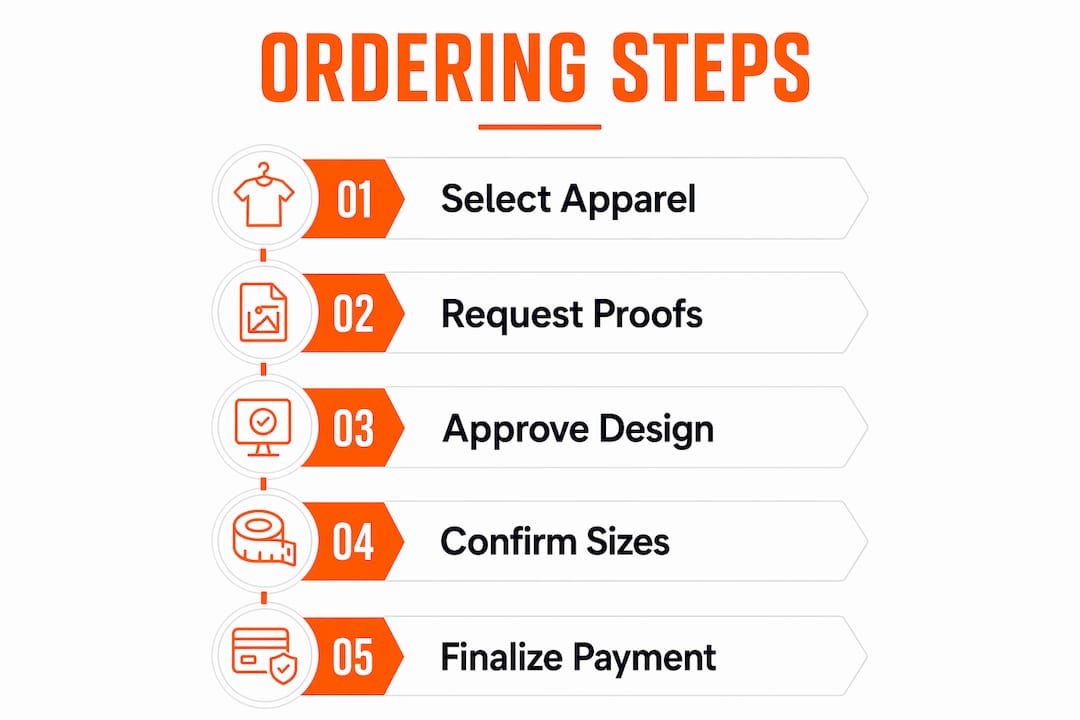
Step 1: Select your apparel and customization options
Choose your garment style, color, and decoration method. Confirm fabric weight, available sizes, and colorways with your supplier. For corporate apparel, embroidery on a structured polo or quarter-zip is the standard choice. For warehouse or outdoor crews, screen-printed T-shirts or safety vests make more practical sense.
Step 2: Request proofs and samples
Digital proofs and physical samples reduce errors and protect you from surprises at delivery. A digital proof shows logo placement, size, and color on a mockup of the garment. A physical sample confirms the actual fabric feel, color accuracy, and decoration quality. Never skip this step on a large order.
Step 3: Review and approve your design proof
Check logo placement, color accuracy, and text legibility. Confirm that your brand colors match the thread or ink colors in the proof. Small errors at this stage cost nothing to fix. The same errors after production can cost you the entire order.
Step 4: Confirm sizing and quantities
Cross-reference your size survey against the quantities in your order form. Confirm that all sizes are in stock. Add your buffer units at this stage. Once production starts, changes to quantities or sizes are rarely possible without added cost and delay.
Step 5: Finalize payment and production schedule
Custom uniform production typically takes 2–6 weeks depending on order complexity and size. Rush options exist but come at a premium. Get your delivery date in writing before you pay. Build in at least one week of buffer between your expected delivery date and the date you need the uniforms in hand.
The table below summarizes the key decisions at each step.
| Step | Key Decision | Common Pitfall |
|---|---|---|
| Select apparel | Garment style, fabric, decoration method | Choosing fabric too light for embroidery |
| Request proofs | Digital mockup and physical sample | Skipping samples on large orders |
| Review proof | Logo placement, color, text | Approving without checking brand colors |
| Confirm quantities | Size breakdown, buffer units | Ordering exact headcount with no buffer |
| Finalize order | Delivery date in writing | Assuming a verbal timeline is binding |
Common mistakes to avoid when ordering custom workwear
Even experienced managers make these errors. Each one costs money, time, or both.
-
Ordering without a size survey. Guessing sizes for a team of 15 or more almost always results in exchanges, reorders, and unhappy employees. A simple form sent to your team takes 10 minutes and prevents weeks of back-and-forth.
-
Ignoring stock availability. A garment listed on a supplier’s website may be backordered. Confirming in-stock availability before finalizing your design prevents the most common cause of order delays.
-
Choosing the wrong uniform type for the job. A lightweight polo is not appropriate for a construction site. A heavy safety vest is overkill for a front desk. Match the garment to the environment, not just the brand.
-
Skipping the proof review. Approving a proof without checking every detail is the single most expensive mistake in custom apparel ordering. Logo placement, color accuracy, and text size all need a second set of eyes.
-
Forgetting lead times. Bulk orders qualify for volume discounts, but they also take longer to produce. Plan your order at least 6–8 weeks before your target date to account for production, shipping, and any corrections.
“The biggest uniform ordering mistakes are not about design. They are about timing and preparation. A business that starts the process two weeks before a grand opening will almost always pay more and get less than one that starts two months out.”
Retail apparel trends also shape what employees expect from their uniforms. Themed and branded apparel has become a stronger signal of brand identity in retail environments, which means the bar for uniform quality is rising across industries.
Key Takeaways
Ordering custom work uniforms successfully requires matching garment type to job role, preparing logo files and size data before contacting a supplier, and building lead time into your schedule from the start.
| Point | Details |
|---|---|
| Match garment to role | Choose fabric weight and style based on the work environment, not just brand preference. |
| Prepare before ordering | Have vector logo files, a size survey, and confirmed stock availability ready before you contact a supplier. |
| Always request proofs | Review digital mockups and physical samples to catch errors before production begins. |
| Build in lead time | Production takes 2–6 weeks; plan 6–8 weeks out to avoid rush fees and stockouts. |
| Order a buffer | Add 10–15% extra units to cover new hires, size exchanges, and damaged garments. |
What I’ve learned from watching small businesses order uniforms
The most common regret I hear from small business owners is not about the design. It’s about the timeline. They find a supplier, love the product, and then discover the order won’t arrive for six weeks. The grand opening is in three. That gap is almost always preventable.
The second thing I’ve noticed is that managers underestimate how much the proof review matters. A logo that looks fine on a screen can look completely wrong stitched onto a navy polo. Thread colors do not map one-to-one to Pantone or hex values. If you care about brand accuracy, request a physical sample on the actual garment color before you approve the full run.
The third pattern I see is over-relying on price as the primary filter. Employee uniform programs that prioritize cost over fabric quality end up with garments that pill, fade, or shrink within a season. Your team wears these uniforms in front of customers every day. The cost per impression is far lower on a $20 shirt that lasts two years than on a $10 shirt that looks worn out in four months.
My honest advice: start earlier than you think you need to, get the sample in your hands before you commit, and treat the proof review as a non-negotiable step. Those three habits will save you more money than any discount ever will.
— Adam
Jam4apparel makes custom work uniforms straightforward
Small business owners and team managers throughout the Chicagoland area trust Jam4apparel for custom work apparel that represents their brand accurately and holds up on the job. Jam4apparel handles screen printing, embroidery, and DTF transfers in-house at its Lake in the Hills facility, which means faster production and direct quality control on every order.
Whether you need 12 embroidered polos for a new retail location or 300 screen-printed safety shirts for a seasonal crew, Jam4apparel works with orders of all sizes. The team provides digital proofs before production, confirms stock availability upfront, and gives you a clear production schedule from day one. Explore custom apparel by industry to see how Jam4apparel serves businesses like yours.
FAQ
What is the standard lead time for custom work uniforms?
Production typically takes 2–6 weeks depending on order size and complexity. Plan your order at least 6–8 weeks before your target date to account for proofing, production, and shipping.
How much do custom work uniforms cost per unit?
Custom workwear costs range from $8 to $25 per set depending on fabric density and order quantity. Bulk orders typically qualify for volume discounts that reduce the cost per unit.
What file format do I need for my logo?
Vector files (.AI, .EPS, or .SVG) are the standard for professional apparel decoration. Raster files like JPEG or PNG do not scale cleanly for embroidery or large-format screen printing.
Should I use embroidery or screen printing for work uniforms?
Embroidery works best for polos, hats, and outerwear where a durable, professional finish matters. Screen printing covers larger design areas at a lower cost per unit and suits T-shirts and casual workwear.
What is the minimum order quantity for custom uniforms?
Minimum order quantities vary by garment type. Standard decorated apparel often starts at 12–24 units, while tailored garments typically require 30 or more units due to the pattern-cutting process.
Recommended
Ready to print your design?
Screen print, embroidery, and DTF — no minimums on many styles.