Embroidery Cost Explained: Pricing by Stitch Count and Item
August 24, 2026
Embroidery Cost Explained: Pricing by Stitch Count and Item
Most custom embroidery runs $5 to $10 per item for a standard left-chest logo, with hats often landing at $5 to $10 and golf shirts closer to $20 to $30 depending on stitch count. The national average total cost for embroidery services sits around $109, with typical jobs ranging from $95 on the low end to $125 on the high end. Large or heavily detailed designs push past $30, sometimes $50 or more, per piece.
Stitch count drives nearly all of that swing. A small logo with dense fill stitching can cost more than a bigger, simpler design, because price tracks machine runtime, not physical size. Digitizing and setup fees add a one-time charge that hits small orders hardest and barely registers on large ones.
Before you accept any quote, ask three things:
- What is the exact stitch count for this design?
- Is there a digitizing or setup fee, and is it one-time?
- What is the per-piece rate at the quantity I’m actually ordering?
Key Takeaways
Embroidery cost is driven primarily by stitch count and order quantity, with digitizing fees adding a fixed, one-time charge that shrinks per piece as volume grows.
| Point | Details |
|---|---|
| Stitch count sets the price | Machine runtime, not garment size, is the biggest factor in your final cost. |
| Digitizing is one-time | A $45 fee costs $1.88 per shirt at 24 pieces but only $0.45 at 100 pieces. |
| Volume changes everything | Per-piece stitching cost can drop from over $9 to under $4 as quantity rises. |
| Complexity beats size | A small, dense design can cost more than a large, simple one. |
| Jam4apparel produces in-house | In-house embroidery, including hats and puff designs, keeps turnaround fast and pricing transparent. |
Links to Authoritative Pricing Guides and Calculators
Cross-check any quote against the same assumptions:
- Thumbtack’s embroidery cost breakdown for national averages.
- Needledown’s pricing calculator for stitch-rate math.
- Compare at least two shop quotes using identical stitch count and quantity assumptions before deciding.
Table of Contents
- How Embroidery Pricing Works: Stitch-Count vs. Flat-Rate Models
- What Do Embroidery Prices Look Like by Item and Stitch Count?
- Why Digitizing and Setup Fees Matter More Than You Think
- What Else Drives Embroidery Cost Up or Down?
- How Volume Discounts Work: A Worked Quoting Example
- What Shop Owners Actually Watch For When Pricing a Job
- How Does Turnaround Time Affect Embroidery Cost?
- Embroidery vs. Screen Printing and Heat Transfer: Which Costs Less?
- How Much Does Design Complexity Really Add to the Price?
- Does Thread Type Change the Price?
- Why Do Minimum Order Quantities Affect Your Price Per Piece?
- What Most Pricing Guides Get Wrong About Embroidery Cost
- Get a Straightforward Embroidery Quote From Jam4apparel
- Frequently Asked Questions
- Sources
How Embroidery Pricing Works: Stitch-Count vs. Flat-Rate Models
Shops price embroidery one of two ways, and knowing which model you’re looking at changes how you read a quote.
Stitch-count pricing charges by the thousand stitches, since that number represents actual machine time. Market rates typically run $1 to $3 per 1,000 stitches depending on a shop’s overhead and equipment. A 6,000-stitch logo at $2 per thousand costs $12 in stitching labor alone, before consumables or markup.
Flat-rate pricing charges a set fee per location or per item, regardless of stitch count within a reasonable range. It’s common for shops running high volumes of similar logos where the math evens out over time.
Each model has tradeoffs:
- Stitch-count pricing is fairer for simple designs but penalizes dense, detailed artwork.
- Flat-rate pricing is predictable and easy to budget, but you may overpay for a sparse design or underpay for a dense one.
- Stitch-count pricing exposes exactly what you’re paying for, which helps when negotiating design changes.
- Flat-rate quotes are faster to get but harder to challenge if you don’t know the underlying stitch count.
Ask which model a shop uses before comparing quotes side by side. A $12 flat rate and a $12 stitch-based quote aren’t necessarily equal value once stitch count enters the picture.
What Do Embroidery Prices Look Like by Item and Stitch Count?
Real numbers make this easier to judge than percentages and ranges alone. Here’s how per-piece stitching cost typically moves across order size, based on banded pricing common in the industry.
| Stitch Count Band | 1 Piece | 24 Pieces | 100 Pieces |
|---|---|---|---|
| Up to 5,000 stitches | $20-$22 | $9-$10 | $4-$5 |
| 5,000 stitches | $22-$30 | $10-$14 | $6-$8 |
| 8,000 stitches | $30-$40 | $15-$20 | $9-$13 |
| 15,000 stitches | $40-$80 | $22-$30+ | $14-$20+ |
These figures cover stitching only, before digitizing, consumables, and garment cost. French Press Custom’s pricing breakdown shows a real example: a 5,000-stitch left-chest logo running $9.63 per piece at 24 units, dropping to $3.50 per piece once you cross 1,000 units.
A few patterns worth noting:
-
Hats carry a premium. Caps require special hooping and often add $5 to $15 per piece on top of standard stitch pricing.
-
3D puff embroidery adds foam backing and extra passes, typically adding $2 to $5 per piece over flat embroidery on the same design.
-
Patches can beat direct embroidery on items that are hard to hoop, like nylon jackets or curved bags. A pre-made embroidered patch sewn or heat-applied on-site often costs less than digitizing the garment itself for a one-off order.
Why Digitizing and Setup Fees Matter More Than You Think
Digitizing converts your artwork into a stitch file a machine can actually run. It’s a one-time fee, but it lands hardest on your first order.
- Simple logos (basic text, one or two colors): typically $10 to $25.
- Medium-complexity designs (multiple colors, moderate detail): $20 to $45.
- Large or intricate designs, including most hat-front artwork, can run $40 to $80 or more.
Setup and hooping fees are separate and cover loading the garment onto the machine. Some shops fold this into digitizing; others bill it per order.
Here’s why quantity matters so much: a $45 digitizing fee split across 24 shirts adds $1.88 per piece. Split across 100 shirts, it adds just $0.45. The design cost doesn’t change. Your order size does all the work.
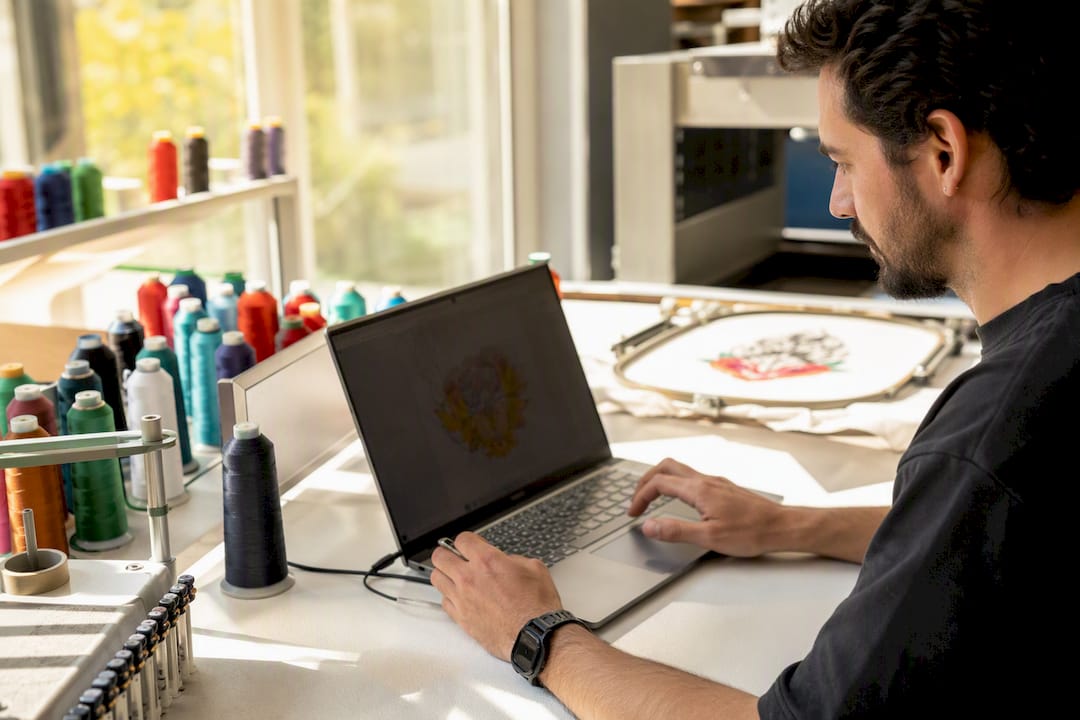
Pro Tip: Ask whether you own the digitized file after paying for it. A reusable file means your next reorder skips the digitizing fee entirely.
What Else Drives Embroidery Cost Up or Down?
Beyond stitch count and digitizing, several practical factors swing your final price.
- Thread color changes. Every color swap requires a machine stop and thread change, and shops often bill for that time separately from stitch count.
- Stitch density and small text. Tight fills and fine lettering pack more stitches into a smaller area, which is why a business card sized logo can rival a larger design in cost.
- Specialty fabrics. Fleece, towels, and leather need extra backing or topping material to stabilize the stitch, and that added handling time raises the price on top of material cost.
- Multiple locations. A logo on the chest plus a name on the sleeve means two separate hoopings, two setups, and roughly double the handling time, even if total stitch count only rises modestly.
None of these are hidden costs if you know to ask about them upfront.
How Volume Discounts Work: A Worked Quoting Example
Take a 6,000-stitch left-chest logo, two colors, on a basic polo. Here’s how the per-piece price moves as quantity climbs, combining stitch labor, consumables, and amortized digitizing.
- 1 piece: roughly $14 stitch labor + $3 consumables + $45 digitizing = about $62 for that single shirt.
- 24 pieces: roughly $12 stitch labor + $2 consumables + $1.88 amortized digitizing = about $16 per shirt.
- 48 pieces: roughly $10 stitch labor + $2 consumables + $0.94 amortized digitizing = about $13 per shirt.
- 100 pieces: roughly $8 stitch labor + $1.50 consumables + $0.45 amortized digitizing = about $10 per shirt.
| Quantity | Approx. Per-Piece Cost | Digitizing Share |
|---|---|---|
| 1 | $62 | $45 |
| 24 | $16 | $1.88 |
| 48 | $13 | $0.94 |
| 100 | $10 | $0.45 |
Want a lower number without cutting corners on your brand? Drop the stitch count by simplifying fine detail, cut down to one thread color, or consolidate multiple small orders into a single larger run. If a garment can’t be hooped easily, ask about switching that item to a pre-made patch instead of direct stitching.
What Shop Owners Actually Watch For When Pricing a Job
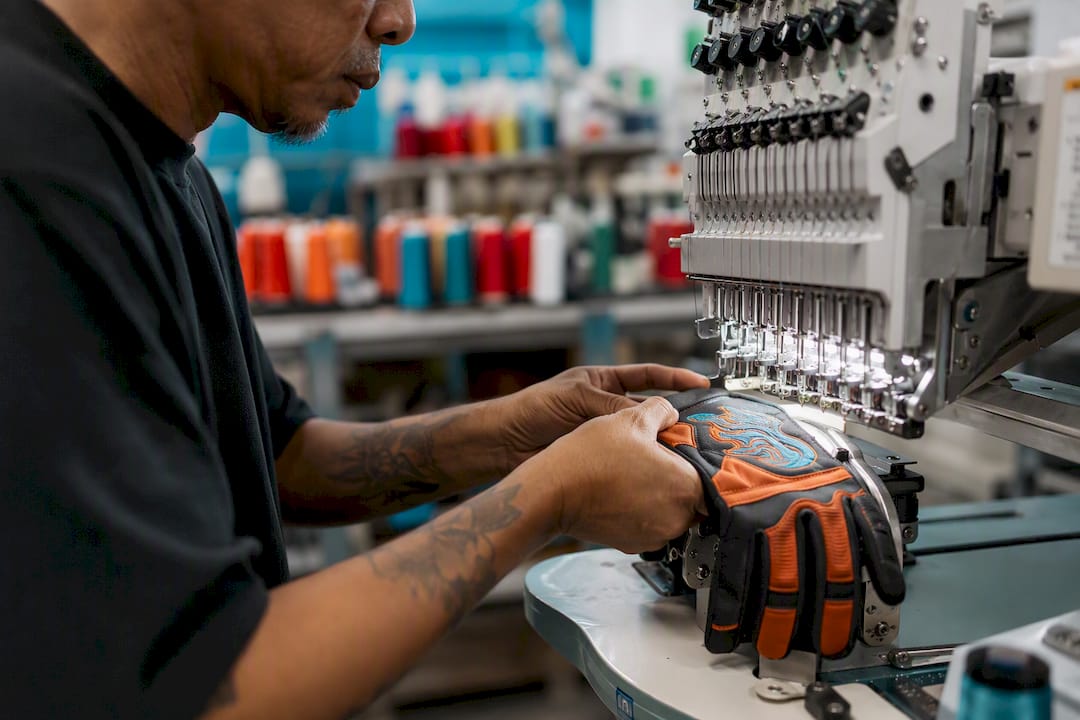
Jam4apparel runs embroidery in-house, including hats, polos, and puff embroidery, which keeps turnaround fast because nothing gets outsourced to a third-party digitizer or run house. That matters more than it sounds. When production stays under one roof, a shop can adjust a design or rerun a test sew-out without adding days to your timeline.
Before approving any quote, ask for:
- The exact stitch count for your artwork.
- Confirmation of whether you own or can reuse the digitized file on reorders.
- A test sew-out if the design has fine detail or an unfamiliar fabric.
- A firm turnaround date and shipping method.
Pro Tip: If your budget is tight, ask your shop to simplify fills, cap the color count at three or fewer, and stick to standard chest or cap-front placement. Those three changes alone often cut 20 to 30 percent off a per-piece quote.
How Does Turnaround Time Affect Embroidery Cost?
Rush orders cost more, and it’s not arbitrary. A standard turnaround, usually 7 to 14 business days depending on order size, lets a shop batch your job with other work running on the same machines, spreading labor cost across multiple orders at once.
Compress that timeline to 48 or 72 hours and the math changes. Rush production often means running your job as a standalone batch, sometimes on overtime hours or a dedicated machine slot that could have handled another client’s order. Shops typically add a rush fee, commonly 15 to 25 percent on top of the base price, though the exact figure varies by shop and by how disruptive the timeline is to their existing schedule.
There’s a second cost driver hiding in turnaround: quality control. A rushed job leaves less room for a test sew-out, which is the step where a shop catches thread-tension issues, puckering, or color mismatches before running the full order. Skipping that step to hit a deadline raises the risk of a reprint, which costs everyone more in the end.
The practical fix is simple. If your event or launch date is fixed, get your quote request in as early as possible. A shop that knows your job is coming three weeks out can slot it into normal production and quote you the standard rate. A shop that finds out you need 200 hats by Friday, when today is Tuesday, has no choice but to charge for the disruption. Turnaround pressure is one of the few cost drivers you can eliminate entirely just by planning ahead.
Embroidery vs. Screen Printing and Heat Transfer: Which Costs Less?
The honest answer is that it depends on your quantity and your design, not on which method is inherently cheaper.
Screen printing has a higher setup cost per color, since each color requires its own screen, but that setup cost spreads thin over large runs. On a 200-piece order with a simple one-color logo, screen printing often beats embroidery on price. On a 12-piece order, embroidery frequently wins, because there’s no screen-burning cost and a small digitizing fee is easier to absorb than screen setup charged per color.
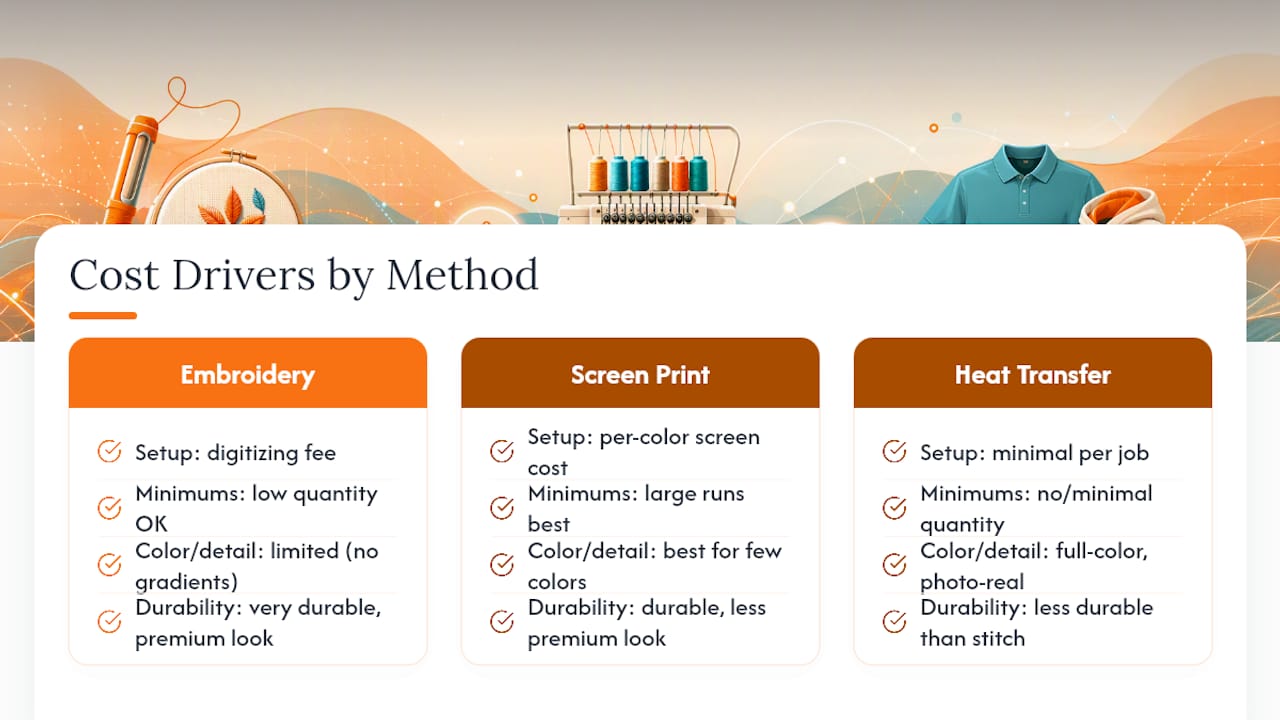
Heat transfer, including DTF (direct-to-film), sits in a different lane entirely. It has close to no minimum order quantity and handles full-color, photo-realistic designs that embroidery simply can’t replicate in thread. If your design uses gradients or dozens of colors, DTF is often the more practical and less expensive route than trying to force that complexity into stitches.
Embroidery earns its higher per-piece cost in durability and perceived value. A stitched logo survives hundreds of washes and reads as more premium on polos, hats, and outerwear, which is exactly why corporate uniforms and team gear lean embroidery even when it costs more upfront than a printed alternative. For a deeper side-by-side, Jam4apparel’s comparison of screen printing and embroidery walks through when each method actually makes financial sense.
The short version: pick embroidery for durability and a professional look on lower-to-mid volume orders, and pick a print method when you need full color, tiny minimums, or the lowest possible per-piece cost on a large run.
How Much Does Design Complexity Really Add to the Price?
Complexity and size are not the same thing, and confusing the two is the single most common reason people misjudge a quote.
A large, simple design, think a bold single-color wordmark, can have a lower stitch count than a small, detailed crest packed with fine lettering and shading. Industry pricing guides consistently point to stitch count, not physical dimensions, as the number that actually predicts cost. Complexity raises stitch count through several specific mechanics: tight fill stitching to render shading or texture, small text that needs extra stitches per letter to stay legible, and fine outline detail that requires multiple stitch passes to look clean instead of ragged.
Digitizing cost follows the same logic. A basic one-color text logo digitizes in the $10 to $25 range, while a detailed crest with shading, multiple fonts, or photo-realistic elements can run $40 to $80 or more, because the digitizer has to manually map stitch direction and density across every element of the design.
If cost is a real concern, the fix isn’t necessarily shrinking your logo. It’s simplifying it. Converting fine gradient shading into flat color blocks, trimming a five-color design to two or three colors, or enlarging small text just enough to reduce stitch density can meaningfully lower both your digitizing fee and your per-piece stitch cost, often without changing how the design reads to the eye at normal viewing distance.
Does Thread Type Change the Price?
Most everyday embroidery runs on standard polyester thread, and it’s the right call for the vast majority of orders. It’s durable, colorfast, and inexpensive relative to specialty options, which is why it’s the default at most shops and doesn’t add a line item to your quote.
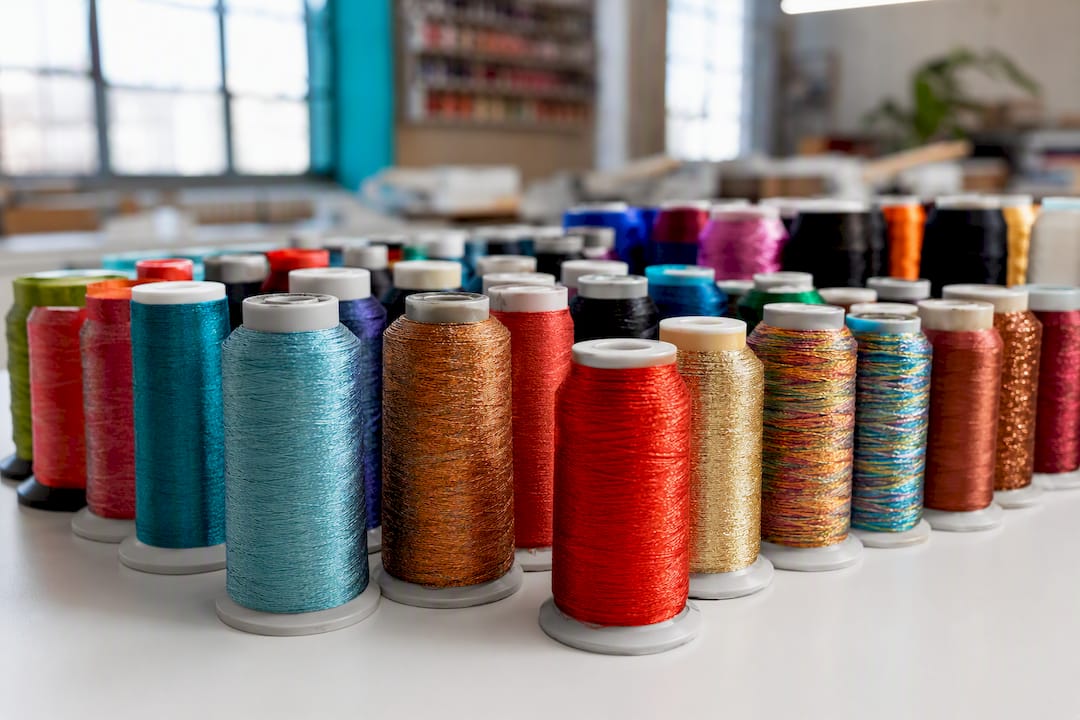
Rayon thread costs a bit more than polyester and gives a slightly higher sheen, favored by some shops for its look on dressier garments, though it holds up to industrial washing less reliably than polyester.
Metallic thread is where cost jumps noticeably. It runs thicker, breaks more often during stitching, and typically requires slower machine speeds to avoid snapping, all of which add labor time on top of the material’s higher per-spool cost. Expect a metallic thread upgrade to add a few dollars per piece, more on designs with heavy metallic coverage.
Specialty threads like glow-in-the-dark, solar-reactive, or variegated color-shift thread sit at the top of the cost ladder. They’re niche products with lower production volume, which keeps the spool price higher, and they often demand more careful tension settings that slow down the run.
If your budget is tight, standard polyester covers nearly every use case, from corporate polos to team jackets, without sacrificing durability. Save the upgrade for a design where the thread itself is the visual feature, like a metallic accent on a varsity jacket, rather than defaulting to it because it sounds premium.
Why Do Minimum Order Quantities Affect Your Price Per Piece?
Minimum order quantities exist because digitizing and setup costs don’t scale down. A shop still has to digitize your design, load thread, hoop the first garment, and run a test sew-out whether you’re ordering 1 piece or 500, and that fixed cost has to land somewhere.
Some shops set a low or no minimum and simply charge more per piece on small orders to cover that fixed cost, which is the more flexible model for individuals ordering a handful of items. Other shops set a formal minimum, often 12 or 24 pieces, and decline single-item orders entirely, because the labor-to-revenue ratio on a one-off job doesn’t pencil out for their overhead structure.
Neither approach is wrong, but they change how you should shop for a quote. If you need just a few pieces, look for a shop with no strict minimum and be ready to pay a higher per-piece rate to cover the digitizing fee on a small run. If you’re outfitting a team or a staff of 20 or more, minimums stop mattering because you’ll naturally clear them, and your focus shifts entirely to negotiating the per-piece rate at your actual quantity.
The practical move for small orders is combining jobs. If you need 8 shirts now and expect to need 10 more in three months, ask whether the shop can hold your digitized file and treat the second order as a reorder rather than a new setup, which sidesteps the minimum-order penalty twice.
What Most Pricing Guides Get Wrong About Embroidery Cost
Most pricing guides treat embroidery like a retail product with a sticker price. It isn’t. It’s closer to hiring a contractor: the quote depends on the job’s specific demands, and two designs that look similar in size can cost wildly different amounts once stitch count enters the picture.
The conventional advice, “expect to pay $5 to $10 per shirt,” isn’t wrong, but it’s incomplete enough to mislead. It skips the variable that actually explains why your quote came in at $22 instead of $8: stitch density. I’d argue the single most useful thing a buyer can do is stop asking “how much does embroidery cost” and start asking “what’s the stitch count,” because that number predicts price far better than item type or garment size ever will.
Where I’d push back on typical shop-hopping advice: chasing the lowest per-piece number across five quotes wastes more time than it saves, especially if those quotes use different stitch counts or hidden digitizing fees. Get the stitch count and fee structure locked first. Compare those numbers, not headline prices.
Get a Straightforward Embroidery Quote From Jam4apparel
Jam4apparel runs embroidery production in-house at our Lake in the Hills facility, which means no outsourced digitizing delays and no third-party markup hiding inside your quote. That matters most for the small and mid-size orders this article focused on, where a fast test sew-out and transparent per-piece pricing make the difference between a quote you trust and one you’re guessing at.
We handle hats, polos, jackets, and puff embroidery, and we’ll tell you your exact stitch count and digitizing fee before you commit to anything. Whether you’re outfitting a martial arts academy, a school spirit wear program, or a small business team, our custom embroidery services page walks through options including 3D puff embroidery for logos that need extra visual weight. Request a free quote and we’ll break the numbers down the same way this article did, line by line, so you know exactly what you’re paying for before you approve a single stitch.
Frequently Asked Questions
What is the average cost of embroidery per item? Most standard logos cost between $5 and $10 per item, with hats often in that same range and golf shirts running $20 to $30. Larger or more detailed designs can climb past $30 to $50 or more.
What is embroidery digitizing, and why does it cost extra? Digitizing converts your logo or artwork into a stitch file a machine can run. It’s a one-time fee, typically $10 to $80 depending on complexity, and applies whether you order 1 piece or 1,000.
How do I calculate embroidery costs for my order? Add stitch labor (roughly $1 to $3 per 1,000 stitches), consumables like thread and backing, and your digitizing fee divided by your total quantity. That amortized digitizing figure is what makes larger orders so much cheaper per piece.
Does design complexity really matter more than size? Yes. A small, dense logo with fine detail can require more stitches, and therefore cost more, than a larger design with simple, open fill areas. Stitch count, not physical size, sets the price.
Are there minimum order quantities for embroidery? Some shops accept single-item orders at a higher per-piece rate; others set a formal minimum, often 12 to 24 pieces, to justify the fixed digitizing and setup cost. Ask upfront which model applies.
Sources
- Embroidery cost | Thumbtack
- Embroidery Pricing Calculator: Rates, Costs, and Tables | Needledown
- How Much Does Embroidery Cost? | French Press Custom
Recommended
- Custom Embroidery Services | Hats, Polos & Apparel | Jam 4 Apparel | Jam 4 Apparel
- Screen Printing vs Embroidery: Which Method Wins? | Jam 4 Apparel
- Embroidery Backing Explained: Types, Uses, and How to Choose | Jam 4 Apparel
- Puff Embroidery Services | 3D Raised Embroidery | Jam 4 Apparel | Jam 4 Apparel
Ready to print your design?
Screen print, embroidery, and DTF — no minimums on many styles.