
Small Shops: 4 Steps to Cut VOCs 95% in Eco-Friendly Screen Printing
September 8, 2026
Small Shops: 4 Steps to Cut VOCs 95% in Eco-Friendly Screen Printing
The single highest-impact change you can make is switching from petroleum-based plastisol to water-based or discharge inks, paired with certified sustainable blanks and a solvent-free reclaim process. Some custom apparel companies run these swaps daily on real production orders. Expect a modest cost bump and a short learning curve on dark garments, but the environmental and health payoff is immediate and measurable.
TL;DR:
- Switching from petroleum-based plastisol to water-based or discharge inks significantly reduces VOC emissions and improves shop air quality.
- Organic cotton blanks absorb inks better but are more costly, while recycled polyester requires specific inks and offers less environmental benefit.
- Adopting closed-loop reclaim systems, filtering wastewater, and optimizing scheduling can reduce pollution regardless of ink choice.
- Simplifying artwork to fewer colors and thoroughly testing curing and wash durability with actual fabrics minimizes waste and reprints.
- Prioritize fabric certification, small-scale testing, and operational efficiencies over solely choosing greener ink formulas for true sustainability.
Table of Contents
- What Makes Screen Printing Eco-Friendly (Water-Based vs. Plastisol)
- Which Fabrics Work Best for Sustainable Screen Printing?
- How Shops Reduce Waste and Pollution in Production
- How Do You Adjust Designs for Eco-Friendly Inks?
- Which Certifications Actually Verify Eco-Friendly Claims?
- What Does an Eco-Friendly Print Run Cost and How Long Does It Take?
- A Shop-Tested Checklist for Going Eco-Friendly
- What Is the Lifecycle Impact of Eco-Friendly Screen Printing?
- What Happens to Printed Garments at the End of Their Life?
- Are There Ink Innovations Beyond Water-Based and Plastisol?
- Where Small Shops Get Eco-Friendly Printing Wrong
- How Companies Help You Print Sustainably Without the Guesswork
- Sources
What Makes Screen Printing Eco-Friendly (Water-Based vs. Plastisol)
Standard plastisol ink is PVC-based and cured with heat, and its cleanup typically involves solvents that release volatile organic compounds into the shop air. Water-based ink uses a water carrier instead of PVC, soaks into the fibers rather than sitting on top, and cleans up with soap and water. Discharge ink goes a step further: it chemically removes the garment’s original dye during curing and deposits pigment in its place, which is why it’s the go-to method for eco-friendly screen printing on dark shirts without the thick, plasticky hand-feel of traditional inks.
Plant-based inks, a newer category built from soy or other bio-derived binders, are gaining traction as a lower-impact alternative to petroleum inks, though supply and color range are still catching up to plastisol.
The health case is not marginal. Switching from petroleum-based inks to water-based inks can reduce VOC emissions by up to 95%, a shift that improves air quality on the shop floor and cuts the ventilation burden on small operations without industrial exhaust systems.
VOC Reduction: Water-based inks can cut volatile organic compound emissions by up to 95% compared to petroleum-based plastisol, according to EPA analysis.
The trade-off is opacity. Water-based ink is transparent by nature, so it struggles on dark fabric unless you add a white underbase, which adds a step and some hand-feel back. Discharge solves that problem on 100% cotton, but it won’t work reliably on polyester or heavy blends. A simple rule of thumb:
- Light garments, simple designs: water-based ink, no underbase needed
- Dark 100% cotton garments: discharge ink for a soft, breathable finish
- Dark poly-blends: plastisol or a specialty discharge activator, tested first
- Want more detail on ink chemistry before you commit? This ink types breakdown covers the differences garment decorators actually run into.
Which Fabrics Work Best for Sustainable Screen Printing?
Ink choice only gets you halfway. The blank underneath carries its own footprint, and picking the wrong one undoes half the benefit of switching inks in the first place.
Organic cotton grows without synthetic pesticides and takes water-based and discharge ink beautifully because the fiber absorbs pigment instead of resisting it. The downside is price and minimum order quantities, since organic cotton blanks typically cost more and come from a smaller pool of mills.
Recycled polyester (rPET), spun from post-consumer plastic bottles, cuts down on virgin petroleum use, but it’s a poor match for discharge ink and needs plastisol or specialty inks formulated for synthetics.
Bamboo blends print well and feel soft, though “bamboo fabric” is often chemically processed rayon, so the eco story is murkier than the marketing suggests. Always ask how the fiber was processed before trusting the label.
Poly-cotton mixes split the difference: cheaper and more durable than 100% organic cotton, but they inherit some of polyester’s printing limits.
A few practical notes for sourcing:
- Look for GOTS certification on organic claims. It verifies the entire supply chain, not just the raw fiber.
- “Recycled content” claims should list a percentage. Anything vague deserves a follow-up question.
- Small businesses should expect higher per-unit costs and longer lead times on certified blanks compared to standard retail-grade tees, so budget accordingly on early orders.
How Shops Reduce Waste and Pollution in Production
Ink and fabric choices mean little if the shop floor is still dumping solvent-soaked rags in the trash and rinsing screens straight down the drain. Real sustainability lives in daily operations.
Independent eco-focused print studios pair certified water-based inks with closed-loop reclaim and multi-stage filtration to keep waste out of the water system entirely. That setup doesn’t require an industrial retrofit. Small shops can install reclaim tanks and basic filtration at modest cost, which cuts effluent and simplifies compliance compared to ad-hoc drain disposal.
Here’s a practical sequence for tightening up shop practices:
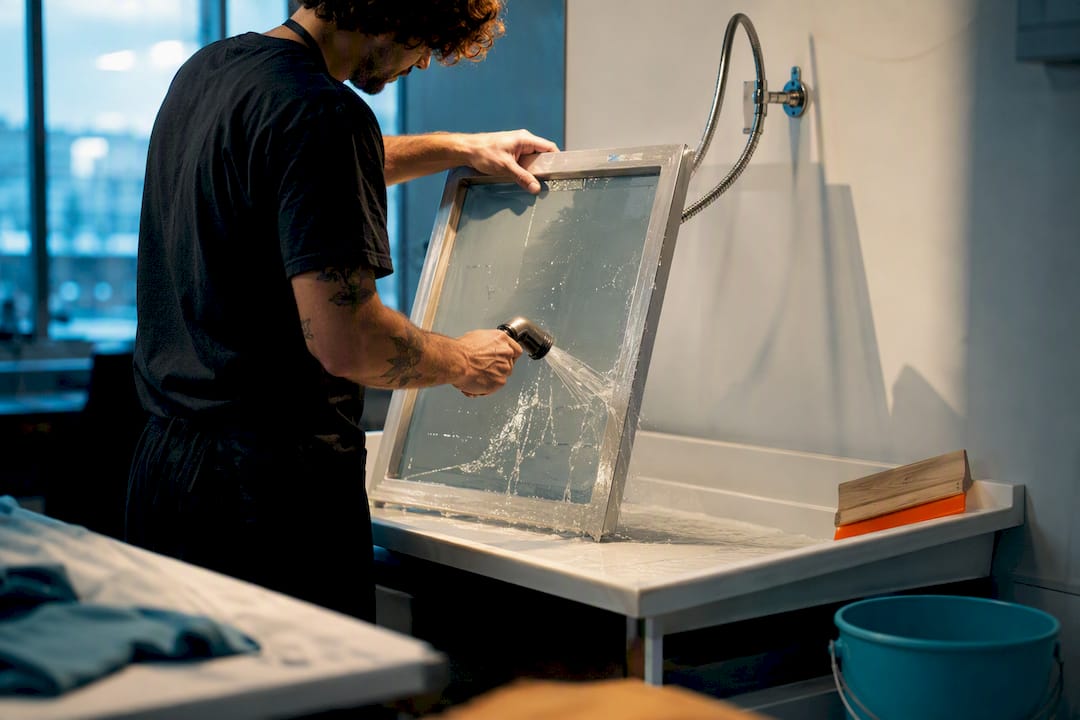
- Swap solvent-based screen reclaim chemicals for citrus-based or enzymatic removers that don’t require a fume hood.
- Install a settling tank or filtration cartridge before any wastewater reaches a drain.
- Batch ink orders and remix leftover water-based ink into future jobs instead of tossing partial buckets.
- Schedule curing runs back to back to avoid reheating conveyor dryers from cold, which wastes energy.
- Add local exhaust ventilation near mixing and curing stations, even with water-based inks, since heated ink still off-gases some vapor.
Pro Tip: Keep a labeled “remix bin” of leftover water-based ink sorted by color family. Most small shops throw out more usable ink than they realize, and a simple sorting system turns waste into free stock for future dark-color underbases or test prints.
Sustainable printing works best as a system: recycled inputs, water-based chemistry, and energy-conscious scheduling working together, rather than a single ink swap carrying the whole claim.
How Do You Adjust Designs for Eco-Friendly Inks?
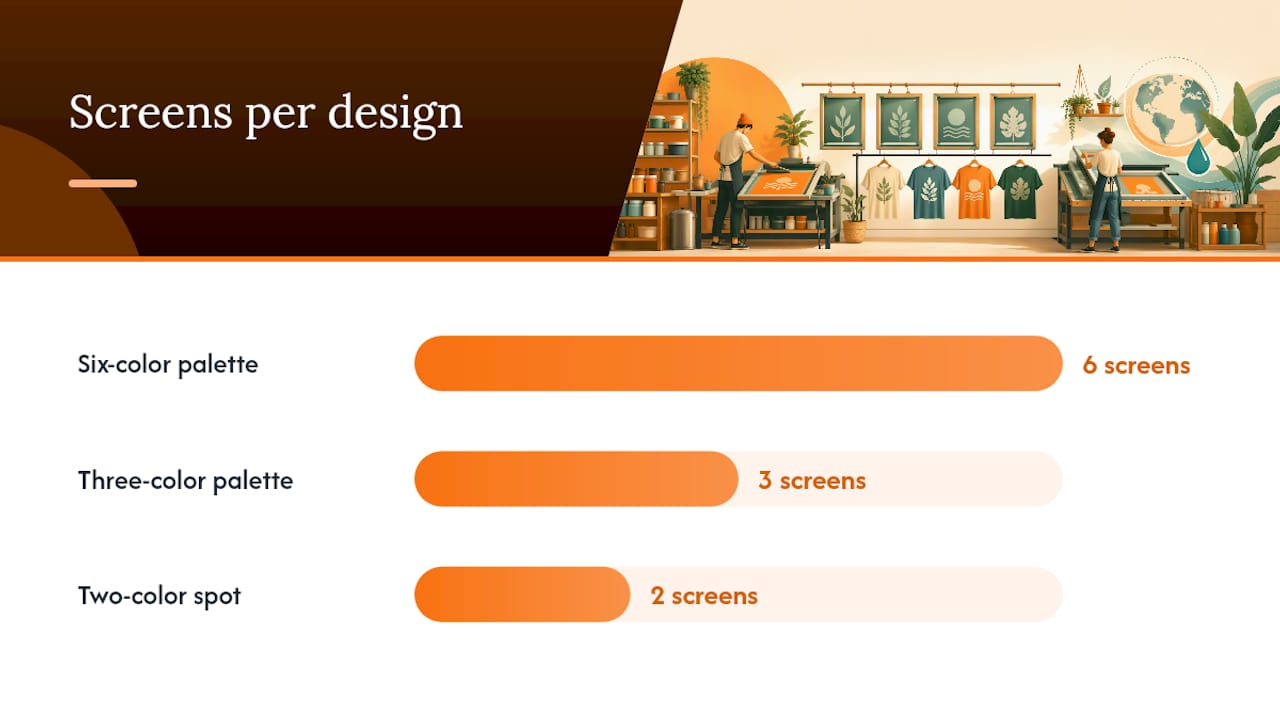
Water-based and discharge inks reward simpler artwork. Every additional color means another screen, another pass, and more ink mixed, so cutting your palette from six colors to three isn’t just a cost saver, it’s a footprint reducer. A spot-color approach built around two or three strong colors usually reads better on apparel than a busy full-color design anyway.
For opacity on light shirts, water-based ink often needs a second pass to build solid coverage, especially on heather or triblend fabrics that show through thin ink layers. For dark garments, discharge requires a precise activator ratio, and mismatched chemistry either under-discharges (leaving the old color visible) or over-discharges (weakening the fabric).
Curing matters more with water-based formulas than plastisol. Under-curing leaves ink that washes out in a handful of cycles; over-curing on discharge can scorch fabric. Run a wash test, five cycles minimum, on every new ink and fabric pairing before committing to a full order.
- Design in 2-3 spot colors when possible
- Test underbase opacity on the actual fabric weight you’ll print
- Confirm cure temperature and dwell time with a swatch, not a guess
- Wash-test before signing off on any bulk run
| Design Factor | Water-Based Ink | Discharge Ink |
|---|---|---|
| Best garment color | Light to mid-tone | Dark, 100% cotton |
| Underbase needed | Often, on dark fabric | Rarely |
| Hand-feel | Soft, breathable | Very soft, dye-like |
| Wash test cycles recommended | 5 | 5 |
Which Certifications Actually Verify Eco-Friendly Claims?
Three labels carry real weight in apparel printing, and each one covers a different part of the chain. GOTS (Global Organic Textile Standard) verifies organic fiber content and tracks environmental and labor practices through the entire supply chain, not just the farm. OEKO-TEX Standard 100 and its ECO PASSPORT certification test inks and finished textiles for harmful substances, confirming what’s absent rather than how the fiber was grown. ZDHC (Zero Discharge of Hazardous Chemicals) focuses specifically on wastewater and chemical management at the manufacturing level.
None of these certifications cover the whole picture alone. GOTS says nothing about the ink used to print the shirt. OEKO-TEX says nothing about how the cotton was farmed. Ask any supplier for the certificate number and check it against the certifying body’s public database rather than taking a logo at face value.
- Request the actual certificate, not just a badge on the website
- Cross-check certificate numbers on the certifying organization’s lookup tool
- Treat “phthalate-free plastisol” claims with skepticism: it’s still PVC-based ink and often still needs solvent cleanup, so verify the actual ink base before believing the marketing
What Does an Eco-Friendly Print Run Cost and How Long Does It Take?
Certified blanks and water-based inks generally run higher per piece than standard plastisol on generic tees, mainly because organic and recycled fabrics cost more at the mill and eco inks require more careful mixing and testing labor. Expect the biggest cost jump on small orders, since certification paperwork and test prints get spread across fewer units.
You can offset that in a few ways:
- Order in bulk where possible. Per-piece pricing on certified blanks drops significantly at higher volumes.
- Limit your color count. Fewer screens means less setup time and less ink waste.
- Build in extra lead time for wash tests and certification document requests. Rushing eco runs is where quality problems creep in.
- Accept the premium on flagship or customer-facing pieces, and save cost-cutting for internal or lower-visibility runs.
A Shop-Tested Checklist for Going Eco-Friendly
Years of running production for schools, teams, and small businesses across the Chicagoland area boil down to one lesson: sequence matters more than any single product choice. Skip a step and you’ll reprint the whole order.
- Pick the blank first. Confirm fiber content and certification before locking in ink type.
- Run a small ink test. Print five to ten garments in a single color to check opacity and hand-feel before committing to the full run.
- Verify the cure. Confirm temperature and dwell time on the actual fabric weight, not a generic chart.
- Wash test. Five cycles, minimum, before final sign-off.
Pro Tip: Run small, iterative sample prints before committing to a large eco-ink order. It costs you a handful of blanks up front and saves you a full reprint later.
When you request a quote, ask specifically for a sample print, copies of certification documents for the blank and ink, and a recommended ink and fabric pairing for your design. The screen printing process guide walks through what that workflow looks like from first proof to final delivery.
What Is the Lifecycle Impact of Eco-Friendly Screen Printing?
A full lifecycle view of a printed shirt covers four stages: fiber growth or recycling, fabric production, printing and curing, and end-of-life disposal. Each stage carries its own environmental cost, and eco-friendly screen printing only improves one link in that chain.
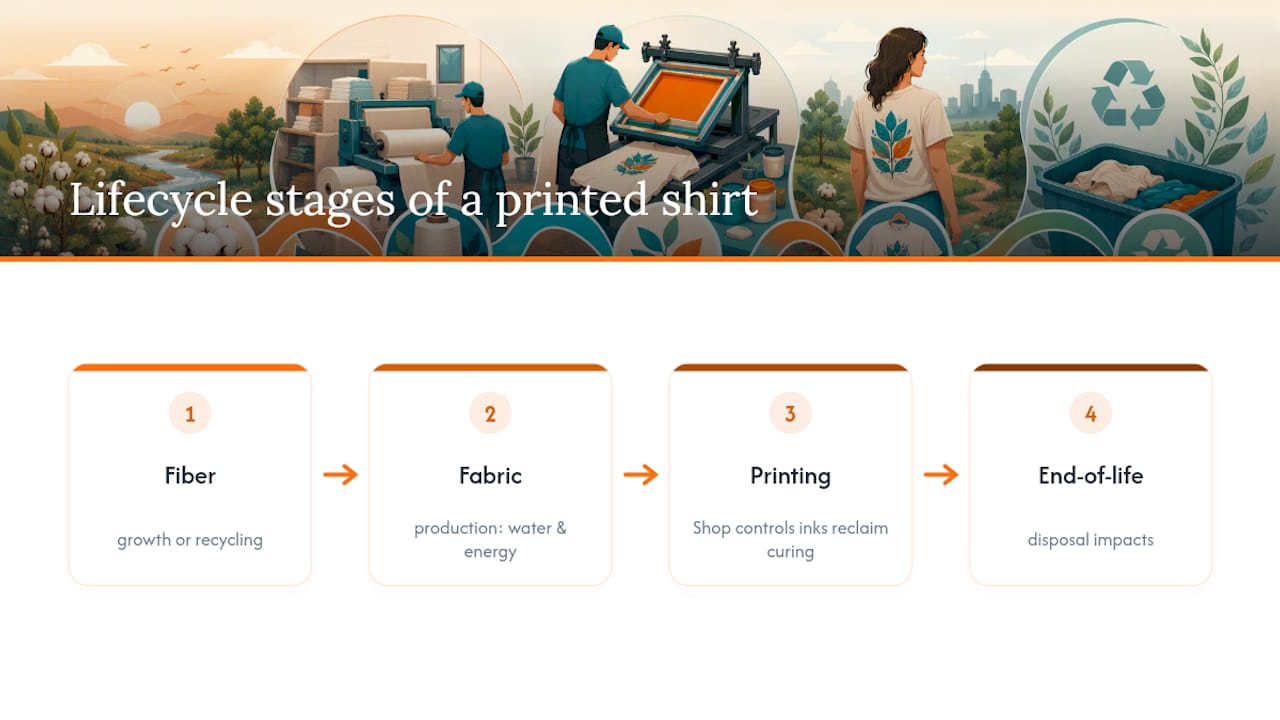
Growing organic cotton avoids synthetic pesticide runoff but still uses significant water. Recycled polyester diverts plastic bottles from landfills but requires energy-intensive processing to convert them into usable yarn. Neither option is emissions-free. What changes is where the impact shows up.
Printing itself is usually a smaller slice of the total footprint than the fabric stage, but it’s the stage a small print shop can control directly. Switching to water-based or discharge ink cuts VOC output at the point of production, and reclaiming screens with solvent-free chemistry keeps that benefit from being undone by chemical runoff downstream.
Energy use during curing adds another variable. Conveyor dryers running constantly at high heat consume more power than batch curing scheduled to minimize reheating cycles. A shop that clusters similar jobs together and cures back to back uses meaningfully less energy per garment than one running scattered small batches all day.
None of these factors work in isolation. A shirt printed with water-based ink on virgin polyester still carries a heavier footprint than one printed with plastisol on GOTS-certified organic cotton. Lifecycle thinking means weighing the fabric, the ink, and the shop process together rather than optimizing one variable and calling the job done.
What Happens to Printed Garments at the End of Their Life?
A printed garment’s end-of-life story depends almost entirely on what it’s made of and what’s stamped on it. Organic cotton and other natural fibers break down in composting or landfill conditions over time. Polyester, recycled or not, does not biodegrade in any meaningful human timeframe.
Ink adds another layer to that equation. Water-based ink soaks into cotton fibers and biodegrades alongside the garment. Plastisol ink, being PVC-based, sits on the fabric surface as a separate plastic layer that survives long after the cotton underneath has broken down, which complicates both composting and mechanical recycling.
Recyclability follows a similar split. Cotton garments can go through textile recycling programs that shred fiber for reuse in insulation, rags, or new yarn blends, though heavy print coverage can interfere with the shredding and sorting process. Polyester blends are harder to recycle because mixed fibers can’t be separated economically at most facilities, one reason single-material garments are easier to process at end-of-life than blends.
For small businesses, that means end-of-life performance is a design decision made months before the shirt is ever worn. Choosing a single-fiber blank, printing with water-based or discharge ink, and avoiding excessive plastisol coverage all make a printed garment easier to compost, recycle, or break down eventually. None of it happens automatically, and none of it shows up on the price tag at checkout.
Are There Ink Innovations Beyond Water-Based and Plastisol?
Water-based and discharge inks solved the VOC and PVC problem, but newer formulations are pushing further. Biodegradable inks built on plant-derived binders instead of synthetic resin are starting to appear from smaller specialty suppliers, aiming to break down more completely than standard water-based formulas once a garment reaches end-of-life.
Soy-based and other bio-resin inks borrow from a technology already established in commercial paper printing, adapted for textile application. They’re not yet mainstream in apparel decoration, and color range and durability testing still lag behind established water-based and plastisol lines, but the trajectory points toward wider adoption as demand grows.
Algae-derived pigments are another early-stage development, explored as a renewable alternative to petroleum-based colorants in ink production. These remain niche and largely experimental for garment printing at commercial scale.
For a small business ordering apparel today, the practical takeaway isn’t to chase the newest formula. It’s to understand that ink chemistry is still evolving, and today’s water-based or discharge choice is a meaningful step, not a final destination. Suppliers who stay current on ink development will be positioned to offer better options as they mature, which is one more reason to ask your printer directly what’s changed in their ink lineup over the past year rather than assuming the options are fixed.
Where Small Shops Get Eco-Friendly Printing Wrong
Most advice on this topic treats ink chemistry like the whole story. It isn’t. The research backs a different priority order: fabric sourcing and shop process changes often move the needle further than the ink swap everyone talks about first.
The conventional wisdom oversells water-based ink as an automatic sustainability win. It’s a real improvement, a 95 percent VOC reduction is not a small number, but printing that ink on virgin polyester with solvent-based reclaim still leaves most of the footprint intact. Operational habits, like remixing leftover ink and scheduling cure runs efficiently, often deliver bigger lifecycle gains than chasing a marginally greener ink formula.
If you’re starting from zero, prioritize in this order: pick a certified or single-fiber blank first, switch your ink second, and fix your reclaim and water handling third. Skipping straight to “eco ink” while ignoring the blank and the drain is how well-meaning shops end up with a shirt that’s greener on paper than in practice. Small, honest steps beat one big marketing claim every time.
— Adam
How Companies Help You Print Sustainably Without the Guesswork
Some companies give small businesses a working shortcut: in-house production means you can get sample prints, ink and fabric testing, and GOTS-ready blank sourcing without chasing three different vendors to piece together an eco-friendly order.

When you request a quote, ask specifically for a sample print on your chosen blank, certification documents for the fabric and ink, and a recommended pairing based on your artwork and garment color. That’s the same sequence outlined in the checklist above, handled in-house instead of on your own. Whether you’re outfitting a school spirit wear program, a sports team, or a growing brand, Jam4apparel’s screen printing services team can walk you through ink and fabric options suited to your budget and timeline. Businesses looking for a broader fit across industries can also check the industries page for examples specific to their organization type. Request your sample print and quote today to see what a sustainable run actually costs for your next order.
Sources
- U.S. EPA — Water-Based Inks Market Analysis (EPA document)
- PaperCut blog — A guide to eco-friendly printing
- Live Ink — Eco-friendly printing
Recommended
Ready to print your design?
Screen print, embroidery, and DTF — no minimums on many styles.