Custom Logo Merchandise for Restaurants: 2026 Guide
June 25, 2026
Custom Logo Merchandise for Restaurants: 2026 Guide
Custom logo merchandise for restaurants is the practice of producing branded physical products, from apparel to drinkware, that carry a restaurant’s logo and reinforce its identity beyond the dining room. The industry term is promotional merchandise or branded merchandise, and it covers everything from screen-printed T-shirts to embroidered aprons and custom takeout packaging. Done right, these products turn loyal guests into walking advertisements and give your staff a polished, unified look that signals professionalism the moment someone walks through the door. This guide covers the top product types, ordering logistics, design rules, and supplier criteria every restaurant owner needs to know in 2026.
1. What are the top types of custom logo merchandise for restaurants?
The most effective branded restaurant products fall into three categories: wearables, drinkware, and packaging. Each serves a different marketing purpose, and the best restaurant merch programs use all three.
Wearables
- Branded T-shirts and sweatshirts. The highest-visibility item in any restaurant merch program. Staff wearing logo tees become mobile billboards. Guests who buy them extend that reach off-premises.
- Custom aprons. A front-of-house staple. Embroidered aprons signal craft and care, especially in farm-to-table or upscale casual concepts.
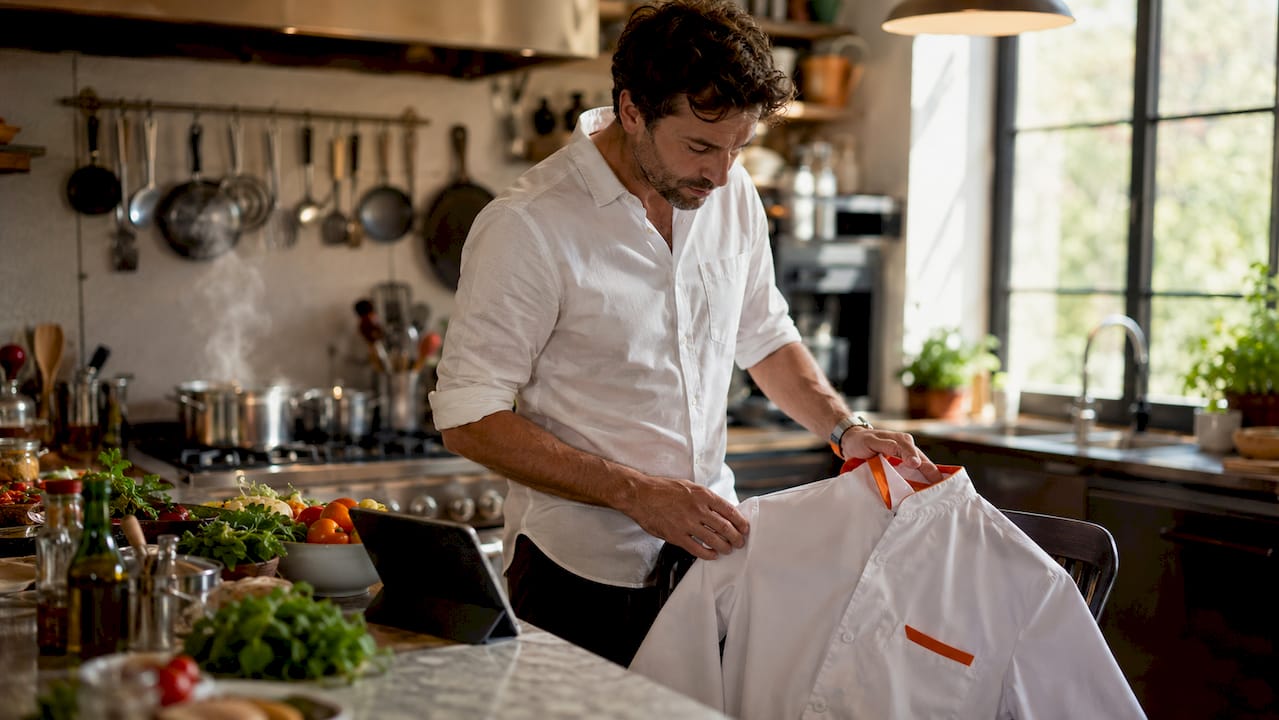
- Chef coats and kitchen uniforms. Back-of-house staff benefit from custom embroidery services on durable, food-safe fabrics.
- Hats and caps. Low-profile embroidered caps are popular restaurant logo apparel items for both staff uniforms and retail sale.
Drinkware and accessories
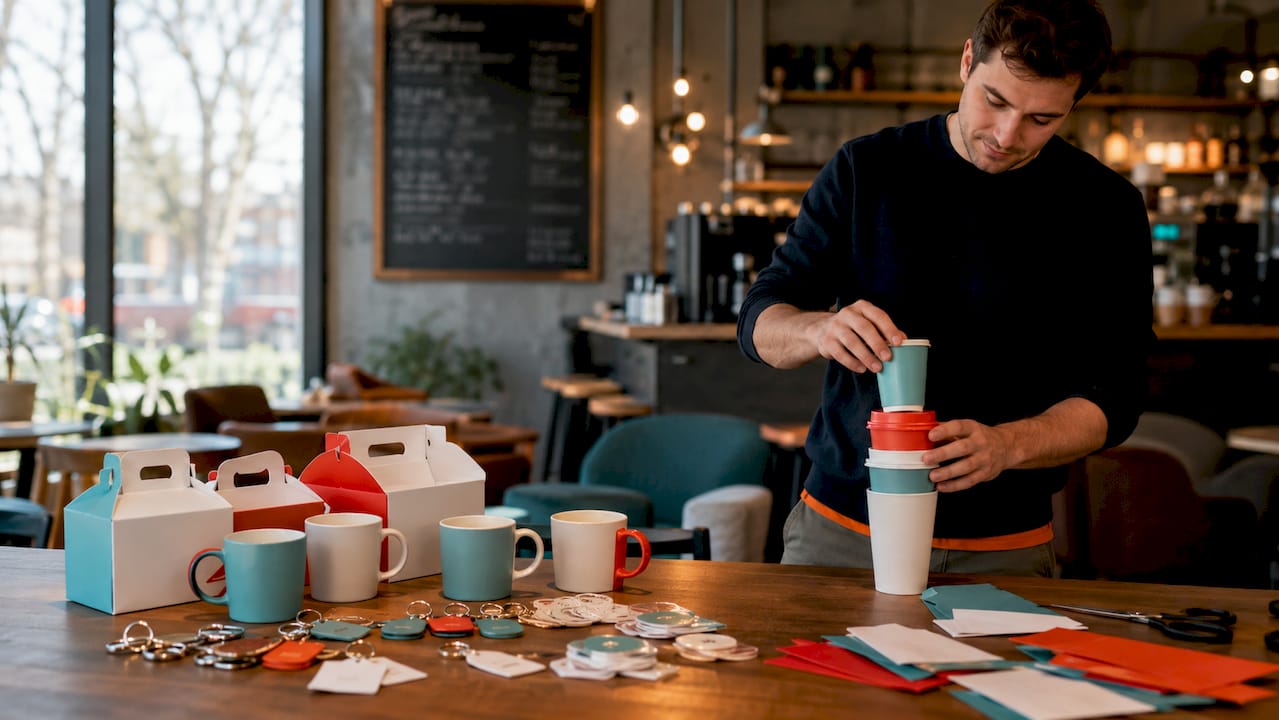
- Custom mugs and glassware. Coffee shops and brunch spots sell logo mugs at the counter. The markup is strong and the repeat exposure is daily.
- Branded water bottles and tumblers. Popular as personalized restaurant gifts for loyalty program rewards or catering events.
- Tote bags. Practical, reusable, and highly visible in urban markets. A tote with a clean logo design gets carried everywhere.
- Bottle openers and keychains. Low-cost unique logo items for restaurants that work well as giveaways or add-ons with a purchase.
Packaging and novelty items
- Custom takeout bags and paper goods. Branded packaging turns every delivery order into a brand impression. Stamp-style logo applications on kraft bags are a cost-effective entry point.
- Signature sauces, spice blends, and cookbooks. High-margin novelty products that deepen guest connection to your concept. These work best for restaurants with a strong culinary identity.
Pro Tip: Matching merch to your brand personality and venue atmosphere is the single fastest way to make products feel authentic rather than generic. A craft brewery should sell pint glasses and hoodies, not keychains.
2. How do restaurant owners efficiently order custom merch?
The ordering process for customized dining merchandise follows a clear sequence. Merch providers collect product details through quote intake forms that capture product type, quantities, timeline, and brand assets before any production begins. This upfront step prevents costly revisions later.
Here is the standard ordering sequence most suppliers use:
- Submit a quote request. Provide your logo files, preferred product type, quantity, and deadline.
- Receive a digital mockup. Review placement, color, and sizing before approving production.
- Approve and pay. Most suppliers require approval sign-off and a deposit before production starts.
- Production and quality check. The supplier produces a sample or runs the full order depending on quantity.
- Shipping or pickup. Local suppliers like Jam4apparel offer in-person pickup, which cuts shipping time and cost.
Minimum order quantities (MOQs) vary significantly by product and decoration method. MOQs range from 100 pieces for embroidery to 300–500 pieces for cut-and-sew items. Some hospitality-focused suppliers offer minimums as low as 5 items, which is ideal for small restaurants testing a new product.
One-time setup fees apply to first-time logo digitization. Setup fees run around $80 for the initial digitization. Reorders using the same logo typically waive this fee entirely. Read more about what to expect on screen printing setup fees before you budget your first order.
Suppliers also store your artwork and specs after the first order. That storage means future restocking orders move faster and maintain consistent branding across every run.
Pro Tip: Review common ordering mistakes before you place your first order. Skipping the mockup approval step is the most expensive mistake a restaurant owner can make.
| Factor | What to expect |
|---|---|
| Minimum order quantity | 5–500 pieces depending on product and method |
| Setup fee | Around $80 for first-time logo digitization; waived on reorders |
| Lead time | Varies by method; see turnaround details below |
| Artwork storage | Most suppliers store files for faster future reorders |
For a full breakdown of production windows, the turnaround time guide from Jam4apparel explains what to expect for screen printing versus embroidery orders.
3. What are the key design tips for restaurant logo merchandise that sells?
Logo readability at real viewing distance is the single most important design rule for restaurant logo apparel. Logos with fine lines or excessive small text do not print well on fabric. A design that looks sharp on a screen can fall apart at 6 inches of stitching.
Follow these design principles before sending files to production:
- Keep it bold and simple. A clean wordmark or icon prints better than a detailed illustration.
- Avoid gradients for screen printing. Gradients require additional screens and raise costs. Flat colors reproduce cleanly and consistently.
- Size your logo for the placement. A chest logo on a T-shirt typically runs 3–4 inches wide. A full-back print can go 10–12 inches. Design for the actual size, not the screen.
- Test readability at distance. A top-performing logo stays legible from several feet away on all merchandise.
Embroidery requires additional technical attention. Embroidery quality depends on digitization details like stitch density and placement size. A clean art file is necessary but not sufficient. The digitizer must also manage thread selection, backing material, and size-by-size placement review to keep the logo consistent across a size run from small to 3XL.
“Choosing uniform styles and merch that fit the brand personality and venue atmosphere enhances customer connection.” — The Print Studio
Affordable design help is widely available. Canva works for simple wordmarks. Fiverr and 99designs connect you with freelance logo designers for under $150. If your current logo was designed for digital use only, ask your supplier whether it needs to be redrawn for print before you commit to a large order.
4. How to choose the right supplier for restaurant promotional products
The right supplier for restaurant promotional products is one that matches your order size, timeline, and quality standard. Not every printer serves small restaurants well, and not every embroidery shop handles food service apparel.
Evaluate suppliers on these criteria:
- Digital mockup support. Any serious supplier provides a mockup before production. Walk away from any vendor that skips this step.
- Minimum order flexibility. If you need 12 aprons for a new location, a supplier with a 144-piece minimum is the wrong fit. Look for low minimum order programs designed for small businesses.
- Decoration method range. Screen printing, embroidery, and DTF (Direct-to-Film) transfers each suit different products. A supplier that offers all three gives you more flexibility.
- Artwork storage and reorder speed. Restaurants restock frequently. A supplier that stores your files and specs cuts reorder time significantly.
- Material and durability options. Staff uniforms need to survive commercial washing. Ask about fabric weight, thread count, and wash durability before ordering.
- Local versus national. Local suppliers offer faster pickup, easier communication, and the ability to review samples in person. National suppliers may offer lower per-unit pricing at high volumes but add shipping time and cost.
Pro Tip: Request a sample before committing to a large run. A physical sample reveals fit, fabric weight, and decoration quality that no mockup can show.
Jam4apparel operates out of Lake in the Hills, Illinois, and serves the Chicagoland area with in-house screen printing, embroidery, and DTF printing. In-house production means shorter lead times and direct quality control, which matters when you are restocking staff uniforms before a busy weekend.
Key takeaways
Custom logo merchandise builds restaurant brand visibility and customer loyalty when products are well-designed, properly ordered, and matched to the restaurant’s concept.
| Point | Details |
|---|---|
| Start with wearables and drinkware | Branded T-shirts, aprons, and mugs deliver the highest visibility per dollar spent. |
| Use digital mockups every time | Approving a mockup before production prevents costly reprints and misaligned logos. |
| Match MOQs to your actual needs | Suppliers with minimums as low as 5 pieces let small restaurants test products affordably. |
| Keep logo designs bold and simple | Fine lines and small text fail in screen printing and embroidery; flat, clean logos reproduce best. |
| Store artwork files with your supplier | Spec storage speeds reorders and keeps branding consistent across every production run. |
What I have learned about restaurant merch after years in the business
The biggest mistake I see restaurant owners make is ordering too much of the wrong thing. A fine-dining concept does not need a rack of graphic hoodies. A taco truck does not need embroidered linen aprons. The merch has to match the room, the price point, and the guest.
The second mistake is going too big too fast. Starting with a limited range, like a logo tee and a branded mug, and expanding based on actual customer response is the smarter path. It reduces upfront investment and tells you what your guests actually want to buy before you commit to a full product line.
Staff apparel is where I would put the first dollar every time. When your team wears your logo consistently, it does two things: it creates a professional impression for guests, and it reinforces internal culture. A server who wears a well-made branded shirt carries themselves differently than one in a generic black polo.
One thing most guides skip is inventory timing. Order merch 6–8 weeks before a seasonal push, a new location opening, or a major event. Rushing an order almost always means paying a premium or accepting lower quality. Build the lead time into your calendar the same way you would a food order.
— Adam
Jam4apparel makes restaurant merch straightforward
Restaurant owners in the Chicagoland area have a local production partner that handles the full range of branded merchandise needs. Jam4apparel specializes in custom screen printing and embroidery for restaurants, cafes, and hospitality businesses of all sizes.
Jam4apparel offers low minimum orders, in-house production for fast turnarounds, and artwork support from the first order through every reorder. Whether you need 12 embroidered aprons for a new location or 500 screen-printed T-shirts for a seasonal promotion, the team at Jam4apparel handles the production details so you can focus on running your restaurant. Request a quote directly on the website to get started.
FAQ
What is the minimum order for custom restaurant merch?
Minimum order quantities vary by product and decoration method. Some suppliers start as low as 5 pieces for hospitality items, while embroidery programs typically require 100 pieces and cut-and-sew products require 300–500 pieces.
How long does it take to produce custom logo apparel?
Lead times depend on the decoration method and order size. Screen printing and embroidery orders typically run 1–3 weeks from approved mockup to delivery. Rush options are available from some suppliers at an added cost.
Do I pay a setup fee every time I reorder?
No. Setup fees apply once for the initial logo digitization, which runs around $80. Reorders using the same logo file typically waive the setup fee entirely.
What file format should I submit for my restaurant logo?
Vector files in AI or EPS format are the standard for screen printing and embroidery. High-resolution PNG files work for DTF transfers. If your logo only exists as a low-resolution JPEG, ask your supplier whether a redraw is needed before production.
Which merch items sell best for restaurants?
Branded T-shirts, logo mugs, and custom aprons are consistently the strongest sellers across restaurant concepts. Starting with these three items and expanding based on customer demand is the most reliable approach for a new merch program.
Recommended
Ready to print your design?
Screen print, embroidery, and DTF — no minimums on many styles.