Custom Embroidered Patches Benefits: Your 2026 Guide
July 21, 2026
Custom Embroidered Patches Benefits: Your 2026 Guide
Custom embroidered patches deliver something most branding tools can’t: a physical, lasting impression that compounds over time. Whether you’re outfitting a restaurant crew, launching a merchandise line, or building team identity for a sports program, the advantages of embroidered patches go well beyond aesthetics. Here’s what makes them worth your attention:
- Durability: Thread stitched into fabric won’t flake, crack, or peel the way printed logos do, even after years of washing and outdoor exposure.
- Brand visibility: A patch worn daily generates around 7,500 impressions per year at a cost-per-impression of roughly $0.00027, far below any digital ad channel.
- Versatility: Patches attach to hats, jackets, bags, aprons, and more, using sew-on, iron-on, or Velcro backing depending on your needs.
- Cost-effectiveness: Bulk orders drop the unit price significantly, and patches store indefinitely, so you’re not locked into a per-garment embroidery run.
- Professionalism: A well-made patch on a uniform reads as more established than a printed logo, signaling credibility to customers on sight.
- Easy rebranding: Velcro-backed patches let you swap logos without replacing entire garments, a practical advantage when your brand evolves.
What are embroidered patches and how are they made?
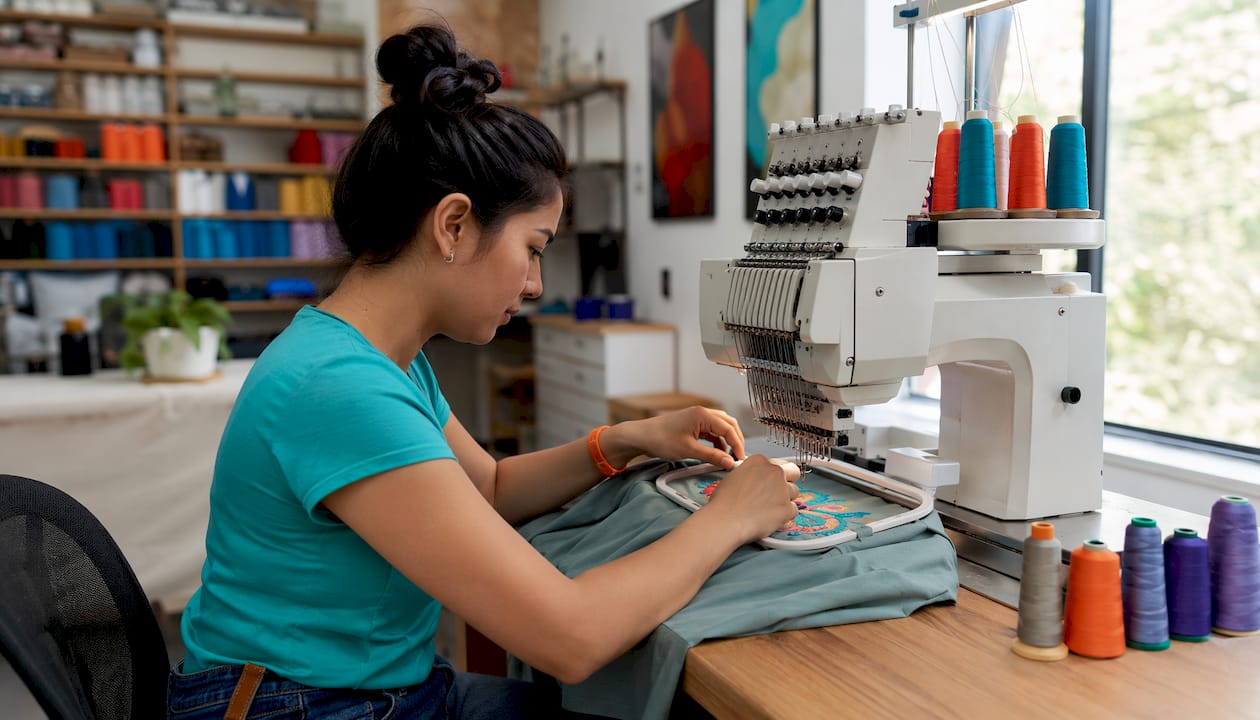
An embroidered patch is a fabric badge where the design is created by stitching colored thread directly onto a woven backing, typically twill or felt. The result is a raised, textured surface with real visual depth. That texture is what separates embroidery from printed or woven patches, and why it photographs so well on workwear and merchandise.
Pro Tip: Stick to 2–4 bold colors and thick lines when designing your patch. Fine details and small text tend to blur once stitched, especially at smaller patch sizes.
Production starts with digitizing your artwork, converting the design into a stitch file a computerized embroidery machine can read. The machine then stitches the design onto the backing material layer by layer. After stitching, the patch is cut to shape, the edges are finished (usually with a merrowed border or heat-cut edge), and a backing is applied.
| Backing Type | How It Attaches | Best For |
|---|---|---|
| Sew-on | Stitched permanently to garment | Uniforms, heavy-duty use |
| Iron-on | Heat-activated adhesive | Casual apparel, quick application |
| Velcro | Hook-and-loop, removable | Tactical gear, rebranding programs |
| Adhesive | Peel-and-stick | Temporary or display use |
Embroidered patches differ from woven patches, which use finer threads to capture small text and detail, and from printed patches, which use dye sublimation for photographic imagery. Embroidery sits between the two: better durability than printed, richer texture than woven, and the clear industry standard for professional uniform branding.
Key benefits of custom embroidered patches
1. Durability that outlasts printed alternatives
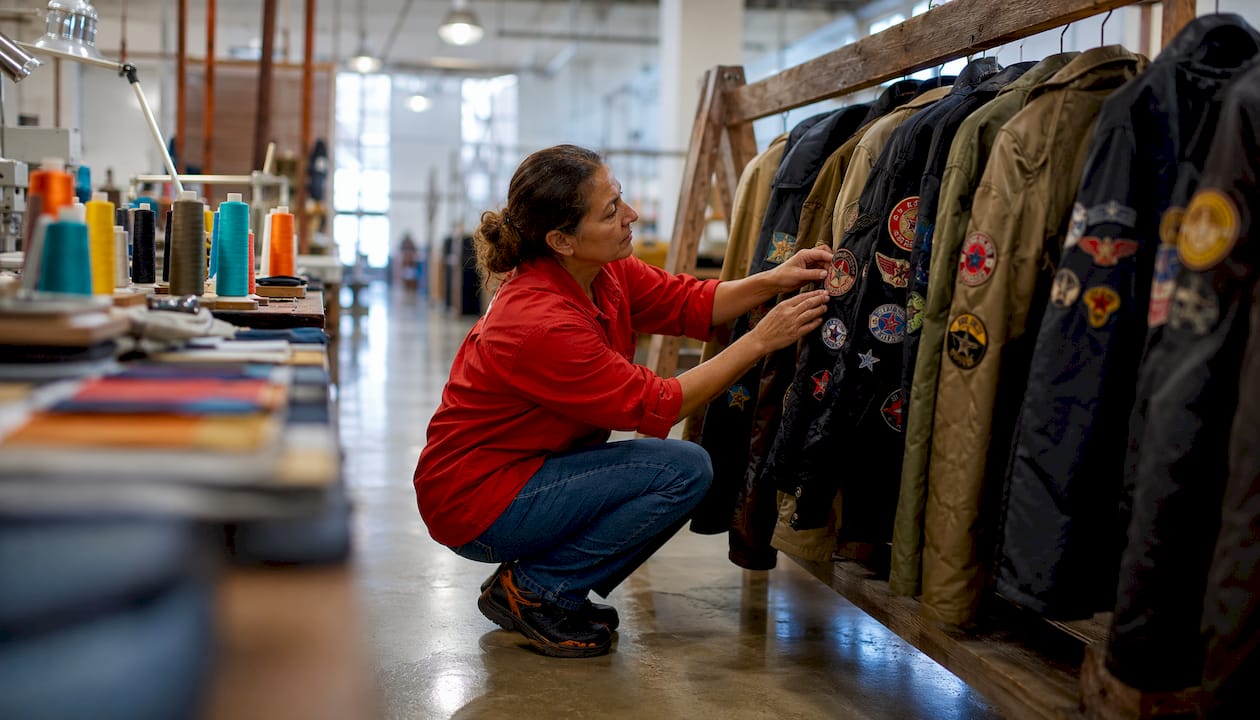
Embroidered patches withstand years of washing and harsh wear without flaking, cracking, or peeling. That’s exactly why tactical, industrial, and service uniforms rely on embroidery rather than screen printing. A printed logo on a work jacket might look sharp on day one and start cracking by month three. An embroidered patch on the same jacket can still look clean after five years of daily use.
2. Brand recognition that sticks
Wearable branding creates a different kind of recall than a banner ad. Research shows that brands associated with patches are remembered three times longer than those seen in standard digital advertisements. When a customer sees your logo on a staff member’s jacket every time they visit, that repetition builds genuine familiarity without any recurring ad spend.
3. Cost-per-impression that beats every other channel
The math here is hard to argue with. A patch on an employee’s jacket generates numerous impressions per year at a very low cost-per-impression. This compares favorably to local print ads and digital clicks, which are typically much more costly. Patches don’t target demographics the way digital ads do, but for local brand recognition and community presence, the economics are difficult to match.
4. Versatility across apparel and industries
Patches work on hats, jackets, polos, bags, aprons, and backpacks. They fit construction crews, restaurant teams, school groups, sports programs, and fashion brands equally well. That cross-industry flexibility comes from the range of backing options and the fact that patches are manufactured separately from the garment, so you can apply them to whatever you need, whenever you need it.
5. Professional appearance that builds credibility
Custom uniform patches improve customer perception of professionalism and reduce the friction that comes from customers not being able to identify staff. A stitched patch reads as more established than a heat-transferred logo. For service businesses where staff enter client spaces, that immediate visual identification matters.
6. Modular branding without printing inconsistencies
Direct embroidery varies slightly from machine to machine and operator to operator, especially across different fabric types. Patches solve that problem. Manufactured to exact specs in a single production run, they deliver consistent visual identity across every garment, regardless of where or when it’s decorated. For brands managing multiple locations or a growing team, that consistency is genuinely hard to replicate any other way.
7. Easy rebranding without replacing garments
Velcro-backed patches let you update your logo, swap seasonal designs, or refresh a campaign without touching the underlying uniform. Instead of scrapping an entire inventory when your brand evolves, you order new patches and swap them out. That flexibility is especially useful for growing businesses that need to move fast without absorbing the cost of full garment replacement.
8. Bulk ordering that drives down unit cost
Ordering patches in volume drops the per-unit price considerably, making them competitive with branded pens on a cost-per-item basis, but with a shelf life measured in years rather than weeks. Patches also store indefinitely, so you can order a batch and apply them as your team grows or your merchandise program expands.
9. Team identity and morale
A shared patch does something a printed shirt often doesn’t: it feels earned. Military units, sports teams, scout groups, and corporate programs all use patches to signal membership and belonging. One documented corporate patch program saw significant improvements in brand recognition and measurable gains in employee pride and retention. The patch became a mark of belonging that staff actively wanted to wear.
10. Organic marketing through wearable promotion
Patches act as conversation starters in a way that pens and flyers simply don’t. A well-designed patch on a jacket or backpack invites curiosity. When customers choose to put your brand’s patch on their own gear, they become advocates rather than just buyers. That organic visibility, generated without any recurring cost, is one of the strongest arguments for patches as a long-term brand identity tool.
11. Collectibility and limited-edition appeal
Limited-edition patches create scarcity and demand. A 50-piece or 100-piece run is a legitimate “only 100 made” claim, and that scarcity drives urgency. Fashion brands, event organizers, and nonprofits use this mechanic to generate social media content, reward loyal customers, and extend engagement well beyond the initial release. The patch itself becomes the incentive.
Where embroidered patches work best, and where they don’t
Embroidered patches perform best on structured, medium-to-heavyweight fabrics: denim jackets, canvas bags, twill hats, polo shirts, and work uniforms. They’re the right call for any application where durability and a premium look matter more than photographic detail.
There are real limitations worth knowing before you order:
- Fine detail and gradients don’t translate well. Embroidery works with thread, which has physical thickness. Small text under roughly 6 points in the finished size will blur. Complex gradients and photographic imagery are better handled by woven or printed patches.
- Lightweight or delicate fabrics can pucker. The weight of an embroidered patch can distort thin materials like silk or lightweight polyester. For those fabrics, a lighter woven patch is a better fit.
- Higher stitch counts increase cost. A large, densely stitched patch costs more than a simple logo. For very large artwork, printed patches may be more economical.
Care and maintenance extends patch life significantly. Machine wash in cold water on a gentle cycle, turn garments inside out before washing, and avoid high-heat dryers. For iron-on patches, avoid ironing directly over the patch face. Sew-on patches on heavy-use uniforms benefit from a reinforcing stitch around the border every year or two.
Patches avoid the inconsistencies of various printing methods on different fabrics, giving brands a reliable, uniform look across every garment type and location.
Industry research on the impact of embroidered patches
The business case for patches is backed by documented outcomes, not just intuition. A 500-person retail chain that invested in a corporate uniform patch program saw brand recognition climb 34%, with measurable increases in employee pride and customer comments about the team’s professional appearance.
On the cost side, the numbers are equally clear. At roughly $2.00 per patch in a 100-piece run, and 7,500 impressions generated per year per patch worn in a public-facing role, the cost-per-impression sits at approximately $0.00027. Compare that to a branded pen at $0.0075 per impression or a local print ad at $0.08, and the patch wins on every time horizon beyond a few weeks.
Professionalism signals matter at the customer level too. Staff wearing embroidered patches are immediately identifiable as official team members, which reduces customer friction and builds trust before a single word is spoken. For retail, hospitality, and service businesses, that instant recognition has real operational value.
Jam4apparel works with businesses across the Chicagoland area to produce custom embroidered patches for uniforms, merchandise, events, and team apparel. In-house production means faster turnaround and tighter quality control, whether you need 25 patches for a small crew or 2,000 for a regional rollout.
Ready to put your logo to work? Jam4apparel’s team handles everything from design digitizing to backing selection, so your patches arrive ready to apply. Get started with custom patches and see what a well-made patch does for your brand.
Key Takeaways
Custom embroidered patches deliver durable, wearable branding at a cost-per-impression of roughly $0.00027, making them one of the most cost-efficient marketing tools available for businesses of any size.
| Point | Details |
|---|---|
| Durability advantage | Embroidered patches resist flaking, cracking, and fading through years of washing and heavy wear. |
| Cost-per-impression | At roughly $0.00027 per impression, patches outperform pens, print ads, and digital clicks on any extended timeline. |
| Brand recall boost | Brands associated with patches are remembered three times longer than those seen in standard digital ads. |
| Modular branding | Patches deliver consistent visual identity across all garment types, avoiding the inconsistencies of direct embroidery. |
| Rebranding flexibility | Velcro-backed patches let businesses update logos without replacing entire uniform inventories. |
Recommended
Ready to print your design?
Screen print, embroidery, and DTF — no minimums on many styles.