Custom Beanies for Organizations: What You Need to Know
August 16, 2026
Custom Beanies for Organizations: What You Need to Know
For most organizations, a cuffed acrylic beanie with an embroidered logo is the right starting point. It’s warm, durable, cost-effective in bulk, and looks professional on everyone from outdoor field staff to school volunteers.
Here’s why the decision is easier than it looks:
- Brand visibility that lasts. A beanie worn through a cold season puts your logo in front of hundreds of people, far longer than a flyer or a tote bag. Custom hats consistently rank among the highest-retention branded items in promotional merchandise.
- Team cohesion at low cost. Matching headwear creates instant visual unity, whether your team is running a winter 5K, staffing an outdoor booth, or traveling to a tournament.
- Fundraising potential. Schools and nonprofits regularly sell custom beanies as spirit wear, often at margins that fund programs directly.
Key Takeaways
Custom beanies are one of the most cost-effective branded items an organization can order, and the right material, style, and decoration method depend entirely on how and where they’ll be used.
| Point | Details |
|---|---|
| Best starter choice | A cuffed acrylic beanie with direct embroidery works for most organizational use cases. |
| File prep matters | Submit vector files (AI, EPS, SVG) or high-resolution PNGs with Pantone or hex color codes. |
| Approve before bulk | Always request a digital mockup and, for large orders, a physical sample before production. |
| Cost scales with quantity | Per-piece price drops significantly with higher quantity orders; setup fees are usually one-time. |
| Jam4apparel | Offers in-house embroidery, DTF, and patch decoration with free mockups and transparent pricing. |
Table of Contents
- Why do organizations actually benefit from custom beanies?
- What materials and styles should your organization choose?
- Which decoration method works best on knit beanies?
- What artwork specs should you hand your vendor?
- What should you expect for pricing, minimums, and lead times?
- How long do custom beanies last, and how should you care for them?
- How do you choose the right supplier?
- Which beanie type fits your organization’s specific use case?
- What Jam4apparel brings to custom beanie orders
- Ready to order custom beanies for your organization?
- Sources
Why do organizations actually benefit from custom beanies?
Branded beanies deliver three outcomes that most other promotional items don’t combine: visibility, utility, and emotional connection. A staff member who wears your beanie on a cold Saturday morning is doing more for your brand than a banner ever could.
For outdoor teams, uniformity matters practically, not just aesthetically. Construction crews, park staff, and youth sports coaches all need warmth on the job. A branded beanie solves that while reinforcing organizational identity. For schools and nonprofits, the fundraising angle is real: a well-designed beanie at a $20–$25 retail price point can generate meaningful margin when ordered in bulk at $8–$12 per unit. Corporate gifting partners can also package branded beanies into curated gift boxes, which raises perceived value for donor recognition and event giveaways.
Winter event giveaways are another strong use case. A beanie handed out at a holiday market or charity walk gets worn immediately, which means your logo is moving through a crowd the same day.
What materials and styles should your organization choose?
Beanie materials and shapes each have a job to do. Picking the wrong one for your use case means recipients don’t wear them, which defeats the purpose.
Common materials:
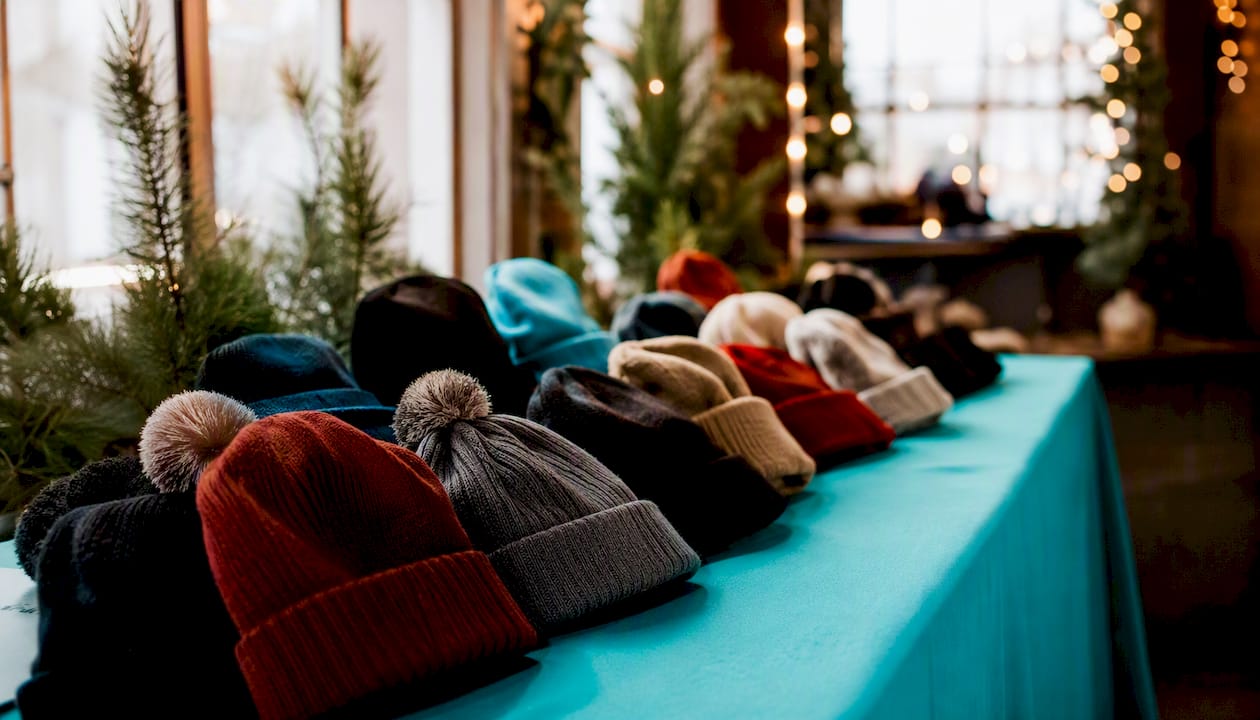
- Acrylic: The most common choice for bulk orders. Affordable, machine washable, holds color well, and works for most climates. Not the warmest option, but reliable for most organizational budgets.
- Wool blends: Warmer and more premium-feeling than acrylic. Better for retail merch or donor gifts where perceived quality matters. Slightly higher cost and requires more careful washing.
- Cotton blends: Lighter and breathable, suited to mild climates or indoor wear. Less common for winter-focused organizations.
- Recycled yarns: A growing option for sustainability-focused brands and nonprofits. Comparable performance to acrylic with a better environmental story.
Common styles:
- Cuffed: The most versatile. The folded cuff gives a clean, flat surface for embroidery or a patch, making it the go-to for professional logos.
- Slouch: Relaxed and fashion-forward. Works for retail drops and youth-oriented brands, but logo placement is trickier.
- Short/fisherman: Minimal coverage, strong aesthetic appeal for lifestyle brands. Less practical for cold-weather utility.
- Pom-pom: High visibility and fun. Popular for school spirit wear and youth teams, less appropriate for corporate or professional contexts.
| Material | Best for | Cost tier |
|---|---|---|
| Acrylic | Uniforms, bulk giveaways | Low |
| Wool blend | Retail merch, donor gifts | Medium–high |
| Cotton blend | Mild-climate indoor wear | Medium |
| Recycled yarn | Sustainability-focused orgs | Medium |
Pro Tip: If your brand uses a clean, geometric logo, a cuffed acrylic beanie with flat embroidery will look sharp and photograph well. If your brand leans lifestyle or outdoor, a wool blend with a woven patch reads more premium.
Which decoration method works best on knit beanies?
Embroidery and woven patches are the two most durable and brand-appropriate methods for knit beanies. Both hold up through repeated washing and maintain crisp edges that surface printing on knit fabric simply can’t match.
Here’s how each method performs in practice:
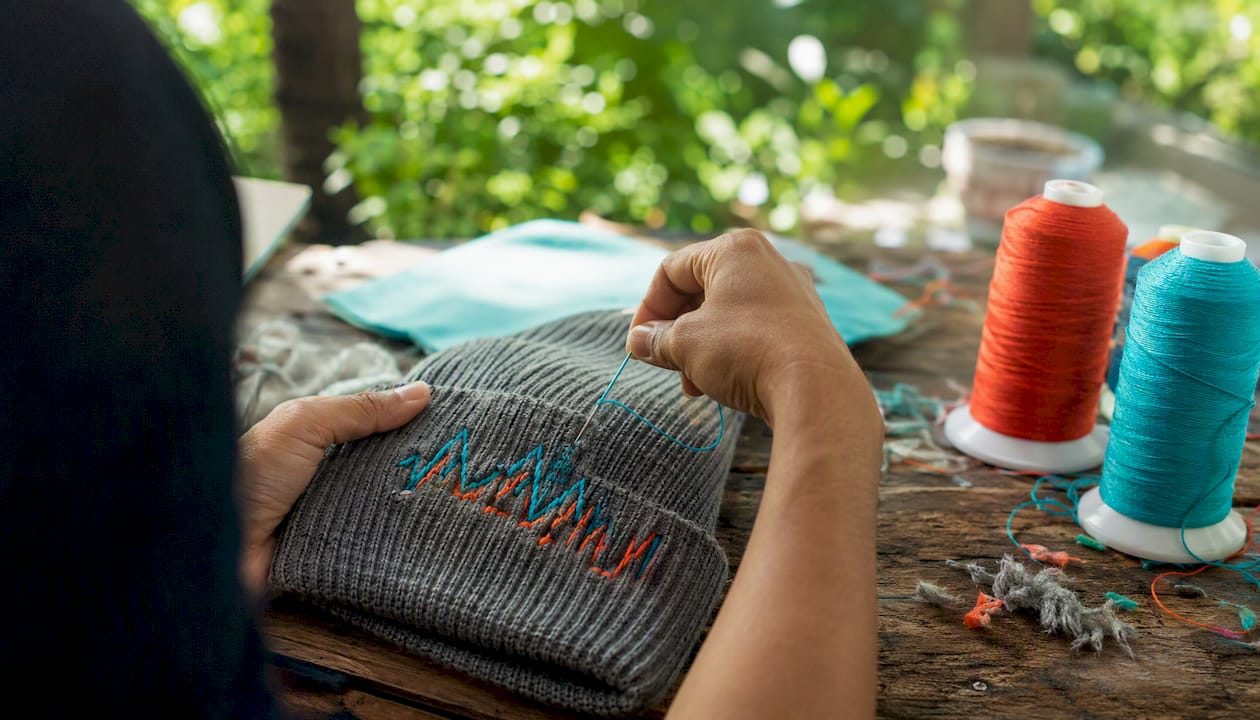
- Embroidery: Thread stitched directly into the knit. Looks professional, lasts for years, and handles most logo shapes well. Works best with bold, simplified designs. Fine lines and gradients don’t translate cleanly at small sizes. Jam4apparel’s embroidery services cover hats and beanies with direct stitch and patch options.
- Woven patches: A separate fabric patch with your logo woven in, then sewn or heat-applied to the beanie. Allows more color detail than direct embroidery and gives a clean, retail-quality finish.
- Leather or badge patches: Debossed or laser-engraved on a leather or faux-leather tab. Minimal color, but strong tactile appeal. Works well for outdoor brands and premium donor gifts.
- DTF (Direct-to-Film) heat-applied patches: Full-color printing on a film that’s heat-pressed onto a patch, then applied to the beanie. Best for complex, multi-color logos. Less durable than embroidery over many wash cycles, but a strong option for event giveaways where longevity is less critical.
Pro Tip: Avoid placing a logo on the body of a slouch beanie without a patch backing. The knit texture distorts direct embroidery and makes fine details unreadable. Always use a patch as a base layer on stretchy or textured knit.
What artwork specs should you hand your vendor?
Getting your files right before you submit saves two or three revision cycles. Decoration methods and file requirements vary, but the checklist below covers what most vendors need.
| Spec | Requirement |
|---|---|
| File format | Vector (AI, EPS, SVG) preferred; high-res PNG as fallback |
| Logo size | 2–3 inches wide for cuff embroidery; up to 4 inches for patch |
| Color format | Pantone (PMS) codes or brand hex values |
| Background | Transparent background on all files |
| Stitch count | Simplified logos typically run 5,000–10,000 stitches for a cuff placement |
Stitch density matters more than most buyers realize. A logo with thin serifs or hairline details will lose definition when converted to thread. Ask your vendor for a digital stitch preview before approving production.
What should you expect for pricing, minimums, and lead times?
Price depends on quantity, decoration method, design complexity, and material choice. Ordering more units typically lowers the per-piece cost, making bulk orders more economical.
| Cost driver | Impact on price |
|---|---|
| Quantity | Largest single driver; per-piece cost drops significantly with higher order quantities |
| Decoration method | Embroidery setup fees typically run $10–$25; patches add per-piece cost |
| Design complexity | Higher stitch counts and more colors increase cost |
| Material | Acrylic is lowest; wool blends add $3–$6 per unit |
Per-piece pricing for embroidered beanies from bulk suppliers generally starts at a modest rate for basic styles, with costs varying by style and quantity. Setup fees are usually a one-time charge per design. Always ask whether the setup fee is waived on reorders.
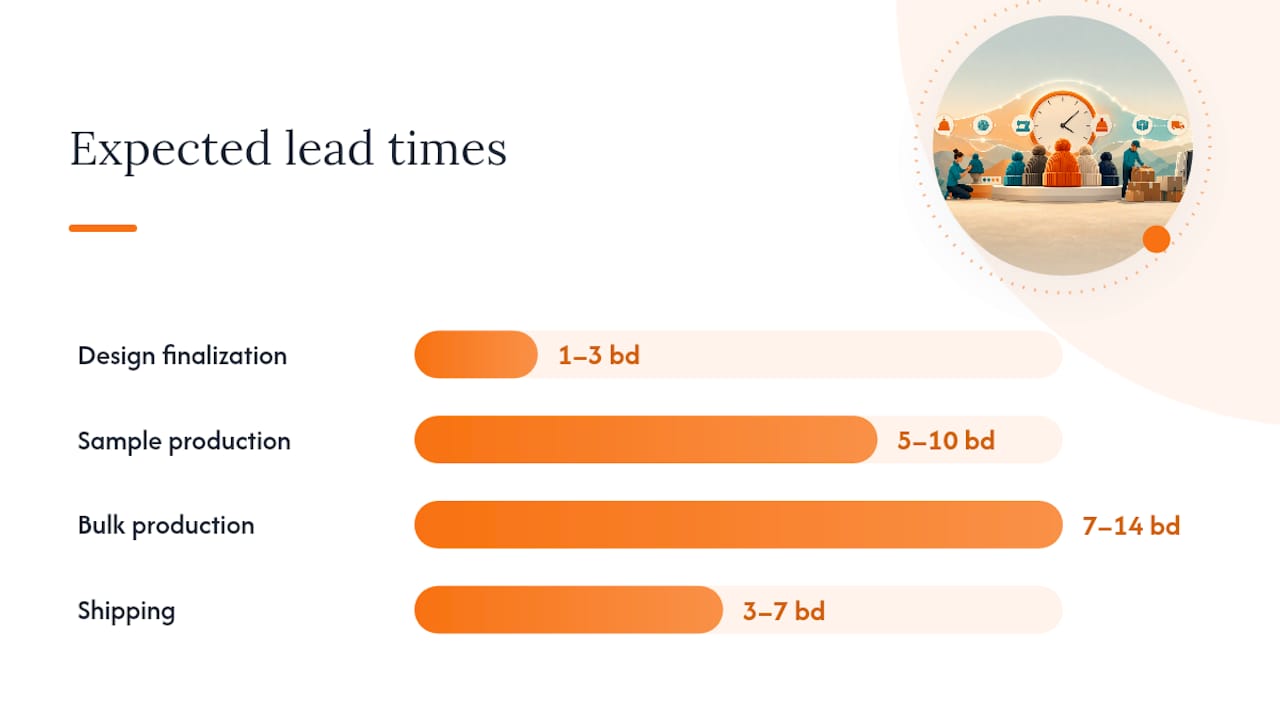
Typical timeline:
- Design finalization and proof approval: 1–3 business days
- Sample production (if requested): 5–10 business days
- Bulk production: 7–14 business days after sample approval
- Shipping: 3–7 business days depending on location
Ordering a physical sample before bulk production is worth the cost. A sample lets you check logo placement, color accuracy, and material feel before committing to 100 or 500 units. Reorder planning becomes much faster once a sample is on file.
How long do custom beanies last, and how should you care for them?
Most knit beanies hold up for multiple seasons with basic care. The decoration method affects durability more than the beanie itself.
Care guidelines:
- Hand wash or machine wash on a gentle cycle in cold water
- Use mild detergent; avoid bleach or fabric softener, which break down fibers
- Reshape while damp and air dry flat; never put a beanie in the dryer
- For patch-decorated beanies, turn inside out before washing to protect the patch edges
Pro Tip: If your organization distributes beanies seasonally, include a small care card with each one. Recipients who know how to wash them correctly will wear them longer, which extends your brand’s visibility.
How do you choose the right supplier?
The right vendor reduces your risk before a single beanie ships. Prioritize suppliers with in-house production, free digital mockups, and transparent pricing. Jam4apparel’s full-service production model covers embroidery, DTF, and custom patches under one roof, which shortens turnaround and keeps quality consistent.
Trust signals to look for:
- Free digital proof or mockup before production begins
- Clear minimum order quantities stated upfront
- Physical sample option with a defined approval process
- Visible examples of past work (schools, teams, nonprofits)
- Transparent setup fees and volume pricing tiers
Red flags:
- No physical samples offered
- Pricing that changes after you submit artwork
- Inability to provide stitch counts or color specs
- Slow or automated responses to pre-order questions
Questions to ask on first contact:
- What is your minimum order quantity for custom beanies?
- Do you offer a physical sample before bulk production?
- Is the setup fee waived on reorders?
- What file formats do you accept, and do you offer art prep?
- What is your current production lead time?
Which beanie type fits your organization’s specific use case?
What Jam4apparel brings to custom beanie orders
Jam4apparel handles beanie decoration in-house, which means embroidery, DTF patches, and custom patches are all produced without outsourcing. That matters for turnaround and consistency. When a vendor controls their own production floor, a rush order doesn’t get stuck waiting on a third-party decorator.
The workflow is straightforward: submit your logo files and quantities, receive a free digital mockup, approve or request revisions, then move to sample or bulk production. For organizations ordering for the first time, the mockup step alone eliminates most of the uncertainty. You see the logo on the beanie before anything is stitched.
Jam4apparel serves schools, sports teams, nonprofits, and corporate clients throughout the Chicagoland area. Industry-specific solutions are available for organizations that need uniform consistency across multiple garment types, not just beanies.
Ready to order custom beanies for your organization?
Jam4apparel offers in-house embroidery, DTF, and custom patch decoration with free digital mockups and transparent pricing for bulk beanie orders.
Getting started takes three steps:
- Gather your logo files (vector preferred, high-res PNG accepted) and decide on quantity and style.
- Request a quote or free mockup through Jam4apparel’s corporate apparel page.
- Approve your digital proof, then confirm whether you want a physical sample before bulk production begins.
Jam4apparel’s custom embroidery services cover hats and beanies directly, with options for flat embroidery, woven patches, and DTF patch application. Bring your logo file and your quantity target, and the team will handle the rest.
Sources
The links below connect you directly to ordering pages, service details, and gifting resources relevant to custom beanie projects.
- Employee Gift Boxes And Custom Branded Corporate Gift Boxes
Recommended
Ready to print your design?
Screen print, embroidery, and DTF — no minimums on many styles.