
Custom Basketball Jerseys for Teams: Design & Order Guide
August 4, 2026
Custom Basketball Jerseys for Teams: Design & Order Guide
Order sublimated custom basketball jerseys from Jam4apparel for game-day kits, and go reversible for practice-heavy rosters. That’s the short answer. Here’s what backs it up:
- Sublimation fuses dye directly into polyester fibers, so graphics stay sharp and breathable after 100+ washes without cracking or peeling.
- Reversible jerseys cost more upfront but eliminate the need for two separate sets during scrimmages and tournaments, saving real money across a full season.
- Jam4apparel handles production in-house at their Lake in the Hills, Illinois facility, which means tighter quality control and faster turnaround than vendors who outsource fulfillment.
- Every order includes a free design proof before production starts, so you approve the exact layout before anything gets printed.
- Team discounts and bulk pricing apply as quantities increase, making per-unit costs significantly lower for full rosters.
Ready to move? Gather your roster with sizes, your logo file (vector preferred), and your color choices, then request a quote or proof from Jam4apparel. The sections below walk through every decision between here and tip-off.
Table of Contents
- What style and decoration method should you choose for your team?
- How do you design personalized basketball uniforms?
- How does the ordering process work, and what does pricing look like?
- How do you size a full team accurately?
- How do you care for jerseys to make prints and fabric last?
- How does Jam4apparel produce and quality-check your order?
- Key Takeaways
- What coaches actually get wrong about custom jerseys
- Get your team jerseys designed and ordered with Jam4apparel
What style and decoration method should you choose for your team?
The three jersey styles serve different purposes, and picking the wrong one wastes budget.
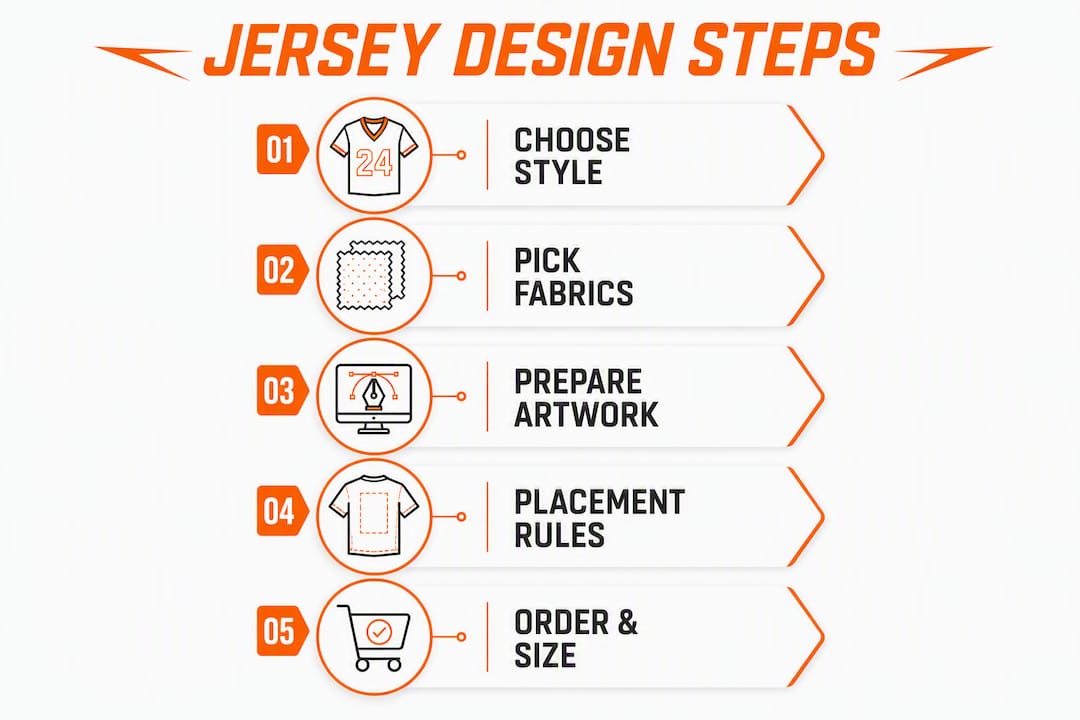
Game jerseys are single-sided, built for presentation, and typically feature full-color graphics with your team name, player names, and numbers. These are what you wear under the lights. Practice jerseys are simpler, often lighter, and meant to take daily punishment without the premium finish. Reversible jerseys do double duty: one side for home, one for away, with a single garment covering both. Reversible styles cost more upfront but add real logistical value for practice-heavy teams running scrimmages and back-to-back tournament days.
Pro Tip: If your team practices three or more times per week or runs regular scrimmages, reversible jerseys pay for themselves by mid-season. You cut laundry cycles in half and never scramble for a second set at a tournament.
Decoration methods compared
- Sublimation: Dye transfers directly into the polyester fibers via heat, maintaining breathability and colorfastness. Best for full-coverage, multicolor designs. No added weight, no peel risk. The practical default for basketball. See how fabric printing techniques compare across methods.
- Screen printing: — Cost-effective for simple, high-contrast designs with one to four colors. Ink sits on top of the fabric, so it adds slight texture and can crack over time with heavy washing. Works well for practice jerseys where budget is the priority.
Fabrics that work for basketball
Lightweight, moisture-wicking polyester blends are the standard for basketball for good reason: they manage sweat, allow full range of motion, and hold sublimation dye exceptionally well. For outdoor or summer leagues, breathable lightweight fabrics reduce overheating during extended play. When evaluating vendors, ask for fabric content specs: look for moisture-wicking finishes and recycled polyester options, which major athletic brands like Nike list as baseline performance features for practice mesh jerseys.
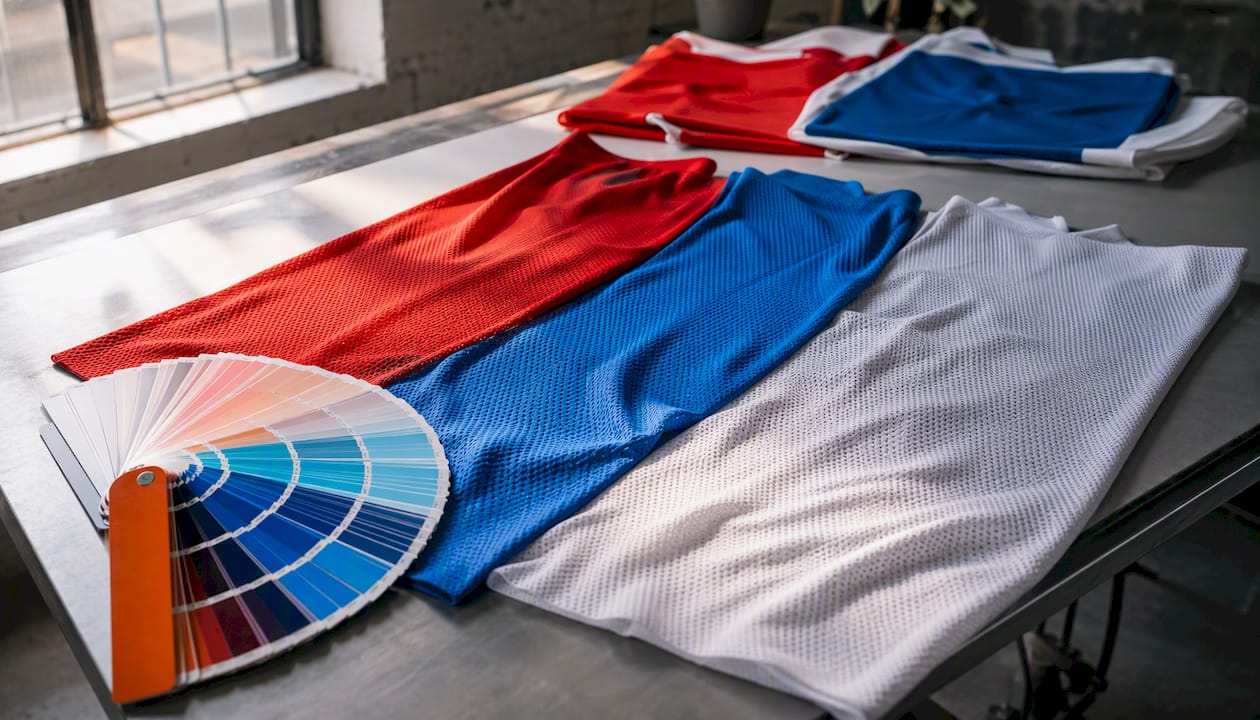
Sublimation requires 100% polyester. Screen printing and DTF work on polyester-cotton blends, though colorfastness is stronger on higher polyester content. Tackle twill can go on most fabrics but adds weight, which matters in a sport where players move constantly.
How do you design personalized basketball uniforms?
Design is where most teams lose time. A clear checklist upfront prevents three rounds of revisions.
Design checklist before you submit:
- Team name and any secondary wordmark
- Player names and corresponding numbers for every roster spot
- Primary and secondary colors (provide Pantone or CMYK values if you have them)
- Sponsor logos, if applicable
- Font preferences for names and numbers (bold block fonts read best from the bleachers)
- Placement preferences: chest logo, front number, back number, shorts branding
Artwork specs
| Spec | Requirement |
|---|---|
| File type | Vector (.AI, .EPS, .PDF) preferred; high-res .PNG accepted |
| Resolution (raster) | Minimum high resolution at print size |
| Color mode | CMYK for print; provide Pantone codes when available |
| Background | Transparent background on logos |
| Bleed | Confirm with vendor for cut edge measurements |
Low-resolution logos are the single most common delay in jersey proofing. If your school or club only has a JPEG pulled from a website, ask your graphic designer or the vendor’s art team to redraw it as a vector before you submit.
Placement rules that actually matter
Front chest logos typically sit centered or left-chest, 2–4 inches from the neckline. Front numbers go centered below the chest logo; back numbers are larger (typically 6–8 inches tall) and centered between the shoulders and waist. Shorts branding usually appears on the left or right leg, 2–3 inches from the hem.
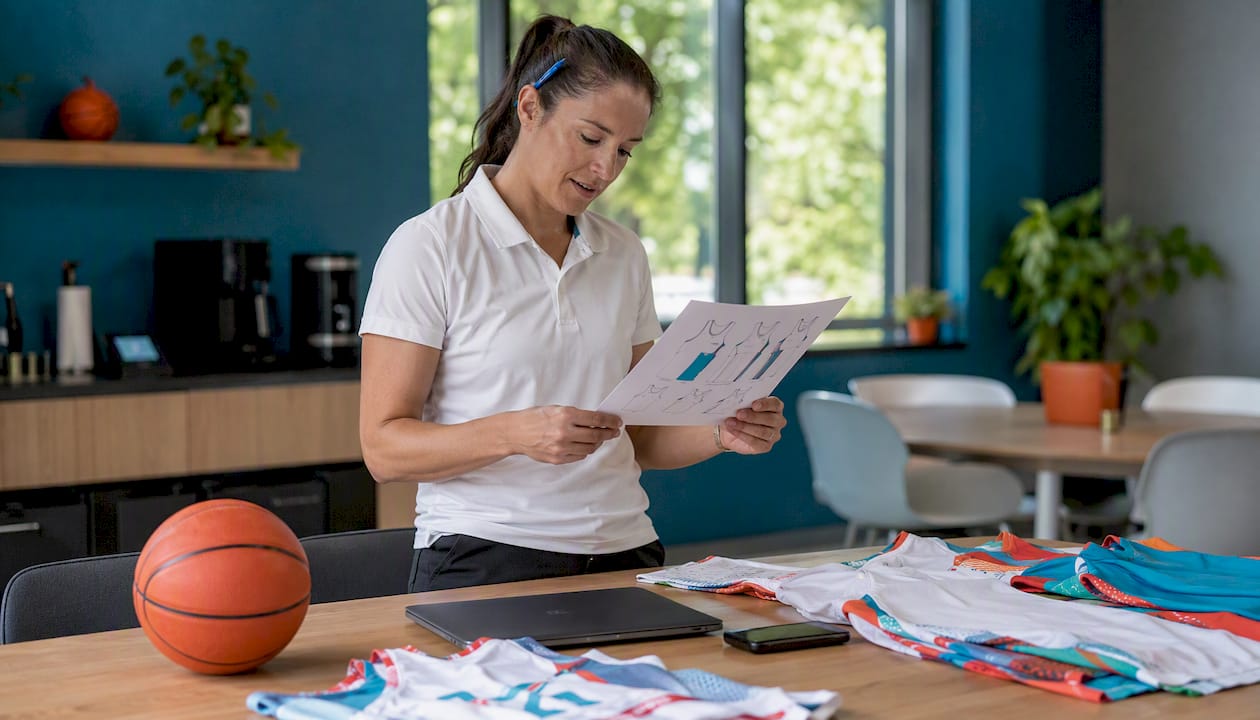
For multi-player personalization, deliver a single spreadsheet with columns for player name, number, and size. That one step cuts proofing errors dramatically and speeds up the approval process. Number fonts deserve real attention: thin script fonts look great on a mockup and become unreadable at game speed from 20 feet away. Stick to bold block or athletic serif styles with strong contrast against the jersey background.
How does the ordering process work, and what does pricing look like?
Step-by-step order flow
- Request a quote with your quantity, decoration method, and any design notes.
- Submit your roster and artwork — player names, numbers, sizes, and logo files.
- Receive your free design proof and review every placement, color, and name spelling.
- Approve the proof (or request revisions — this step repeats until it’s right).
- Production begins after written approval.
- Shipping or local pickup once production is complete.
Pricing variables
Per-unit cost drops as quantity increases. A single jersey costs significantly more per piece than a 12-player set, and a 20-player order costs less per unit than a 12-player one. The main pricing variables are decoration method (sublimation typically costs more than basic screen print), number of print locations, and whether the jersey is reversible. Some vendors include all personalization — names, numbers, logos — in a single base price. Always confirm this before you approve a quote to avoid per-element surcharges that inflate the final invoice.
For single-item orders or fundraising stores, print-on-demand services offer no-minimum ordering with global delivery. For a full season roster, bulk ordering with a local vendor like Jam4apparel typically delivers better per-unit pricing and faster local support.
Turnaround timeline
| Stage | Typical window |
|---|---|
| Proof delivery | 1–3 business days after artwork submission |
| Proof revision cycle | 1–2 business days per round |
| Production | 7–14 business days after approval |
| Standard shipping | 3 business days |
| Rush production | Ask vendor — availability varies |
Red flags to watch for: no free proof offered, all-in pricing not confirmed in writing, turnaround times stated as ranges without a production-start date, and no saved design file for reorders. A vendor who saves your design file can lock in consistent pricing on reorders and turn them around faster.
- Confirm whether rush fees apply and what the cutoff date is for your event.
- Ask if the vendor handles artwork cleanup or if you need print-ready files.
- Get the all-in price per unit in writing before approving the proof.
How do you size a full team accurately?
Sizing errors are the most expensive mistake in team apparel. A jersey that doesn’t fit gets worn once.
How to measure correctly:
- Chest: measure around the fullest part of the chest, keeping the tape parallel to the floor.
- Waist: measure around the natural waist, about one inch above the navel.
- Length: measure from the top of the shoulder to the desired hem point.
For youth players, measure each athlete individually rather than guessing by age. Kids the same age can vary by two or three sizes, and youth sizing charts don’t map cleanly to adult small/medium/large.
Sample sizing reference
| Youth Size | Chest (in.) | Recommended Age |
|---|---|---|
| YS | 26 | 6–8 |
| YM | 28 | 8 |
| YL | 30 | 10 |
| YXL | 32 | 12 |
| Adult S | 34 | 14 |
| Adult M | 38 | 16 |
| Adult L | 42 | Adult |
| Adult XL | 46 | Adult |
Order one or two spare jerseys in the most common sizes (typically YM, YL, and Adult M) to cover mid-season sign-ups without a full reorder. For players who fall between sizes, go up — a slightly loose jersey plays better than one that restricts movement.
Common pitfalls: ordering based on a player’s street-clothes size (athletic cuts run differently), ignoring that moisture-wicking polyester has minimal stretch, and assuming all brands use identical measurements. Always cross-reference the vendor’s specific size chart, not a generic one.
How do you care for jerseys to make prints and fabric last?
Sublimated jerseys are the most forgiving to wash. Because the dye is part of the fiber, not sitting on top of it, you won’t see cracking or fading from normal machine washing. Cold or warm water (under 104°F) with a mild detergent works fine. Avoid fabric softener — it coats the moisture-wicking fibers and reduces performance over time.
Everyday care rules:
- Wash inside-out to protect graphics and numbers.
- Use cold or warm water; skip hot cycles entirely.
- Skip fabric softener and bleach on all decorated apparel.
- Hang dry when possible; if you tumble dry, use low heat.
Tackle twill and vinyl require more care. High heat in the dryer can loosen adhesive on vinyl numbers and cause twill edges to curl. Always hang dry tackle twill jerseys or use the lowest dryer setting available.
For stains, treat immediately with cold water and a small amount of dish soap before washing. Hot water sets protein-based stains (blood, sweat residue) permanently. Don’t scrub the print area — blot instead.
Pro Tip: For tournament weekends with back-to-back games, rotate two sets of jerseys rather than washing and drying the same set overnight. Repeated high-heat drying shortens the life of any decoration method, including sublimation.
How does Jam4apparel produce and quality-check your order?
Jam4apparel runs production in-house at their Chicagoland facility, covering screen printing, embroidery, DTF transfers, and custom patches under one roof. That matters operationally: when printing, assembly, and quality checks happen in the same building, problems get caught before they ship rather than after.
What in-house production means for your order:
- Direct quality control at each production stage, not relayed through a third-party fulfillment house.
- Faster handling of rush requests because no external vendor scheduling is involved.
- Consistent results across a full team set, since the same equipment and operators handle every piece.
- Reorders are faster when your design file is saved on file, with pricing that stays consistent.
The free design proof is a full visual mockup of your jersey before a single piece goes into production. You see exact placement, colors, names, and numbers. If anything is off, you request a revision. Production only starts after you give written approval. That step alone prevents the most common and costly errors in team apparel.
Jam4apparel serves sports teams, schools, and organizations throughout the Chicagoland area with dedicated account support, team discounts on bulk orders, and a portfolio of team apparel that coaches can review before committing to an order.
For teams that want to see the full range of decoration options, the product catalog covers available jersey styles and customization methods. Coaches ordering complementary gear like hoodies or warmups can also reference Jam4apparel’s team apparel guide for coaches for consistent kit planning.
Key Takeaways
Sublimated custom basketball jerseys from Jam4apparel give teams the best combination of durability, breathability, and full-color design, with a free proof step and in-house production that keeps turnaround tight.
| Point | Details |
|---|---|
| Sublimation is the default method | Dye fuses into polyester fibers, staying vibrant and breathable after 100+ washes without cracking. |
| Reversible jerseys save money over a season | Higher upfront cost pays off for practice-heavy teams by eliminating the need for two separate sets. |
| Submit vector artwork and a roster spreadsheet | Clean files and a single organized roster cut proofing errors and speed up approval. |
| Confirm all-in pricing before approving | Some vendors charge per element; get names, numbers, and logos confirmed in one base price in writing. |
| Jam4apparel offers free proofs and bulk discounts | In-house production in Chicagoland means direct QC, faster rush handling, and consistent reorder pricing. |
What coaches actually get wrong about custom jerseys
Most teams treat the jersey order as a last-minute logistics task. That’s the real problem. The design proof step exists precisely because coaches submit a logo they grabbed from the school website at 72 DPI, pick a number font that looks sharp on a laptop screen, and then wonder why the finished jersey looks muddy from half-court.
The decoration method conversation gets skipped even more often. Sublimation is the right call for most basketball teams, but it’s not because it’s the newest technology. It’s because basketball is a contact sport played in a hot gym, and a jersey that adds weight, traps heat, or peels after twenty washes is a liability. Tackle twill looks great in a trophy case. On a player diving for a loose ball, it’s a different story.
The other thing coaches underestimate: reversible jerseys aren’t just a convenience item. For youth leagues and rec programs running two practices a week plus weekend tournaments, a reversible set means you never show up to a scrimmage with the wrong color. That’s a real operational win, not a luxury upgrade.
Where heavy appliqué does make sense is for a championship kit or a senior night presentation jersey — something meant to be kept, not washed forty times. Jam4apparel can walk you through that trade-off based on your actual use case, which is exactly the kind of conversation worth having before you approve a proof.
Get your team jerseys designed and ordered with Jam4apparel
Jam4apparel gives sports teams a direct path from roster spreadsheet to finished jerseys, without the back-and-forth that slows down most custom orders. In-house production in Lake in the Hills, Illinois means your order doesn’t get handed off to a fulfillment warehouse. You get a real account contact, a free design proof before anything prints, and bulk pricing that scales with your roster size.
Before you reach out, pull together four things: your full roster with player names, numbers, and sizes; your logo file in vector format (.AI or .EPS) if you have it; your primary and secondary colors; and your event deadline. That’s everything needed to generate an accurate quote and move straight into proofing.
Request a quote or start your order through Jam4apparel’s team apparel page, or visit jam4apparel.com to review the full range of decoration options and contact the team directly. Once you submit your artwork and roster, expect a design proof within one to three business days.
Recommended
Ready to print your design?
Screen print, embroidery, and DTF — no minimums on many styles.