
What Apparel Bundle Pricing Really Includes
August 28, 2026
What Apparel Bundle Pricing Really Includes
Apparel bundle pricing is the total cost of a decorated garment order: the blank garment itself, the decoration setup, the per-piece decoration charge, and any extras like shipping or rush fees. The fastest path to an accurate number is sending your supplier the garment SKUs, exact quantities by size and color, print-ready artwork, your decoration preference, and a deadline. Jam4apparel builds package deals around exactly this information, using in-house production to keep those numbers tight and turnaround fast.
TL;DR:
- Using smaller order quantities, especially under 24 pieces, keeps setup fees high relative to per-unit costs, limiting savings.
- Screen printing offers the best value at larger volumes by dividing setup fees across more garments, while embroidery costs stay steady regardless of volume.
- Supplying detailed, print-ready artwork with specific size, color, and placement instructions helps avoid unpredictable charges and ensures accurate quotes.
- Combining different orders into one larger purchase boosts quantity tiers and reduces overall cost, especially for recurring or seasonal needs.
- Jam4apparel’s in-house production and file storage enable reorder cost savings by eliminating setup fees after the initial order.
Table of Contents
- What Drives Apparel Bundle Pricing on Every Quote
- How Much Does a Custom Apparel Bundle Cost by Quantity?
- What Should You Send a Supplier for an Accurate Quote?
- How Can You Lower the Cost of an Apparel Bundle?
- How Jam4apparel Builds Bundle Pricing for Real Orders
- Ready to Get a Bundle Quote? Here’s What to Send
- Where to Verify Pricing Examples and Method Comparisons
- Sources
What Drives Apparel Bundle Pricing on Every Quote
Every quote you get back is built from the same handful of variables, whether it’s coming from a school spirit wear order or a 500-piece corporate rollout. Once you know what’s driving each line item, a confusing quote turns into a checklist.
The garment itself sets your floor. A basic cotton tee costs less than a performance polyester polo, and sizes above 2XL almost always carry an extended-size upcharge that suppliers tack on separately. Decoration method changes everything above that floor:
- Screen printing charges a setup fee per color, commonly $20 to $40 per screen, so a three-color logo costs more to set up than a one-color name.
- Embroidery requires digitizing your artwork into a stitch file first, typically a one-time fee of $25 to $75, then charges per piece based on stitch count.
- DTF and DTG transfers skip most setup costs entirely, which is why they often work for smaller or mixed-design orders.
- Sublimation prints the design into the fabric itself, common on jerseys, and pricing shifts with fabric performance level rather than color count.
Setup fees usually apply once per design, not once per order. Reorder the same logo six months later and a good supplier should charge only the per-piece decoration cost, not a fresh setup fee, assuming they kept your files on record. Quantity tiers and minimum order thresholds (often 24 to 48 pieces per design) determine which price bracket you land in, and everything else, rush production, shipping, packaging, player numbering, and artwork cleanup, gets added as separate line items on top.
How Much Does a Custom Apparel Bundle Cost by Quantity?
Per-piece price drops fastest at four points: a small run of a dozen or two pieces, a medium run around fifty, a large run in the low hundreds, and a bulk run of several hundred or more. Understanding where your order lands on that curve matters more than any single price you see quoted.
- Small runs (12–24 pieces). Setup fees get spread across so few units that they dominate your per-piece cost. A one-color screen print job here often costs nearly as much per shirt as a three-color job at 100 pieces.
- Medium runs (25–99 pieces). This is where screen printing starts pulling ahead of embroidery on cost for large graphic designs, while embroidery holds steady for polos and jackets where a logo is small and durability matters more than coverage.
- Large runs (100–499 pieces). Setup cost per piece becomes almost negligible. This is the sweet spot for team uniforms, staff shirts, and spirit wear where the design stays fixed all season.
- Bulk runs (500+ pieces). Per-piece pricing hits its floor, though premium brands and extended sizes still add a consistent markup regardless of volume.
Screen printing tends to win on cost at higher quantities because per-color setup fees get divided across far more pieces, while embroidery’s stitch-based pricing stays comparatively flat whether you order 30 pieces or 300. Jerseys complicate the math further: sublimation and performance-fabric jerseys carry higher base costs than basic polyester ones, and most suppliers set separate minimum order quantities in the 10 to 50 range with shorts, socks, and numbering priced independently.
Wholesale apparel data shows per-piece savings of 40 to 55 percent between single-piece retail and max-volume tiers for mid-market brands, which is why combining smaller orders into one purchase is one of the most reliable ways to shrink your total bill without changing anything about the design.
What Should You Send a Supplier for an Accurate Quote?
An accurate bundle quote depends entirely on what you hand over first. Vague requests get vague, unreliable numbers back. Send this instead:
- Garment SKU or brand and style number, plus color
- Exact quantities broken down by size and color, not just a total
- Print-ready artwork, vector format preferred, with the exact color count
- Print or embroidery location on the garment (chest, sleeve, full back)
- Your deadline and delivery address
Then ask the supplier questions that expose costs a bare per-piece number hides:
- Are setup or digitizing fees itemized separately, and do they carry forward to reorders?
- What’s the per-piece price at the next quantity tier up?
- What does shipping typically run, and is rush production available, and at what surcharge?
- Is there a sample policy, and what happens if a piece arrives with a defect?
Pro Tip: Ask specifically whether your supplier stores digitized embroidery files or screen setups after the first order. A supplier that keeps them on file can often skip that charge entirely on a reorder, which changes your real cost per season, not just per order.
Suppliers who quote only a flat per-piece number without asking about fabric, color breakdown, or turnaround are usually leaving out setup, shipping, or quality details that surface later. An itemized quote lets you set two supplier bids side-by-side and compare garment cost against garment cost, setup against setup, instead of comparing two mystery totals.
How Can You Lower the Cost of an Apparel Bundle?
Cutting your bundle price without cutting quality comes down to a handful of decisions made before you ever request a quote.
- Combine separate small orders (staff shirts this month, volunteer shirts next month) into one purchase to jump a pricing tier.
- Simplify the artwork. Fewer colors and a single print location reduce setup costs directly, especially on screen printing.
- Match the decoration method to the garment: embroidery for polos and jackets, screen printing or DTF for large graphic tees.
- Order a modest buffer of 5 to 10 percent extra stock rather than risking a costly small-batch reorder later, and confirm extended-size upcharges before you finalize sizes.
- Ask about package deals or recurring-order programs, and plan your lead time so you’re never paying a rush surcharge for an order you could have placed two weeks earlier.
Businesses managing apparel as a recurring need, rather than a one-off purchase, tend to save the most over a year by documenting garment specs and keeping digital files on hand for the next reorder.
How Jam4apparel Builds Bundle Pricing for Real Orders
Jam4apparel prices bundles the same way this guide breaks them down: garment cost, decoration setup, per-piece charge, extras, all itemized, never bundled into one mystery number. In-house production across screen printing, embroidery, and DTF means setup files and digitized logos stay on record, so schools, sports teams, martial arts academies, and nonprofits across the Chicagoland area don’t pay a second setup fee on a reorder they place the following season.
Combining orders across departments or teams into a single package deal is the single most requested cost-saving move Jam4apparel customers make, and it works because quantity tiers reward exactly that kind of consolidation.
— Adam
Ready to Get a Bundle Quote? Here’s What to Send
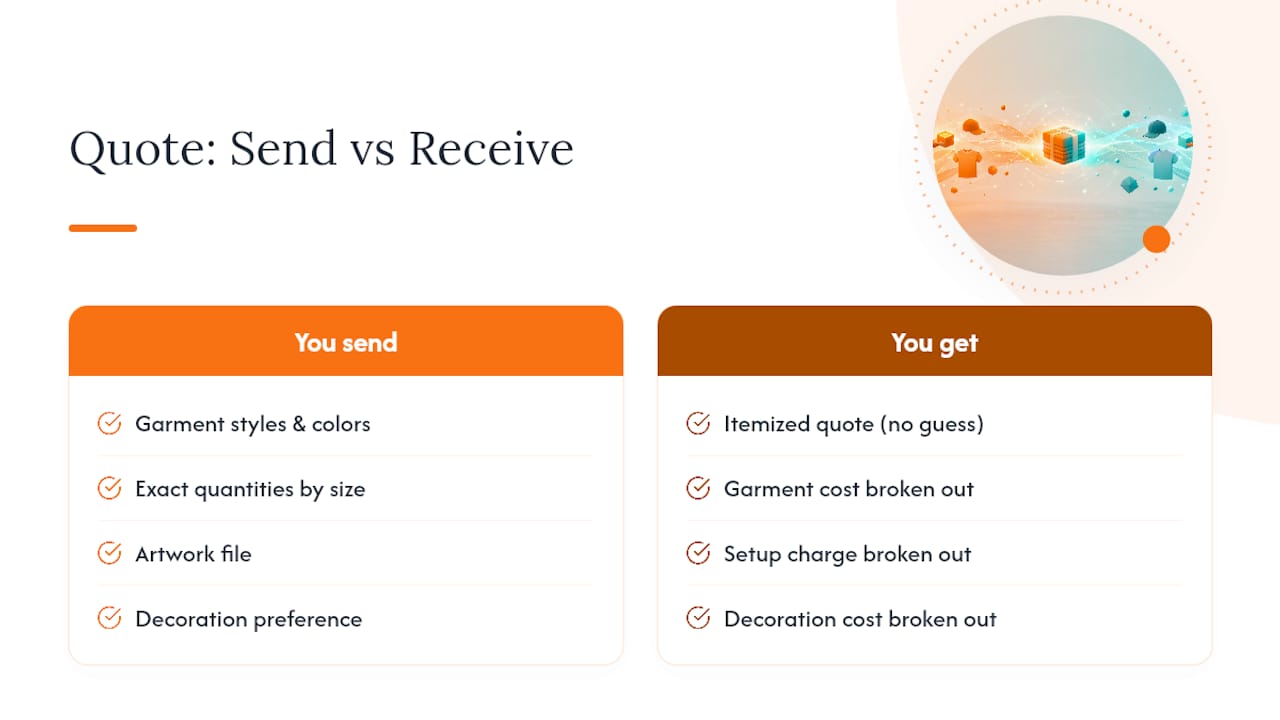
Getting a real number from Jam4apparel starts with the same checklist covered above: garment styles and colors, exact quantities by size, your artwork file, decoration preference, and your deadline. Send that over and you’ll get back an itemized quote, not a single guessed-at price, with garment cost, setup, and decoration broken out separately so you can see exactly what you’re paying for.
Every quote includes a free design proof before production starts, so you approve the exact placement and colors before anything gets printed or stitched. Digitized embroidery files and screen setups get stored on file, which means your next season’s reorder skips the setup charge entirely. Turnaround times are quoted upfront alongside pricing, so rush costs never show up as a surprise later.
Whether you’re outfitting a coaching staff, a school spirit wear program, or a company-wide uniform rollout, browse apparel packages by industry or head straight to Jam4apparel’s quote page to send your specs and get an itemized number back.
Where to Verify Pricing Examples and Method Comparisons
Cross-check any quoted SKU against live wholesale pricing before you commit to a decision.
- The wholesale apparel pricing guide shows how blank garment costs shift across quantity tiers.
- The custom team jersey buyer’s guide covers sport-specific fabric and MOQ differences.
Sources
- Wholesale Apparel Pricing Guide USA | Bulk Clothing Deals & Savings Tips
- Custom Uniforms for Small Businesses: A Complete Ordering Guide | French Press Custom
- Custom Team Jerseys: A Buyer’s Guide for Club Managers
Recommended
Ready to print your design?
Screen print, embroidery, and DTF — no minimums on many styles.